Hikaru Kuribayashi, 18, won the $100,000 George D. Yancopoulos Innovator Award at ISEF 2026 for a Julia-based simulation that predicts complex origami-style folding. He developed the program in 2025 using Markov Chain Monte Carlo techniques over roughly six months, drawing on materials from a University of Tokyo lab. Kuribayashi says the research could enable compact solar panels and quickly deployable emergency shelters, and his project beat more than 1,700 international finalists.
How an 18-Year-Old Turned Origami Into a $100,000 Science Prize
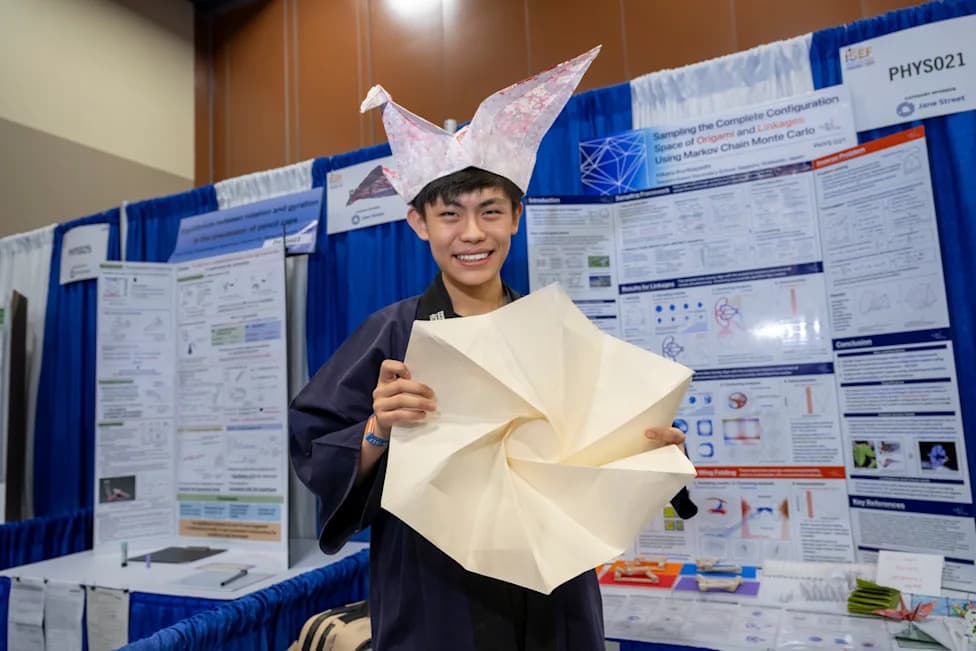
Hikaru Kuribayashi won top prize at the 2026 Regeneron International Science and Engineering Fair in May.Chris Ayers/Chris Ayers Photography/License by Society for Science
Hikaru Kuribayashi, 18, won the $100,000 George D. Yancopoulos Innovator Award at the 2026 Regeneron International Science and Engineering Fair for a simulation that predicts complex folding patterns inspired by origami.
Growing up on Hokkaido, Japan’s northernmost island, Kuribayashi said he frequently noticed folding patterns in leaves, flower petals and insect wings. That early fascination—combined with lessons from his grandmother—eventually became the basis for a computational research project that blends art, nature and engineering.
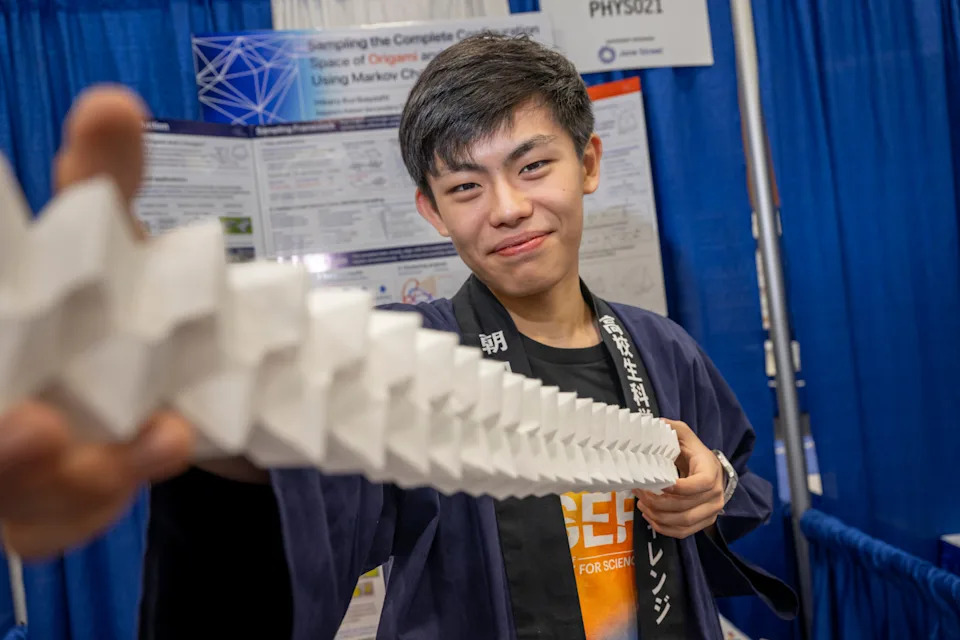
Hikaru Kuribayashi traveled from Japan to Arizona to compete in this year's competition.Chris Ayers/Chris Ayers Photography/License by Society for Science
From Inspiration to Algorithm
In 2025 Kuribayashi spent about six months developing a simulation program in the Julia programming language to predict how intricate folds behave. The program uses Markov Chain Monte Carlo (MCMC) techniques to generate many sample scenarios and estimate likely folding outcomes. Kuribayashi told Business Insider that he relied on advanced materials supplied by a lab at the University of Tokyo while building the project.
"Imagine a tiny ladybug. That ladybug actually uses origami patterns to fold and expand its wings," Kuribayashi said, describing how natural forms inspired his work.
Challenges and Hands-On Work
Kuribayashi said testing the software exposed numerous bugs and demanded extensive troubleshooting. Although he learned to code in middle school, he described his programming skills as still developing and chose to write and verify the code himself rather than rely fully on AI-assisted tools, which he noted can sometimes produce errors that require human checking.
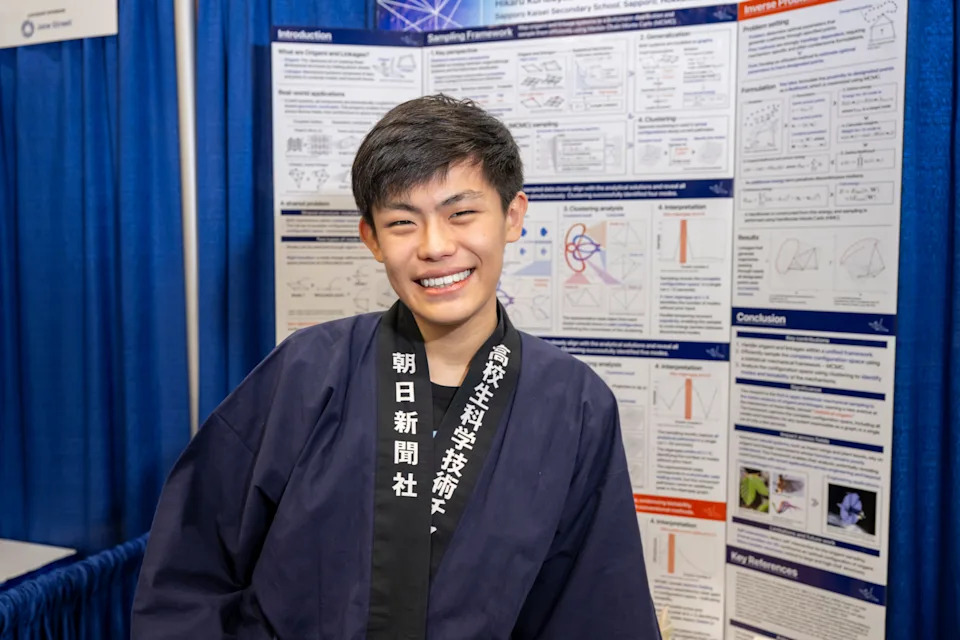
Hikaru Kuribayashi developed a simulation program that predicts complex folding outcomes.Chris Ayers/Chris Ayers Photography/License by Society for Science
Real-World Applications
Kuribayashi believes insights from efficient natural folding could inform engineering solutions, such as compact, deployable solar panels for satellites and rapidly deployable, stiff emergency shelters—technologies particularly relevant to earthquake- and tsunami-prone regions like Japan.
A Global Stage
His project beat more than 1,700 high-school finalists from around the world at ISEF 2026, where finalists shared over $7 million in awards. Kuribayashi said winning the top prize felt surreal and credited family, teachers and mentors for their support. After returning from Arizona, he celebrated with his family and grandparents.
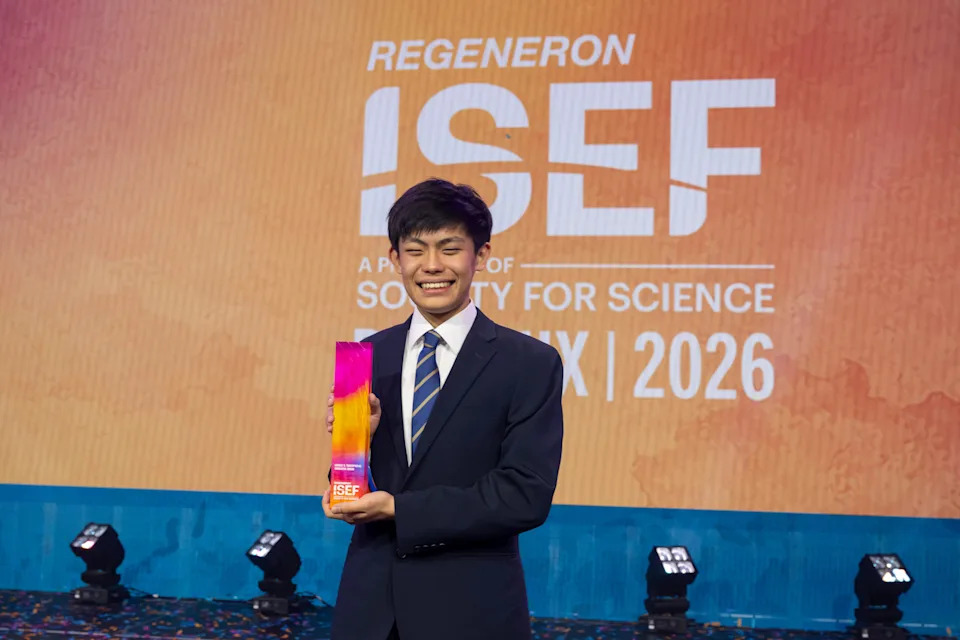
The George D. Yancopoulos Innovator Award includes a $100,000 scholarship.Chris Ayers/Chris Ayers Photography/License by Society for Science
Kuribayashi also valued the chance to meet other young researchers at the fair and learn from diverse perspectives: "Local finalists have a huge passion for their research, and that was really, really fascinating," he said.
Why It Matters
By combining observations of natural folding with computational modeling, Kuribayashi’s work points to new patterns and design strategies that could make structures more compact, efficient and deployable—bridging curiosity-driven observation and practical engineering.
Help us improve.