Researchers suggest that Thoth's dual animal representations — the sacred ibis and the hamadryas baboon — may be explained by both species’ moonlike appearance. Linguistic evidence links Thoth’s name to a term meaning "bright/white thing," and mummified sacred ibises with bright feathers have been found in Egyptian burials. Spectroscopic measurements show the birds' and baboons' reflectance closely matches moonlight, supporting the idea that their luminous coloring helped associate them with the moon god.
Why Thoth Appears as an Ibis and a Baboon — Moonlight May Explain It
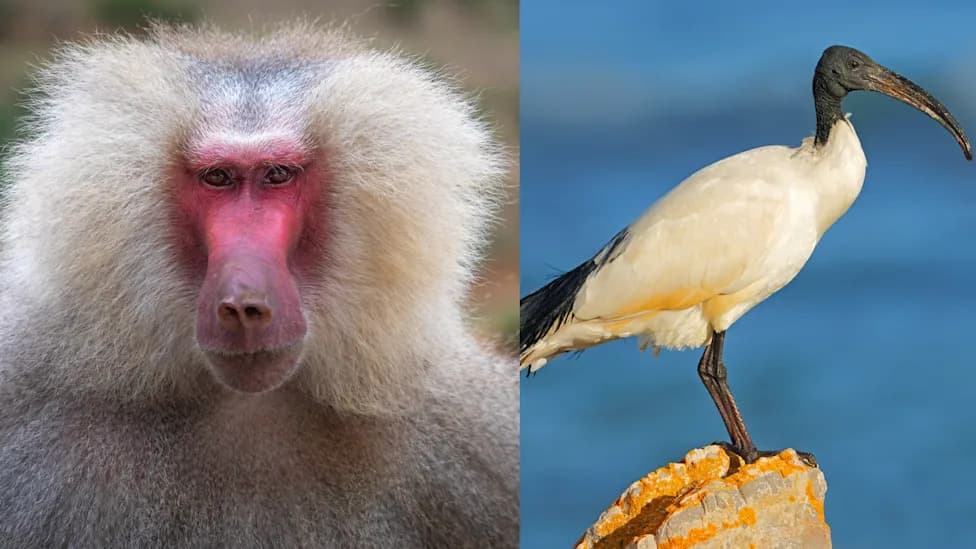
A Hamadryas baboon in Eritrea (left). An African sacred Ibis perched on a rock in South Africa (right).
Why did ancient Egyptian deities sometimes take the forms of particular animals? New research suggests that for Thoth — the god of the moon, wisdom, writing and magic — the answer may lie in moonlight itself.
Linguists have traced Thoth's Egyptian name to a North African expression meaning a "bright/white thing," and archaeologists have long noted that the African sacred ibis (Threskiornis aethiopicus) appears frequently in Egyptian burials, often preserved as mummified birds with bright white feathers. Yet Thoth was also commonly depicted as a baboon, or as a human with the head of an ibis. Why two very different animals should represent the same deity has puzzled scholars.
To explore that puzzle, a team of researchers measured the wavelengths of light reflected from the animals historically associated with Thoth. Using spectroscopy — a technique that objectively records spectral reflectance rather than relying on subjective color descriptions — they analyzed the silver-grizzled fur of the hamadryas baboon (Papio hamadryas), the fur of the olive baboon (Papio anubis), and the white plumage of the sacred ibis.
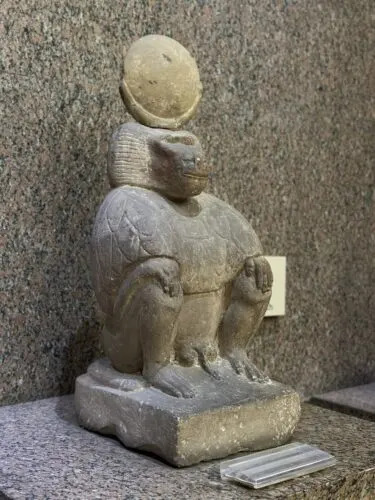
A statue of the god Thoth depicted as a baboon.Image: Catherine Hobaiter.
"We examined the two species of baboon accessible to ancient Egyptians, P. anubis and P. hamadryas, along with T. aethiopicus, and found that the grizzled hair of P. hamadryas and plumage of T. aethiopicus have spectral profiles indistinguishable from moonlight," the authors report in the journal Time and Mind.
The researchers found that the spectral profiles of the hamadryas baboon's fur and the sacred ibis's plumage closely match the dominant wavelengths reflected by moonlight. That visual similarity lends weight to the idea that ancient Egyptians associated these animals with Thoth because their appearance evoked the pale, luminous quality of the moon.
Catherine Hobaiter, a primatologist at the University of St Andrews and lead author of the study, noted that Egyptians had access to multiple species of both ibis and baboon but consistently selected the white ibis and the silver‑grizzled hamadryas for Thoth's iconography. "So, sacred ibises and hamadryas baboons are different in many ways, but one thing that unites them is their moon-like colour," she said.
The findings do not exclude other cultural reasons for the animals' sacred status — ecological behavior, symbolic associations, and ritual practice all likely contributed — but they add a measurable, sensory explanation: animals that reflected moonlike light would have been powerful visual symbols for a lunar deity.
Why it matters: This study illustrates how combining linguistics, archaeology and objective visual science (spectroscopy) can reveal how sensory perception shaped ancient religious symbolism.
Help us improve.