Researchers documented 109 great white sharks around Mud Island, Nova Scotia, in one month, including a roughly 20‑foot, three‑ton female nicknamed Big Rose. Twenty‑five sharks were recorded multiple times, suggesting site fidelity, and a 16‑foot female, Sweetheart, was satellite‑tracked down the U.S. East Coast. Scientists say the pattern could indicate nearby critical habitat — possibly a birthing area — but more study is needed. Rising sightings likely reflect improved monitoring and recovering prey populations, not an immediate public safety crisis.
109 Great White Sharks Recorded Off Nova Scotia in One Month — Meet 20‑Foot ‘Big Rose’
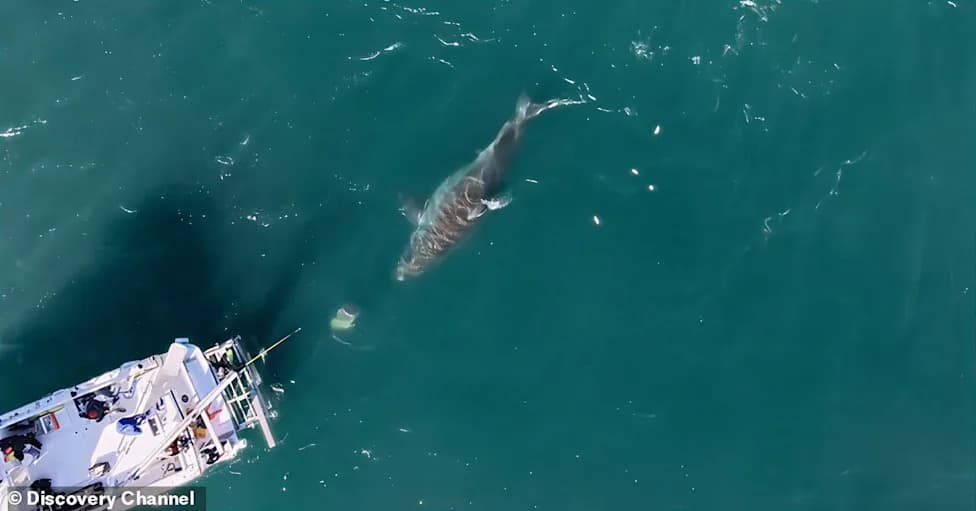
Image: Daily Mail - Discovery Channel
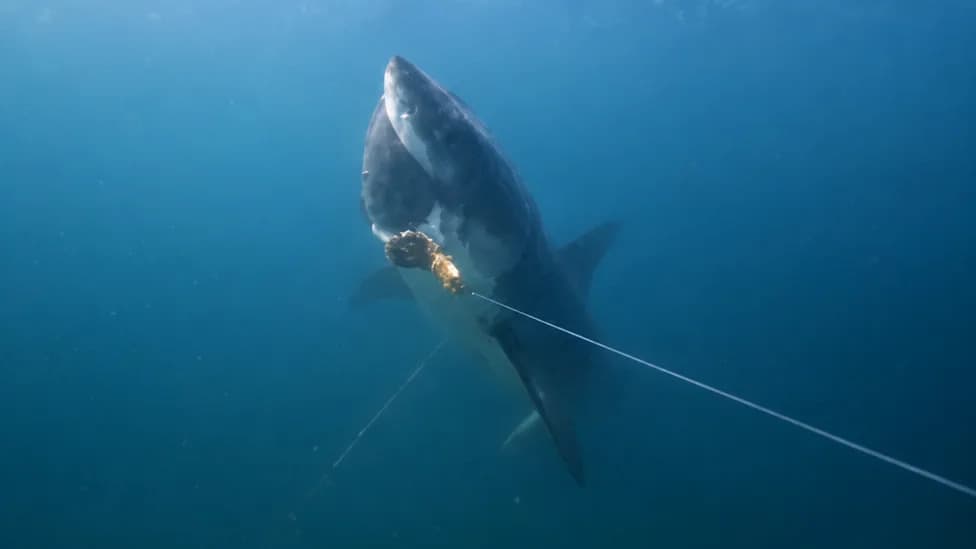
Off Mud Island, Nova Scotia, researchers lowered a baited cage into gray‑green coastal waters only to encounter far more large great white sharks than they expected. Dr. Neil Hammerschlag returned with a Discovery Shark Week team to relocate and tag an enormous female previously seen at the site.
The expedition first documented three sharks over 14 feet, then a 16‑foot female the team nicknamed "Sweetheart." Shortly after, they recognized a distinctive rose‑shaped scar on the flank of an even larger animal — an individual dubbed "Big Rose." Big Rose is estimated at roughly 20 feet long and about three tons.
What the Team Found
Over one month the researchers recorded 109 great white sharks around Mud Island, and 25 of those animals were observed more than once, indicating site fidelity rather than brief passage. Satellite tagging of Sweetheart later tracked her along the U.S. East Coast, past Florida and toward Louisiana, showing these animals can move long distances while repeatedly using particular areas.

Image: Daily Mail – Discovery Channel
Why This Matters
Researchers suggest the pattern — repeated sightings combined with long‑range movements — could mean Mud Island sits adjacent to ecologically important habitat, possibly a birthing or pupping area. That interpretation remains unconfirmed and will require more targeted study, including systematic tagging, aerial surveys, and prey‑density assessments.
"This expedition points toward a hypothesis, not a verdict," researchers say. Improved monitoring is revealing patterns that were previously invisible.
Context and Public Risk
Reported great white detections have risen across the Northwest Atlantic, from Newfoundland to Florida. Scientists attribute much of this increase to improved monitoring (more tags and cameras) and recovering seal populations — key prey for great whites — rather than a sudden spike in shark numbers. Importantly, shark bites on people remain statistically rare.
If Mud Island is ultimately confirmed as critical habitat, that finding would reshape how policymakers and conservation groups protect that stretch of the North Atlantic. In other words, the biggest story is not just the sharks' size, but how much we still have to learn about their movements and life history.
Image credit: Daily Mail / Discovery Channel
Help us improve.