Oral argument provides meaningful but limited insight into Supreme Court voting. Analyzing 56 signed decisions (October 2025–April 2026, 495 votes), word-count and speaking-turn models predicted roughly two-thirds of individual votes in the best specifications, while Martin–Quinn ideology matched a simple always-petitioner case-level baseline. Oral argument was most informative in closely divided cases and for certain justices (Kagan, Gorsuch, Jackson), but it is unreliable for identifying the pivotal fifth vote. Observers should therefore treat confident postargument readings with caution.
Can Oral Argument Predict the Supreme Court? Evidence From 56 Cases
Some Supreme Court oral arguments give a strong hint of the eventual result; others mislead or reveal only part of the story. After the rehearing in Louisiana v. Callais, SCOTUSblog observed the bench seemed "ready to curtail [a] major provision of the Voting Rights Act," and the opinion that followed confirmed that broad direction. In contrast, Trump v. Barbara produced clear bench skepticism but a cross-ideological coalition in the opinion. And Chatrie v. United States looked from the bench like a likely loss for the petitioner, yet the Court ultimately found the government's acquisition of cellphone-location records to be a search.
Scope and Method
This analysis examines 56 signed decisions argued between October 2025 and April 2026, encompassing 495 individual justice votes. It compares several ways of "reading" argument: raw word counts directed at each side, counts of speaking turns, proportional and justice-specific measures of questioning, previously used question-count metrics, and pre-term Martin–Quinn (MQ) ideological scores. The goal is to assess how much information oral argument provides about individual votes and about case winners.
What Oral Argument Predicted
The simplest rule treats heavy questioning as a signal of skepticism: if a justice spent more words questioning the petitioner, that is read as a vote for the respondent, and vice versa. Applied mechanically, this word-imbalance rule predicted 64.2% of individual justice votes in the sample. Counting speaking turns was slightly less accurate (about 60%), suggesting that the volume of engagement carries more information than frequency alone.
At the case-outcome level, the raw word-imbalance rule identified 33 of 56 winners (58.9%). A magnitude-weighted version—where larger imbalances count for more—improved performance (63.8% of individual votes; 64.3% of case outcomes). Allowing the relationship to vary by justice (a justice-specific model) produced the best fit: roughly 66.5% of individual votes and 66.1% of case outcomes.
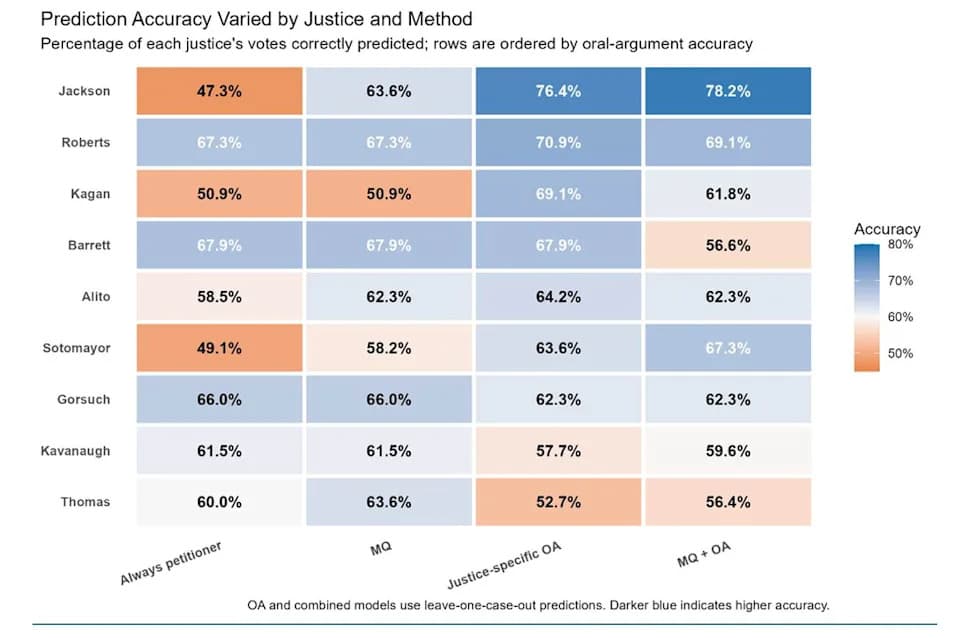
The predictive power varied by justice. The raw word-imbalance rule worked especially well for Justices Elena Kagan, Neil Gorsuch, and Ketanji Brown Jackson (about 75%+ accuracy), while it performed only slightly better than chance for Chief Justice John Roberts and Justice Amy Coney Barrett. These differences likely reflect distinct questioning styles—some justices use questions primarily to challenge advocates, while others use questions to clarify, manage argument flow, or refine doctrine—and some participate sparsely, making proportional imbalances noisy.
Oral Argument Was Most Informative In Close Cases
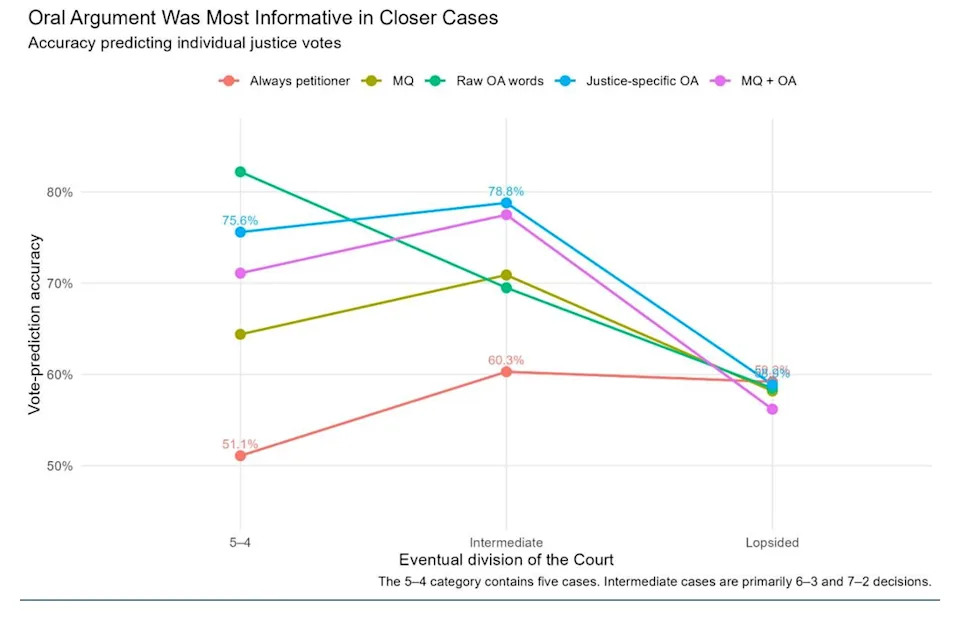
Contrary to intuition, oral argument was most informative when the Court itself was divided. In the five 5–4 cases (45 votes), the raw word-imbalance rule predicted 82.2% of votes; the justice-specific model predicted 75.6%. In moderately divided cases (6–3 and 7–2), the justice-specific model predicted 78.8% of votes—substantially better than simple baselines. By contrast, unanimities and near-unanimities produced lower vote-accuracy (about 56–59%).
That pattern makes sense: in lopsided cases the bench may debate scope, remedy, or doctrinal limits while agreeing on the result. In close cases, bench questioning often maps more directly to the substantive divisions that determine each justice's vote.
Ideology, Baselines, and Combined Models
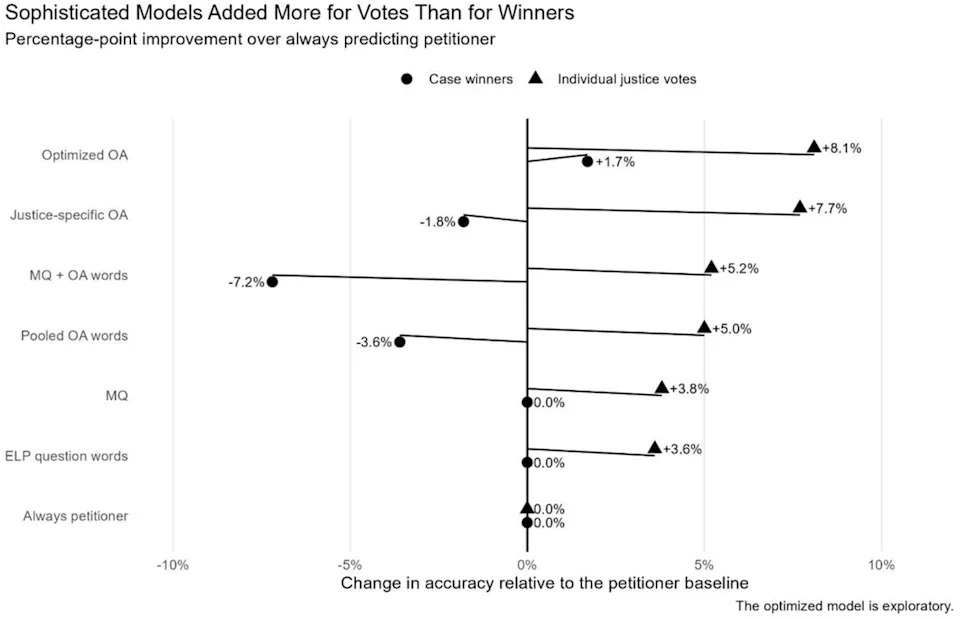
Martin–Quinn ideology scores provide a different prior. The MQ model predicted 62.6% of individual votes and correctly identified 38 of 56 case winners (67.9%)—the latter matching a simple always-petitioner baseline because petitioners prevailed in 38 of 56 cases. At the vote level, MQ improved over the naive baseline (58.8% accuracy) by about 3.8 points. The pooled oral-argument model improved accuracy by about five points, and the justice-specific oral-argument model by nearly eight.
Combining MQ scores with oral-argument measures yielded only modest additional gains (around 64% of individual votes) and did not outperform MQ or the petitioner baseline at the case level. In short, word counts and ideological priors supply overlapping information, and their naive combination does not guarantee large improvements.
When Argument Points the Wrong Way
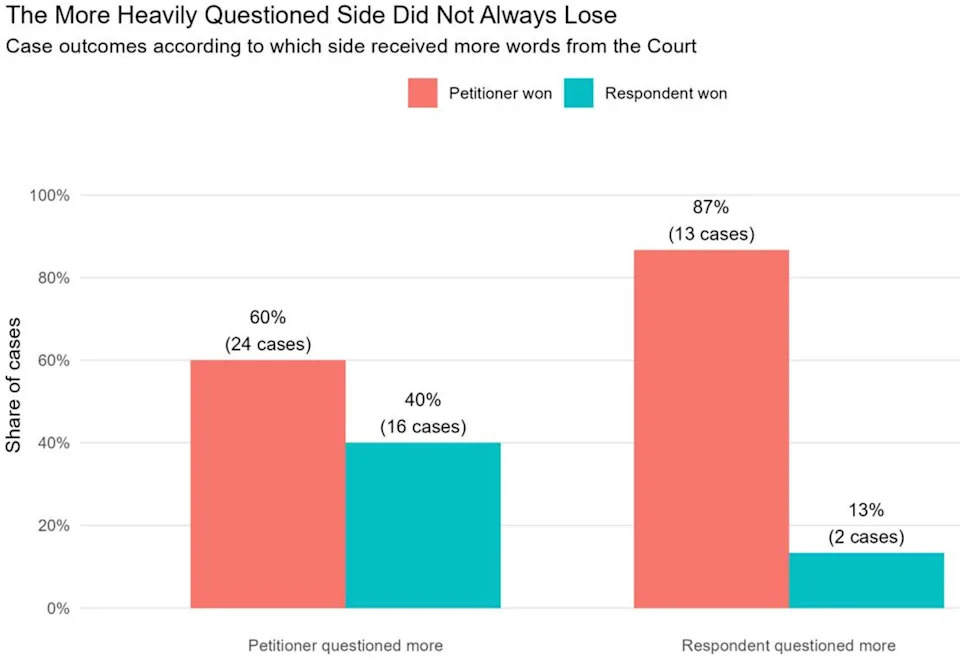
There are notable counterexamples where bench attention did not predict the outcome. In Chevron U.S.A. Inc. v. Plaquemines Parish, every speaking justice directed more words to Chevron's side—yet Chevron won. Olivier v. City of Brandon also saw questioning that seemed to favor the respondent (or at least expressed concerns about the petitioner's theory), but the Court unanimously ruled for the petitioner. Chatrie v. United States likewise showed that argument can understate the strength of a doctrinal coalition.
These cases illustrate an important caveat: sustained questioning can signal weakness, but it can also reflect the importance, novelty, or doctrinal consequences of a position that the Court is probing carefully. Word counts are evidence, not a vote tally.
Conclusion
Oral argument contains meaningful information about how individual justices will vote—especially for some justices and in closely divided cases—but it is an imperfect predictor of the Court's overall judgment. The best oral-argument models predicted roughly two-thirds of individual votes, outperforming simple baselines by several percentage points. However, predicting the pivotal fifth vote that decides a close case remains difficult; simple word-count and question-count approaches can illuminate internal alignments without reliably pinpointing the majority.
Bottom Line: Treat confident postargument pronouncements with caution. Oral argument helps map leanings, particularly in divided cases, but it is no substitute for careful doctrinal analysis and attention to coalitions.
Help us improve.