Federal reviewers found Indiana’s DNR has collected at least $109 million in mitigation fees since 2018 but has struggled to begin many required wetland and stream restoration projects on time. The program was behind on more than 173 wetland credits and over 84,711 stream credits at the end of 2025, prompting the Army Corps to request a corrective action plan. DNR cites staffing shortages, pandemic delays and high demand; critics and advocates disagree on policy, funding and the program’s scale. Two service areas temporarily paused credit sales while DNR works to catch up.
Federal Review: Indiana DNR’s Wetlands Mitigation Program Falls Short After Collecting $109M

Mark Becker, land acquisition division director at DNR. (Courtesy photo)
Federal reviewers say Indiana’s Department of Natural Resources (DNR) has collected at least $109 million in in‑lieu fee (ILF) payments since the mitigation program began in 2018, but many projects intended to replace destroyed wetlands and streams have not started within the three‑growing‑season timeframe required by federal rules.
The state program is overseen by the U.S. Army Corps of Engineers, which generally requires land acquisition and initial construction on mitigation projects to begin within three years of the first credit sale in a service area. DNR’s 2025 annual report and Army Corps reviews say that timeline has frequently not been met across multiple service areas.
Backlog and federal response: As of the end of 2025 the program was behind on more than 173 wetland credits (sold by the acre) and over 84,711 stream credits (sold by linear foot). The backlog includes more than 60% of stream credits sold and nearly a third of wetland credits. Because of those shortfalls, the Army Corps’ Louisville district asked DNR in June to submit a corrective action plan and a projected timeline to reduce outstanding obligations.
DNR temporarily halted credit sales in two of its 11 service areas — Upper White and Whitewater–East Fork White — to prioritize catching up on obligations, program officials said.
Progress, staffing and causes: DNR has fully completed two mitigation projects since 2018 and lists 27 projects in various stages of development, including two under construction and three awaiting permits. Mark Becker, DNR’s land acquisition division director, cited early staffing shortages, COVID‑19 delays, unexpectedly high demand for ILF credits and lengthy permitting and review processes as key reasons for the lag. The program added four staff members in 2023 and reports a growing pipeline of projects now entering regulatory review.
The 2025 report notes regular monthly coordination between DNR and the Army Corps’ Louisville district but also points to prolonged review response times and evolving Corps requirements that have contributed to delays and likely raised future delivery costs. DNR requested deadline extensions from the Army Corps districts for its 2025 obligations; the Louisville district has not granted an extension pending review of DNR’s corrective action plan.
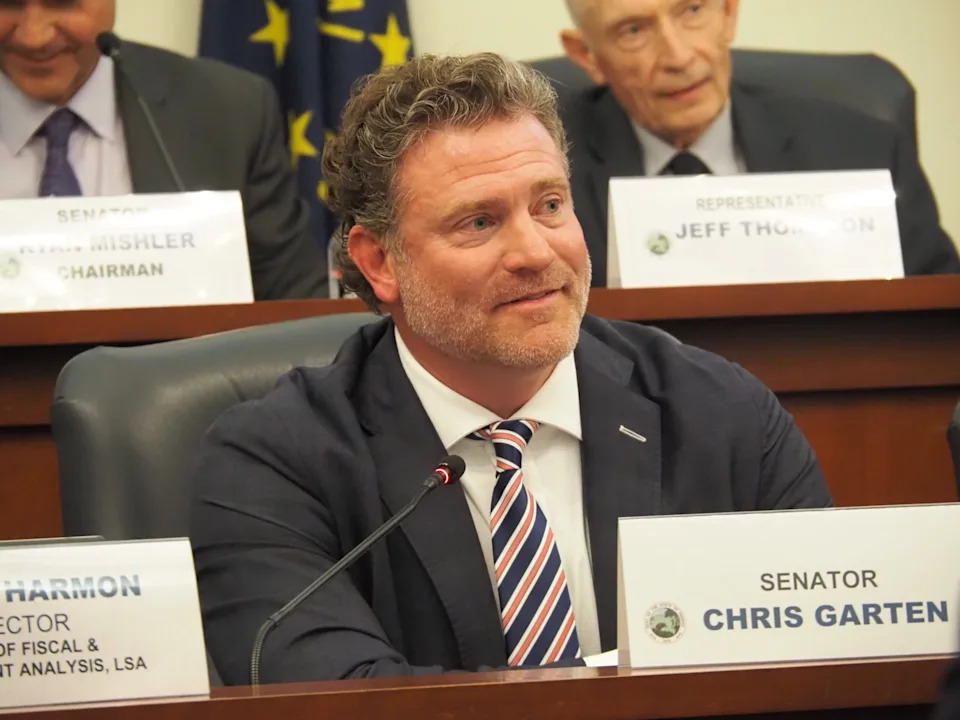
Sen. Chris Garten, R-Charlestown, asks questions during a State Budget Committee meeting on Thursday, April 16, 2026. (Provided Photo/Leslie Bonilla Muñiz/Indiana Capital Chronicle)
How the program works: Developers or permit holders that impact wetlands or streams can buy ILF credits from DNR instead of conducting immediate mitigation themselves. DNR then assumes responsibility to restore, create, enhance or preserve comparable wetland or stream functions within the affected service area. Revenues are allocated as follows: 70% to service area funds for acquisition, planning, construction and management (over $76 million to date), 15% to administrative costs, and 15% to reserves.
Of more than 1,000 credit purchases since 2018, only 66 have been deemed fulfilled — meaning mitigation activity occurred in the appropriate service area. DNR has fulfilled 30 credits via its two in‑house projects and purchased 38 fulfilled credits from private mitigation banks.
Where purchases come from: The Indiana Department of Transportation (INDOT) has been the largest buyer, spending nearly $45 million on credits—more than private buyers ($40.9 million) and other governments ($22.4 million). Federal guidance and practice often steer highway projects toward ILF purchases because they frequently impact wetlands and because ILF payments are generally preferred over permittee‑conducted mitigation.
Policy debate: Critics, including Republican state Sen. Chris Garten, argue the program has expanded too far and questioned whether taxpayers are effectively funding mitigation through transfers between government agencies. Garten sponsored laws in 2021 and 2024 that changed state wetland classifications and protections, moves supporters say reflect a desire to recalibrate regulation.
Environmental advocates counter that Indiana’s abundant lakes, rivers and flat topography make wetland protections especially important for flood storage, groundwater recharge, water quality, wildlife habitat and recreation. Susie McGovern of the Hoosier Environmental Council highlighted continuing staffing and funding shortfalls at both DNR and the Army Corps, and she flagged growing data center development as an emerging pressure on wetlands in parts of the state.
“It’s either habitat or it’s water quality or it’s flood detention… When mitigation doesn’t happen, you’re not getting it back. That’s why the program exists,”
— Morgan Robertson, University of Wisconsin–Madison, who helped draft the 2008 federal ILF rule.
Outlook: DNR says more projects are moving into the regulatory stage and expects credits to be delivered over the coming years, but delivery will depend on timely reviews, permitting, land protection actions and the multi‑year monitoring that releases credits incrementally. Stream projects require a minimum of seven years of monitoring and wetlands a minimum of ten before credits are fully released for resale.
Help us improve.