Physicists at Shanghai Jiao Tong University have for the first time observed a spacetime crystal melting in a tabletop experiment, revealing that spatial and temporal order can disintegrate through different mechanisms.
The study, published in the Proceedings of the National Academy of Sciences (PNAS), used hundreds of small plastic disks on a plate vibrated at 100 Hz to create a classical analogue of a spacetime (time) crystal. The collective system self-organized into a triangular lattice that rotated as a rigid body with an emergent period of roughly five hours — a slow rhythm that persisted for up to a day despite the fast, noisy drive.
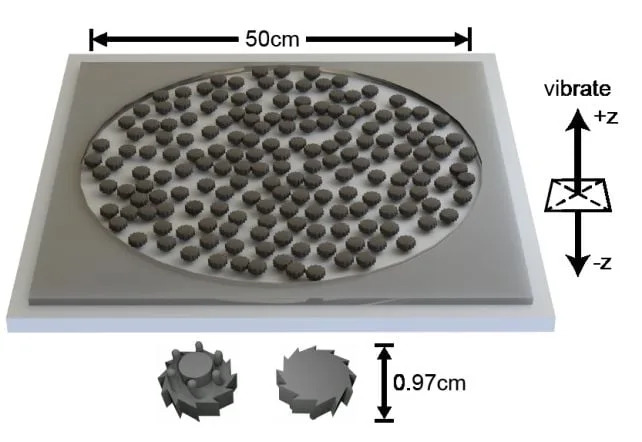
A diagram illustrating the experiment. (Liu et al.,PNAS, 2026)
How the Experiment Worked
The setup resembles a Chladni-plate experiment but substitutes grains of sand with tiny plastic disks. Each disk has six angled, pin-like legs under it; as the plate oscillates the legs briefly strike the surface, producing random kicks from the driving motion. Individually the disks jitter chaotically, but at high packing density they spontaneously form a triangular lattice that collectively rotates.
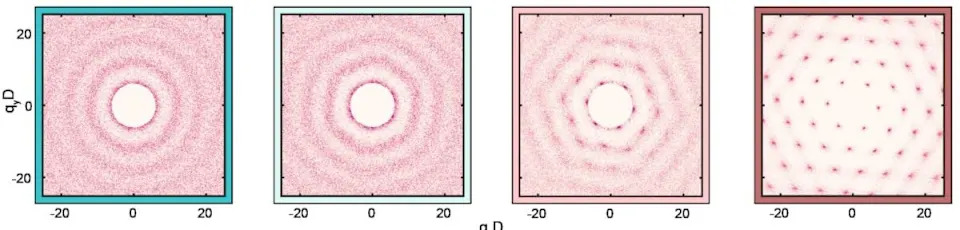
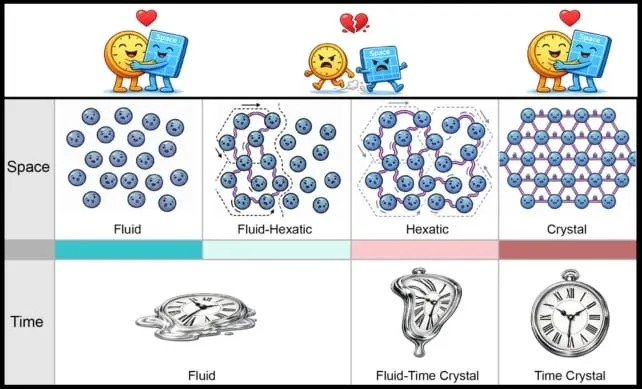
Arrangements of particles from disordered (left) to ordered (right). (Liu et al.,PNAS, 2026)
Emergent Temporal Order
Crucially, the lattice’s five-hour rotation is independent of the plate’s 100-Hz oscillation: the slow, synchronized motion is an emergent property powered by the drive but not locked to its frequency. That separation of time scales is what qualifies the system as a classical spacetime crystal.
Spatial and temporal order melt separately in a spacetime crystal, producing intermediate fluid-hexatic and fluid-time-crystal states before both forms of order are lost. (Liu et al.,PNAS, 2026)
Watching It Melt
To trigger melting, the researchers reduced the particle density by removing disks. Instead of a single smooth transition back to disorder, the crystal broke down in three distinct stages:
Subscribe to ScienceAlert's free fact-checked newsletter
- Localized Temporal Failures: Small patches lost synchronized timing while the rest of the lattice continued rotating coherently.
- Global Loss of Temporal Order: The overall rhythmic motion collapsed even though the triangular spatial lattice remained largely intact.
- Spatial Breakdown: Defects nucleated and proliferated through the lattice, ultimately destroying the spatial crystalline order and producing a disordered fluid-like state.
What Drives the Three Stages
The team identified two distinct physical processes: temporal order fails primarily because effective interactions between neighboring disks weaken, disrupting the synchronized rhythm; spatial order fails as defects spread through the lattice, a familiar route to melting in ordinary crystals. The separation of these mechanisms suggests that rules governing order in time can be fundamentally different from those governing order in space.
“Our experimental results reveal an intricate three-stage melting scenario in which spatial and temporal crystalline order melt at distinct critical values and through different physical mechanisms, supporting the independence of these spacetime symmetries,” the authors write.
Why This Matters
Time crystals and their classical analogues are a frontier for understanding nonequilibrium phases and symmetry breaking. Observing a spacetime crystal melt — and seeing temporal and spatial order decouple — provides a new experimental window onto how complex patterns of order emerge and vanish in driven systems. While quantum time crystals pose additional challenges, classical models like this one offer accessible platforms to explore the principles that may apply more broadly.
Reference: Liu et al., Proceedings of the National Academy of Sciences (PNAS), 2026.