Researchers used awake fMRI in rats to show that mescaline suppresses activity in parts of the cerebellum while strengthening functional connectivity between the cerebellar nuclei and regions such as the hippocampus, thalamus and somatosensory cortex. Behavioral tests found reduced odor‑evoked responses and frequency‑specific disruptions in auditory filtering. The results suggest mescaline may recalibrate which sensory channels are amplified or suppressed, but whether the same mechanisms operate in humans is unknown.
Mescaline Rewires Sensory Filtering: Rat fMRI Shows Cerebellar Suppression but Stronger Cross‑Brain Connectivity

(Albert Fertl/Moment/Getty Images)
Every second the brain receives a torrent of visual, auditory, olfactory and internal bodily signals. Neural circuits continuously filter that incoming information so only a small portion reaches conscious awareness. A new rodent study suggests that mescaline — the psychoactive compound found in several cactus species and used ceremonially for millennia — may change how those filters operate.
Mescaline acts in part on serotonin-sensitive receptors and can dramatically alter perception of color, form, time and selfhood. While the cerebellum is best known for coordinating movement and balance, growing evidence implicates it in attention, emotion, memory and sensory processing. One hypothesized cerebellar function is to suppress familiar or expected sensations so the brain can focus on novel or important inputs. The new experiments tested whether mescaline modifies cerebellar activity and its communication with other brain regions.

YouTube Thumbnail
Study Design
The authors used awake functional magnetic resonance imaging (fMRI) to measure brain activity in rats. In the primary experiment, 24 adult rats (12 females, 12 males) were split evenly between mescaline and control conditions. The animals were gradually acclimated to the scanner so imaging could be performed without anesthesia, which can confound neural signals. A separate behavioral experiment used 16 rats to assess auditory gating (prepulse inhibition).
Key Findings
- Cerebellar Activity Decreased: Mescaline reduced neural activity in portions of the cerebellum.
- Connectivity Increased: Despite localized suppression, functional connectivity between the cerebellar deep nuclei and multiple regions (hippocampus, thalamus, somatosensory cortex and midbrain) increased substantially after mescaline.
- Hippocampal Link Emerged: Under baseline conditions the cerebellar nuclei had essentially no measurable functional connection with hippocampal subregions; after mescaline, seven of nine hippocampal subregions showed connectivity to the cerebellar nuclei.
Sensory And Behavioral Tests
To probe sensory consequences, researchers presented an almond scent that rodents typically find rewarding. Control animals produced a clear neural response to the odor, but mescaline-treated rats showed almost no odor-evoked response. In prepulse inhibition tests the mescaline group filtered repeated loud sounds effectively at low and high frequencies but failed to filter at a middle frequency — a frequency-selective disruption rather than a uniform breakdown of sensory gating.
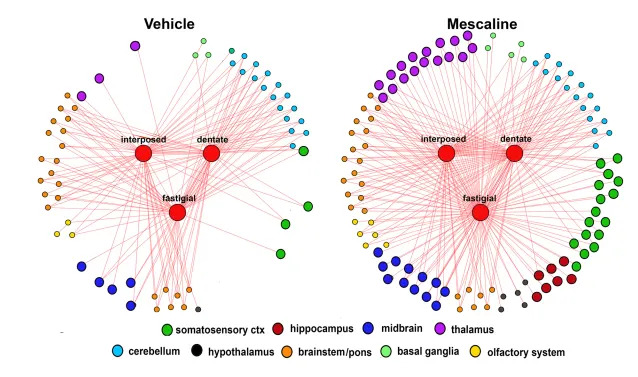
Radial maps showing the connections between different brain regions in control (left) and experimental (right) mice. (Cavallaro et al.,Neurosci. Bull., 2026)
"It looks more like the drug is recalibrating the gain or precision assigned to different sensory channels, suppressing some and amplifying others, rather than degrading the whole system uniformly." — Noah Cavallaro, study first author
Interpretation And Limitations
The combined results suggest a plausible mechanism by which mescaline could produce altered bodily awareness and perception: reduced local cerebellar activity together with increased communication to memory (hippocampus), relay (thalamus) and body‑sense (somatosensory cortex) regions may allow relatively raw, unfiltered sensory and interoceptive signals to reach higher brain areas.
However, important caveats remain. The study cannot determine whether rats experience subjective phenomena such as visual distortions or changes in self‑awareness. The researchers also did not continuously monitor peripheral physiology (heart rate and respiration) during scanning, so some observed signals might reflect physiological rather than strictly neural effects. The reason why only a mid-range auditory frequency showed impaired filtering is not yet understood and needs follow-up work.

Subscribe to ScienceAlert's free fact-checked newsletter
Prior human imaging analyses of multiple psychedelics, including mescaline, have reported altered connectivity across large-scale brain networks and deeper structures such as the cerebellum. Those human datasets were pooled across studies and did not directly test cerebellar sensory filtering the way this rodent work did, so translating these findings to human psychedelic experience remains an open question.
The findings are reported in Neuroscience Bulletin. The study emphasizes convergence across imaging and behavioral measures but stops short of confirming subjective effects in humans.
Help us improve.