Demogorgonichthys arcanus, a tiny, eyeless fish discovered in Huntsville's Bobcat Cave, is so genetically distinct it has been placed in a new genus. Genetic tests show part of the rhodopsin gene is missing, explaining its lack of light response. Researchers have observed roughly 20 individuals at a time, and the find highlights the hidden biodiversity of cave systems and the need to protect groundwater-linked subterranean habitats.
New Eyeless 'Demogorgon' Fish Discovered in Alabama Cave — A Species So Distinct It Earned Its Own Genus
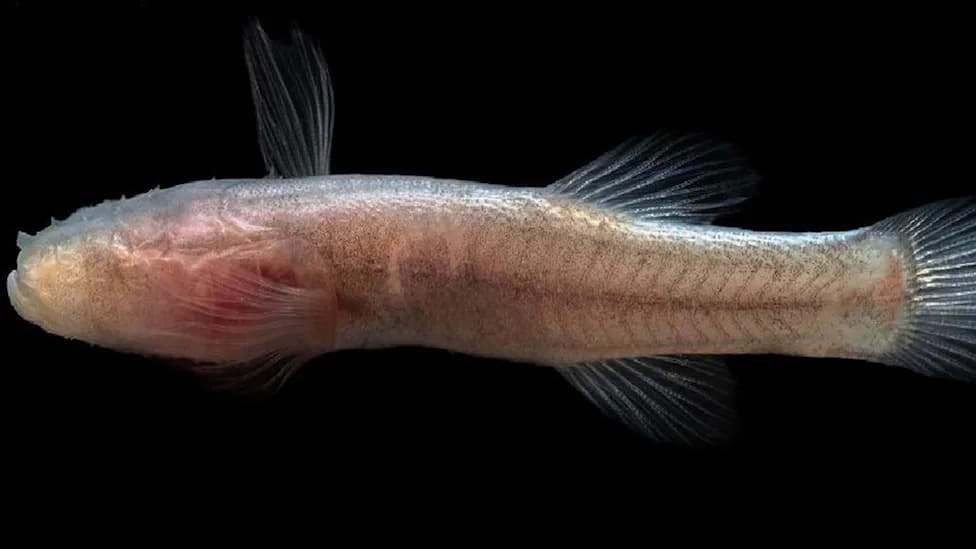
Photo Credit: Auburn University
Scientists exploring Bobcat Cave in Huntsville, Alabama — long monitored for the endangered Alabama cave shrimp — have identified a second remarkable resident: a tiny, eyeless fish so distinct researchers placed it in a new genus.
Demogorgonichthys arcanus, commonly called the demon cavefish, is pale, under 2 inches long, and completely without external eyes. The discovery, reported in Scientific Reports and covered by Popular Science, was made by a team from Auburn University and marks an unusually clear example of a previously unknown vertebrate emerging from a cave system researchers have studied for nearly 40 years.
What Makes This Fish Unique
Although related to other North American cave fishes such as the southern cavefish and the Alabama cavefish, the demon cavefish differs markedly in body shape, snout morphology, and genetic markers. Genetic analysis revealed that part of the rhodopsin gene — which contributes to light sensing in many animals — is missing and nonfunctional in this species, helping explain its lack of response to light.
"Most of the time when we discover new species, we are finding differences within organisms we already knew were there. This was different. This was a new discovery that had not been seen before, and that is really rare," said Jonathan Armbruster, co-author of the study and curator of fishes at the Auburn University Museum of Natural History.
Conservation Implications
Field teams have recorded only about 20 individuals at any one time, suggesting the species could be among the rarest fishes on Earth. Because cave systems are closely linked to groundwater, protecting caves like Bobcat Cave also helps safeguard regional water quality and human water supplies. Narrowly adapted species such as the Alabama cave shrimp and the demon cavefish are especially vulnerable to changes in water quality, land use, and pollution.
Taxonomist Pamela Hart named the fish after consulting a list of mythological figures for inspiration; Popular Science noted the name "Demogorgon" ultimately traces back to ancient mythology and gained popular recognition from modern media.
Scientists continue to monitor Bobcat Cave and say the discovery—a genetically distinct fish assigned to its own genus—strengthens the case for conserving subterranean ecosystems and their connected groundwater resources.
Help us improve.