Archaeologists excavating farmland between Halberton and Sampford Peverell in Devon have revealed a 129-square-foot polychrome mosaic dated to the 4th century A.D., part of a larger Roman villa complex that includes a substantial bathhouse. Teams from the University of Exeter and Cotswold Archaeology, with community volunteers, also found painted-plaster walls, plunge pools and artefacts such as a silver-plated spoon and a blue glass intaglio showing Victory. The mosaic will be stabilised, conserved and later displayed at the Tiverton Museum of Mid-Devon Life.
Rare 4th-Century Polychrome Mosaic, Bathhouse and Villa Unearthed Under Devon Farmland
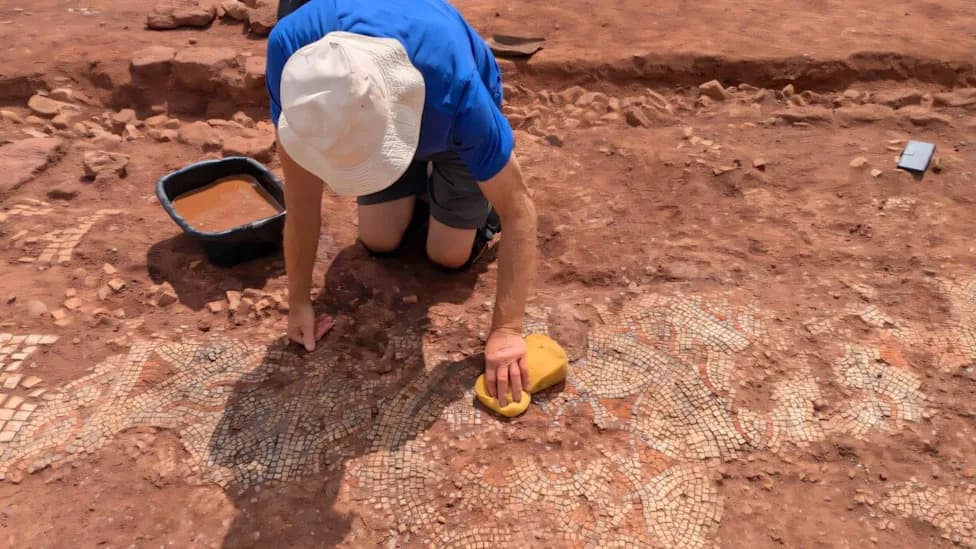
Photo Credit: University of Exeter
Archaeologists have uncovered the remains of a substantial Roman villa complex beneath farmland in Devon, England, revealing a rare polychrome mosaic floor, a sizeable bathhouse and a suite of artefacts that point to an affluent late-Roman household.
The two-month excavation, carried out between Halberton and Sampford Peverell by teams from the University of Exeter and Cotswold Archaeology with community volunteers, exposed a roughly 129-square-foot mosaic composed of thousands of tesserae in red, white and dark blue-gray shades. Specialists date the pavement to the 4th century A.D.
Mosaic Details
The mosaic’s central motif is a circular design: a stylised flower made from eight overlapping teardrop-shaped petals. County Archaeologist Bill Horner described the find as especially significant, noting that the polychrome mosaic is the westernmost example discovered in a Roman villa in Britain.
Bathhouse and Domestic Features
Excavations also revealed a separate bathhouse with painted-plaster walls and at least two plunge pools, suggesting the estate offered both comfort and displayable luxury. These features align with architectural choices used by wealthy occupants to signal status in late Roman Britain.
Other Finds
Archaeologists recovered pottery fragments, a copper-alloy bangle, a silver-plated spoon and a blue glass intaglio that had been used to seal wax documents — one intaglio bears the image of the goddess Victory. Together these objects help build a fuller picture of daily life and personal possessions on the estate.
Conservation And Display
Conservators are carefully stabilising and lifting the mosaic so its surface, colours and patterning can be preserved. Once conservation is complete, the mosaic is expected to go on display at the Tiverton Museum of Mid-Devon Life.
“This villa was undoubtedly home to people of wealth and high standing,” said project lead Dr. Susan Greaney, underlining the social significance of the discovery.
What is now quiet agricultural landscape was once the site of a sophisticated estate equipped with luxury fittings and amenities, offering a rare glimpse of elite Roman life in western Britain.
Help us improve.