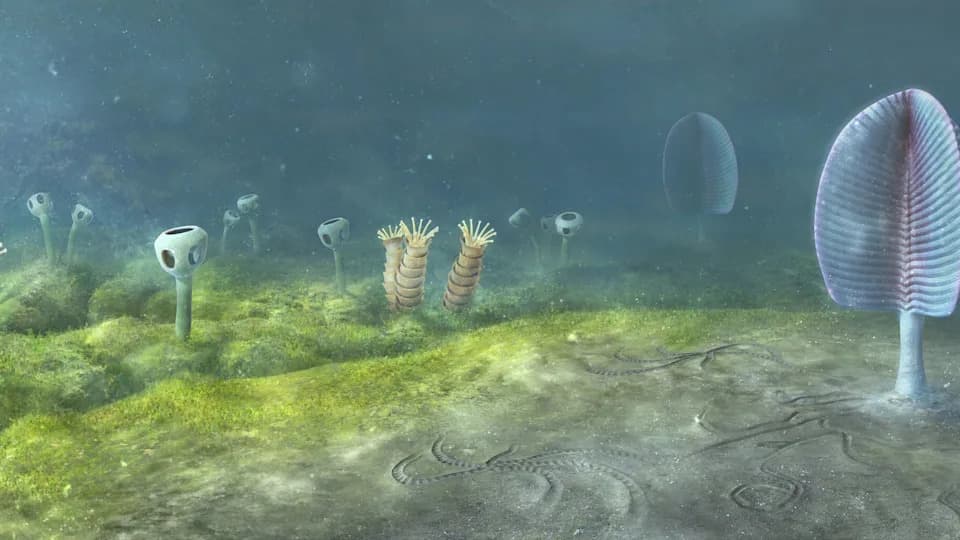
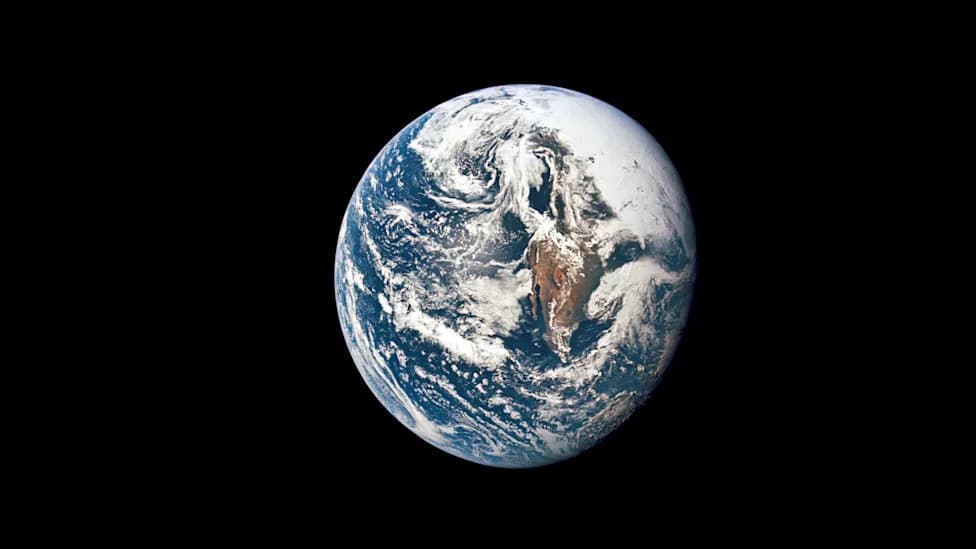
What If a Pre-Human Civilization Left a Geological Footprint? The "Silurian hypothesis," proposed by Adam Frank and Gavin Schmidt, explores whether an advanced civilization could have arisen on Earth before humans and what traces it might have left. Inspired in part by the Paleocene-Eocene Thermal Maximum (~55 million years ago), the study considers durable signals such as carbon isotope shifts, persistent pollutants, plastics and heavy metals in sediments. While most scientists favor natural causes for ancient climate events, the idea prompts stronger, testable criteria for identifying any past technological signatures and highlights lessons for our own impact on the planet.
Could an Advanced Civilization Have Lived on Earth Before Us? Inside the ‘Silurian Hypothesis’
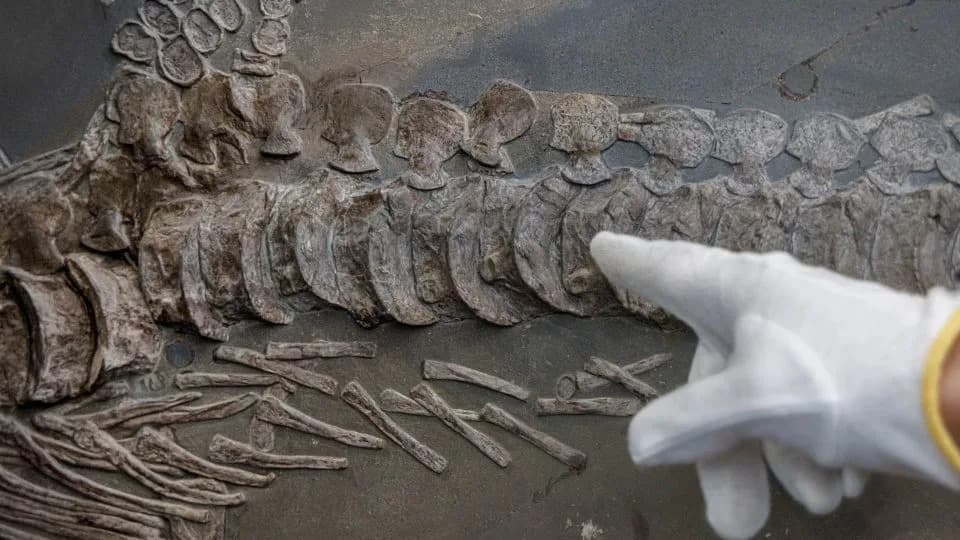
The fossilized tail bones of an Ichthyosaurus, around 190 million years old and weighing 800 kilograms. - Markus Scholz/picture alliance via Getty Images
What if an industrial, energy-using civilization arose on Earth millions of years before humans — and then vanished? That provocative question is the core of the "Silurian hypothesis," proposed by astrobiologist Adam Frank and climate scientist Gavin Schmidt. Their 2018 thought experiment asks which kinds of traces such a civilization might leave in the geological record and whether we would be able to recognize them today.
What Is the Silurian Hypothesis?
The name borrows from a fictional species in the TV series Doctor Who, but the idea is scientific: if a technologically advanced society had existed in deep time, could we detect its legacy now? Frank and Schmidt framed the question to encourage researchers to identify specific, testable signatures — chemical, physical and biological — that an ancient industrial civilization might imprint on sediments and rocks.

A Silurian, a fictional character from the TV show "Doctor Who," which was part of an advanced race of reptiles that pre-dated humans. - Everett Collection
Why This Idea Matters
The hypothesis is partly inspired by a dramatic climate event about 55 million years ago: the Paleocene-Eocene Thermal Maximum (PETM). During the PETM, global temperatures rose rapidly (estimates as high as ~15 °F), and large amounts of carbon entered the atmosphere, causing widespread ecological disruption. While most scientists attribute the PETM to natural causes such as volcanic activity or methane release, Frank and Schmidt asked: could such anomalies ever be the fingerprint of a lost technological civilization?
How Would We Look For Evidence?
Frank and Schmidt examined several classes of evidence that could persist over millions of years:
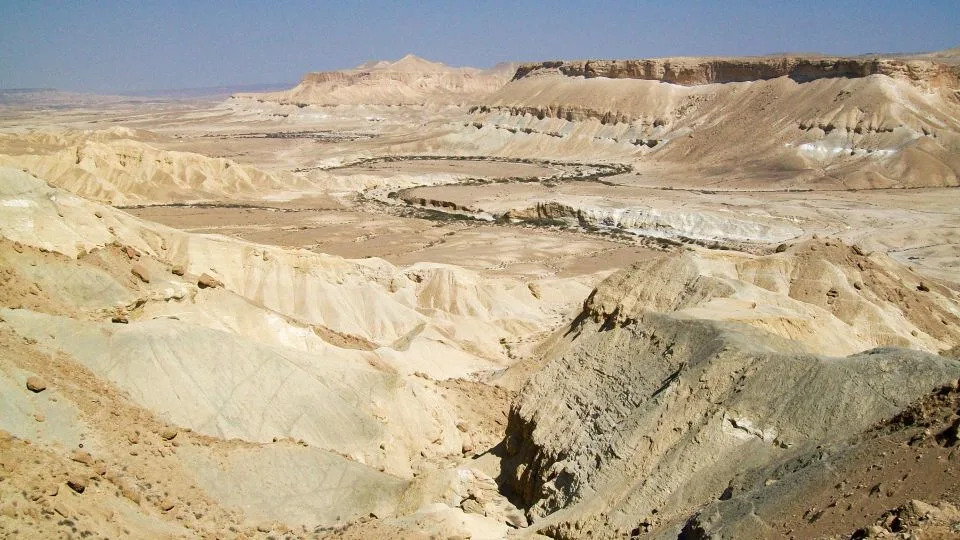
Sand dunes in bright sun in the Negev Desert, Israel. This is the oldest large-scale stretch of land on Earth. - Smith Collection/Gado/Getty Images
- Geochemical Signals: Sudden changes in carbon isotopes, oxygenation levels, or unusual concentrations of synthetic chemicals could stand out in sedimentary layers, much like the distinct bands visible in the Grand Canyon.
- Technofossils and Persistent Pollutants: Materials such as plastics, persistent organic pollutants, synthetic hormones, and rare heavy-metal concentrations from electronics might survive in trace form long after structures and artifacts are gone.
- Fossils and Architecture: Physical structures and organic remains are vulnerable to erosion, tectonics and recycling. Over millions of years, built environments would be largely destroyed or buried, and fossilization is rare and selective.
Preservation Challenges
Earth actively reshapes itself: plate tectonics, volcanism, erosion and sedimentation continually alter the surface. The planet’s patchy fossil record further complicates detection — only a tiny fraction of organisms fossilize, and many fossils remain undiscovered. The oldest large continuous land surface exposed today, the Negev Desert, is roughly 1.8 million years old, which illustrates how little direct surface evidence survives across deep time.
Critiques and Counterarguments
The idea has generated useful scientific debate. Geologist Jan Zalasiewicz and others argue that the fossil and technofossil records are more revealing than Frank and Schmidt imply: large-scale industrial activity should leave distinctive, globally distributed signatures that are detectable in sediments. Zalasiewicz is open to imaginative scenarios — from song-singing dinosaurs to poetic ammonites — but he considers it reasonable to rule out a prior civilization on the scale of modern industrial society.
Why Scientists Care
Frank and Schmidt did not claim the Silurian hypothesis is true; rather, they used it as a framework to ask what evidence would be necessary to test the possibility robustly. The exercise serves as both a scientific prompt and a cautionary reflection: if energy-intensive civilizations commonly alter planetary systems in ways that lead to collapse, what does that imply for humanity’s future?
"Are we an experiment the planet has run that is going to fail?" — Adam Frank
Takeaway
The Silurian hypothesis is a thought experiment that sharpens how we think about long-term environmental change and the detectability of technological societies in deep time. It does not replace mainstream explanations for ancient climate events, but it encourages clearer criteria for what would count as evidence of past technological activity — and reminds us that our own industrial footprint will be written into Earth's future sediments.
Help us improve.