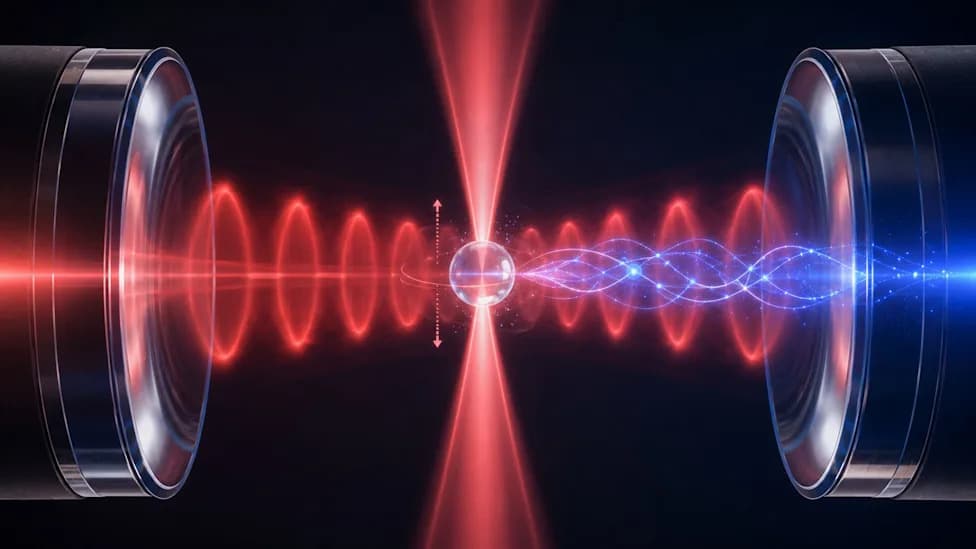
Researchers found that bright light can produce a contactless drag on graphene nanotubes in water by generating excitons that create transient charge fluctuations at the graphene–water interface. Terahertz spectroscopy confirmed that suppressing excitons removes the effect, tying the slowdown to electronic rather than thermal hydrodynamic mechanisms. The discovery suggests optical control of friction could one day be used to influence reaction rates or guide nanoscale devices, though practical applications remain exploratory.
Light Can Create Friction — Scientists Observe Contactless Quantum Drag On Graphene Nanotubes
Scientists Discovered Contactless Frictiongg030055 - Getty Images
Friction normally comes from two surfaces rubbing together. New lab experiments, however, show a different kind of drag: when graphene nanotubes suspended in water are brightly illuminated, they slow down rather than speed up. Researchers attribute this surprising effect to contactless, light-induced "quantum" friction mediated by rapidly fluctuating electronic charges on the graphene surface.
How Light Creates Contactless Friction
Physical chemist Sebastian Kruss and colleagues at Ruhr-University Bochum exposed graphene nanotubes in water to increasing light intensity and tracked their motion. Instead of the expected rise in diffusion from added thermal energy, the nanotubes decelerated under brighter illumination. The team linked that slowdown to excitons—bound electron–hole pairs created when light excites electrons in graphene.
Although excitons carry no net charge, their formation produces transient charge fluctuations and optical emission (the nanotubes fluoresced under the beam). Those fluctuating charges couple to low-frequency modes of nearby H₂O molecules at the graphene–water interface, transferring momentum to the solvent and producing a measurable drag force despite the absence of physical contact.
Evidence And Context
The researchers used terahertz (THz) spectroscopy to probe the role of excitons; when exciton formation was suppressed, the light-induced drag disappeared, strengthening the link between electronic excitations and the contactless friction. This result builds on earlier studies that reported electromagnetic friction effects at water–carbon interfaces and altered frictional behavior when graphene electrons are excited.
"Friction is expected to increase when the surface response function of the substrate overlaps with the low-frequency spectrum of the solvent…this is demonstrated by anomalies in hydrodynamic friction at water–carbon interface and by the rapid cooling of hot electrons in graphene in water," the authors wrote in Nature.
Why Graphene Matters
Graphene’s atomically smooth, one-atom-thick lattice provides an ideal platform to reveal nonclassical friction mechanisms because conventional roughness-driven friction is effectively absent. Graphene is mechanically robust—often described as much stronger than steel for its weight—and its electronic properties allow high exciton mobility and rapid charge fluctuations that couple to the solvent.
Potential Applications And Caveats
Controlling quantum friction with light could open new ways to modulate chemical reaction rates at surfaces or steer microswimmers and nanorobots in fluid environments using optical fields. That said, these findings are early-stage and were observed under controlled laboratory conditions; practical applications will require further study of scalability, materials, and safety inside complex environments such as biological tissue.
Overall, this work reveals an unexpected route by which light can exert drag at the nanoscale and highlights how quantum electronic effects can reshape familiar forces like friction.
Help us improve.