Software engineers are confronting a rapid shift as AI takes on more of the coding workload. While some fear skill erosion and job losses, others are retraining to validate and integrate AI-produced code or organizing collectively for protections. Experts say the value of pure code production is waning, while problem definition, systems design and AI oversight are rising. The industry is likely to evolve into a hybrid model where engineers work alongside AI tools rather than being wholly replaced.
Chasing Skills, Returning To Fundamentals and Organizing: How Software Engineers Are Adapting to AI

George Dover poses for a portrait at his home in Beaverton, Oregon. Dover was laid off in 2024.Photograph: Leah Nash/The Guardian
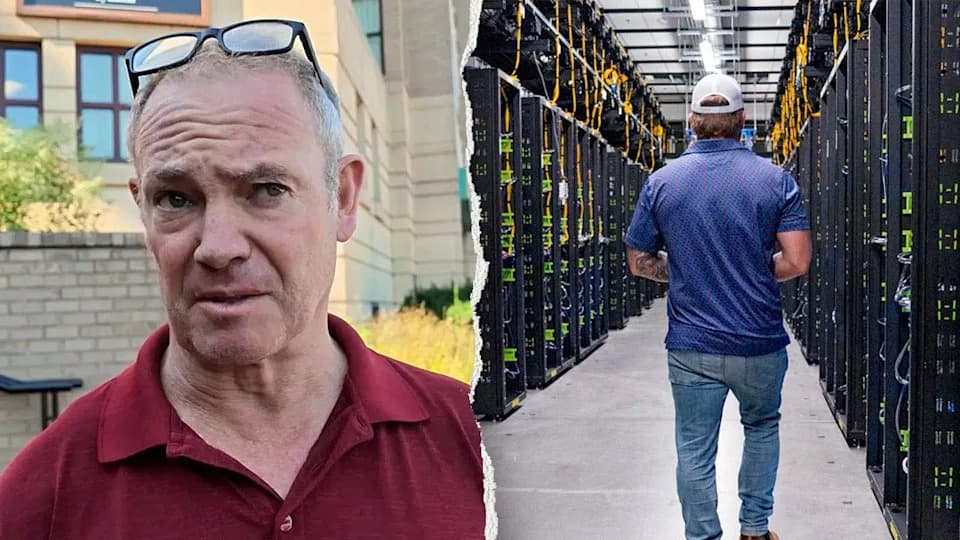
Every weekday, Matt, a software engineer who asked to remain anonymous to protect his job, treasures a four-hour train ride to Pawling, New York. He uses that time to work on a personal project: a browser-based video game for which he writes every line of code himself. "I am actively trying to keep my axe sharp," he says, deliberately avoiding AI where he can as his paid work shifts toward reviewing AI-generated code.
How AI Is Changing The Work
Since the public release of tools like ChatGPT in 2022, the role of many software engineers has begun to change. Tasks that once required hands-on coding are increasingly automated, while new work—reviewing, validating and integrating AI-produced code—has grown in importance. Companies such as Google have said roughly 75% of some internal code is now AI-assisted, a figure that illustrates how quickly workflows are evolving.
"Now it's not about who can write the most code," says Ethan Mollick, associate professor at Wharton. "The emphasis shifts to defining problems, designing systems and directing AI tools effectively."
The Human Impact: Layoffs, Anxiety and Career Shifts
For many engineers, the shift has been unsettling. Layoff trackers like Layoff.fyi report more than 600,000 U.S. tech workers have lost jobs since 2022. At the same time, the unemployment rate for computer science graduates rose to about 7% in 2024, and underemployment exceeded 19% according to New York Fed data. U.S. tech job listings on Indeed fell roughly 36% from 2020 to 2025.
Stories from the field are mixed. George Dover, a six-year engineer in Portland, Oregon, took a temporary job as a substitute kindergarten teacher after a 2024 layoff. He learned to use AI to generate website code and focused on critically reviewing the results—searching for bugs, security gaps and odd AI decisions. After nearly two years and hundreds of applications, he secured a role oriented around AI.
Other engineers, like Sam in Los Angeles, fear that AI has stripped away the creative parts of their job, leaving them to "review code I didn't write." Many are considering new careers or side projects as a hedge against uncertainty.
Why Some Work Still Needs Humans
Experts point out several reasons human engineers will remain important. Validating AI-generated code requires domain knowledge to find vulnerabilities, understand architectural tradeoffs, ensure security and maintain performance. Additionally, building and running large AI models is expensive—Reuters reports OpenAI spent roughly $8bn and Anthropic about $3bn in recent years—costs that are likely to be passed to customers and that make full automation less likely in many contexts.
How Engineers Are Adapting
Engineers are responding in several ways:
- Doubling down on fundamentals: practicing algorithmic thinking, architecture and low-level coding to stay sharp.
- Learning to evaluate AI outputs: developing skills in code review, testing, security audits and systems design.
- Pursuing new roles: focusing on AI-centred engineering jobs, product design or adjacent fields.
- Organizing collectively: forming resources and campaigns to help displaced workers navigate layoffs and negotiate better protections.
Collective Action: New Worker Resources
Some engineers are channeling anxiety into organizing. Kaitlin Cort, who left her engineering job, founded What We Will as part of the Tech Workers Coalition to help tech workers through layoffs, benefit access, up-skilling and union organizing. The group has run campaigns assisting Amazon and Oracle employees and has supported conversations with Meta staff about surveillance practices. Such efforts reflect growing interest in worker-led responses to rapid AI adoption.
Outlook
The long-term shape of software engineering remains uncertain. Many analysts believe the craft of typing code is declining in relative value while skills in problem definition, system design and AI oversight gain prominence. Those who retool—learning to guide, evaluate and integrate AI—are likeliest to thrive in a hybrid future where engineers are supported by, rather than replaced by, AI.
Key takeaway: AI is reshaping software engineering—reducing some traditional coding tasks while creating new emphasis on oversight, validation and systems thinking. Engineers who sharpen fundamentals and learn to manage AI outputs are best positioned for the transition.
Help us improve.