Researchers have identified a clonal melanoma spreading among brown bullhead catfish in Lake Memphremagog, representing the first confirmed transmissible cancer in a fish and the first in a freshwater animal. Genetic sequencing shows tumors from different fish are far more similar to each other than to their hosts, supporting transmission rather than independent occurrence. About one-third of sampled fish had visible lesions by 2014, tumor tissue showed elevated arsenic, and spawning season is the leading transmission hypothesis. Key next steps include controlled transmission experiments, immune-response studies, and broader surveillance.
Contagious Melanoma Detected in Lake Fish — First Transmissible Cancer Found in a Freshwater Species
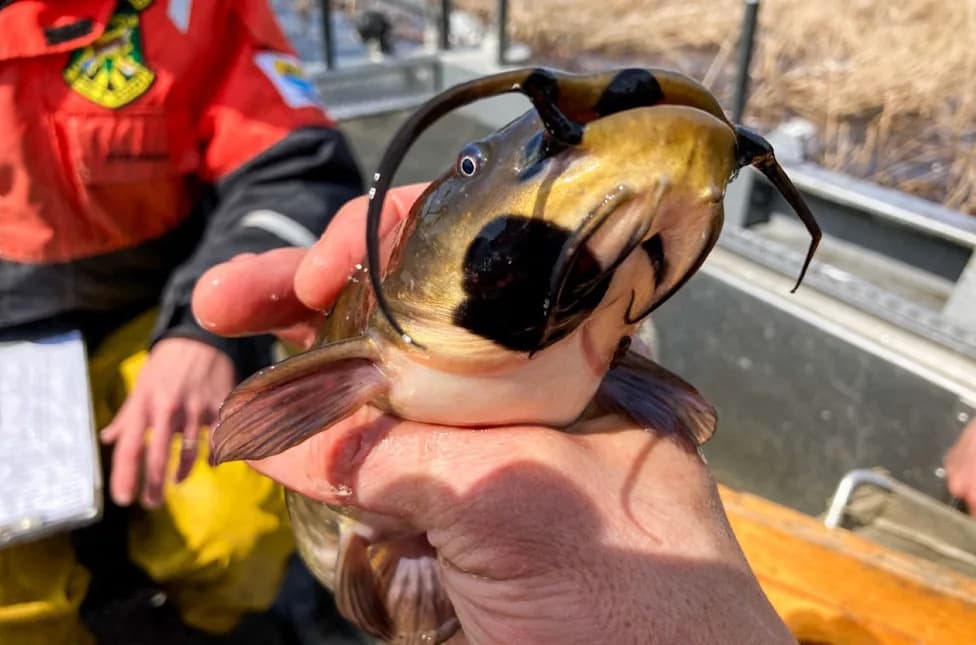
Image: Vermont Fish & Wildlife Department
Researchers studying brown bullhead catfish in Lake Memphremagog, on the Vermont–Quebec border, have identified a melanoma that appears to move from fish to fish as a single clonal cancer lineage rather than arising independently in each animal. This discovery marks the first confirmed transmissible cancer in any fish species, the first in a freshwater animal, and only the fourth naturally occurring transmissible cancer documented across the animal kingdom. There is currently no evidence the cancer poses a risk to humans.
What the Evidence Shows
Scientists first noticed black skin lesions on catfish in 2012 and initially considered environmental contamination or an infectious virus. Genetic sequencing told a different story: tumors taken from entirely different fish were far more genetically similar to one another than to their host fish. That genetic signature strongly indicates a single cancer cell lineage is spreading between individuals rather than independent tumors arising in each fish.
Key Findings
Prevalence: By 2014, surveys found roughly one-third of catfish in the affected area had visible lesions.
Chemical Signature: Tumor tissues contained elevated arsenic levels; researchers are investigating whether this is a cause, consequence, or unrelated accumulation.
Likely Transmission Route: Spawning season—when fish aggregate and make frequent physical contact—is the leading hypothesis for how the cancer spreads, although direct laboratory confirmation of transmission has not yet been demonstrated.
Environmental Causes Considered: Investigators tested for toxin exposure and examined the possible impact of a nearby landfill; water-quality testing and the broad distribution of affected fish across the lake make a single localized environmental trigger unlikely.
Reviewing scientists described the genetic evidence as "totally compelling" for a transmissible cancer, while noting that controlled experimental transmission still needs to be shown.
Why This Matters
The discovery expands our understanding of how cancer can behave in the wild. The most comparable example is Tasmanian devil facial tumor disease, which has devastated its host species. Whether the catfish melanoma will become similarly destructive is unknown; key open questions include how the cancer evades fish immune defenses, how long the lineage has been circulating, and whether the same cancer exists in bullhead populations beyond Lake Memphremagog.
Next Steps for Researchers
Planned research priorities include controlled laboratory transmission experiments, studies of fish immune responses to the cancer, and expanded regional surveillance to map its geographic distribution and prevalence. If transmissible cancers are possible in freshwater vertebrates, more species and water bodies may need screening.
Bottom line: This is an important, well-supported finding that raises new conservation and scientific questions. There is no known human risk, but the discovery fundamentally broadens the map of how cancer can spread across animals in nature.
Help us improve.