Lithuania has begun exhuming Soviet-era Red Army graves near Vilnius as part of a parliamentary "de‑Sovietisation" campaign adopted after Russia's 2022 invasion of Ukraine. Archaeologists in Vievis have uncovered remains and fragments of an "eternal flame" from a Soviet memorial many locals consider a propaganda symbol. Vilnius says relocations comply with Article 17 of the First Geneva Convention and that remains will be reinterred at a nearby Orthodox cemetery. Moscow has protested strongly and may raise the case in international courts, accusing Lithuania of discrimination.
Lithuania Exhumes Soviet Red Army Graves Near Vilnius in Drive to Bury Soviet Legacy
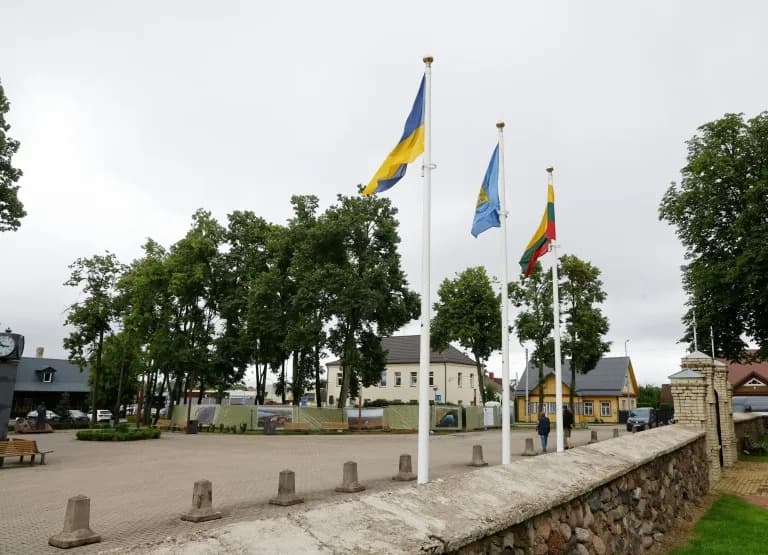
The excavation site in the city center of Vievis, Lithuania, is pictured on July 20, 2026 (Petras MALUKAS)
A wartime burial ground on the outskirts of Vilnius has become a fresh diplomatic flashpoint as Lithuania moves to remove the last visible symbols of Soviet rule. Archaeologists in Vievis are carefully excavating the skeletal remains of Red Army soldiers and dismantling relics of Soviet memorialization, part of a broader campaign Vilnius calls "de‑Sovietisation."
Excavations in Vievis
Teams led by chief archaeologist Tadas Simonauskas are sifting through clay-coloured soil to recover human remains and artefacts. Workers found a twisted fragment of a gas pipe — once part of an "eternal flame" installed by Soviet authorities to commemorate what Moscow still calls the "Great Patriotic War." For many Lithuanians, such monuments served a propaganda purpose and masked the realities of occupation.
"The memorial site served a propaganda purpose," Simonauskas told reporters on site. A local pensioner, Petras Martisius, said: "The memorial stood here to remind us that we were supposedly 'liberated' by the Soviets. They should have been moved earlier."
Legal And Political Context
Shortly after Russia's full-scale invasion of Ukraine in 2022, Lithuania's parliament enacted a "de‑Sovietisation" law clearing the way to remove remaining Soviet monuments and relocate graves. At the time, 157 Second World War–era Soviet burial sites were listed in the country's cultural heritage register; Vilnius has revoked protected status for four sites where plaques had reportedly been altered to inflate the number of burials.
Rita Kunceviciene, who oversees heritage objects at the Lithuanian Culture Ministry, said some plaques were changed to bolster a Russian narrative that Lithuanians do not honour their "liberators." Vilnius argues the relocations follow international standards and that remains will be reinterred respectfully in a nearby Orthodox cemetery.
International Reaction And Potential Legal Dispute
Moscow has strongly protested the exhumations, calling them an attempt to rewrite history and summoning Lithuania's envoy several times. Baltic journalists report the Kremlin may raise the issue in international litigation, accusing Lithuania of discriminating against ethnic Russians. "Russia is using the international arena as a way to spread its narrative that the Baltic states support nazism and discriminate against ethnic Russian minorities," said investigative reporter Indre Makaraityte.
Lithuanian officials point to Article 17 of the First Geneva Convention, which provides for subsequent exhumations, identification of remains and possible repatriation. Vaidas Andriejauskas of the Elektrenai municipality, which is overseeing the work, said: "This was merely a Soviet symbol marking their territory. We will rebuild a small monument for the soldiers at the cemetery — we are not destroying marks of their existence."
Where Relocations Have Begun
Lithuania began moving graves in July 2023 from Pumpenai, followed by Siauliai in April 2024 and Vievis in July 2024. The remains will be reburied in a nearby Orthodox cemetery after identification procedures are completed.
Context: The effort reflects a wider Baltic reassessment of Soviet-era symbols amid heightened security concerns after Russia's invasion of Ukraine and rising tensions between Moscow and the EU/NATO member states on NATO's eastern flank.
Help us improve.