Photons created in the Sun’s core don’t travel straight to the surface. Instead they undergo a "random walk," being repeatedly absorbed and scattered in the Sun’s dense interior, which greatly slows their outward progress. A 1992 recalculation by Mitalas and Sills, using a realistic density profile, found mean step lengths under 0.1 cm for much of the interior and extended the diffusion time to about 170,000 years. Once photons escape the photosphere they cross the 150 million km to Earth in roughly eight minutes.
Sunlight’s Long Journey: ~170,000 Years To Escape the Sun — Then 8 Minutes To Reach Earth
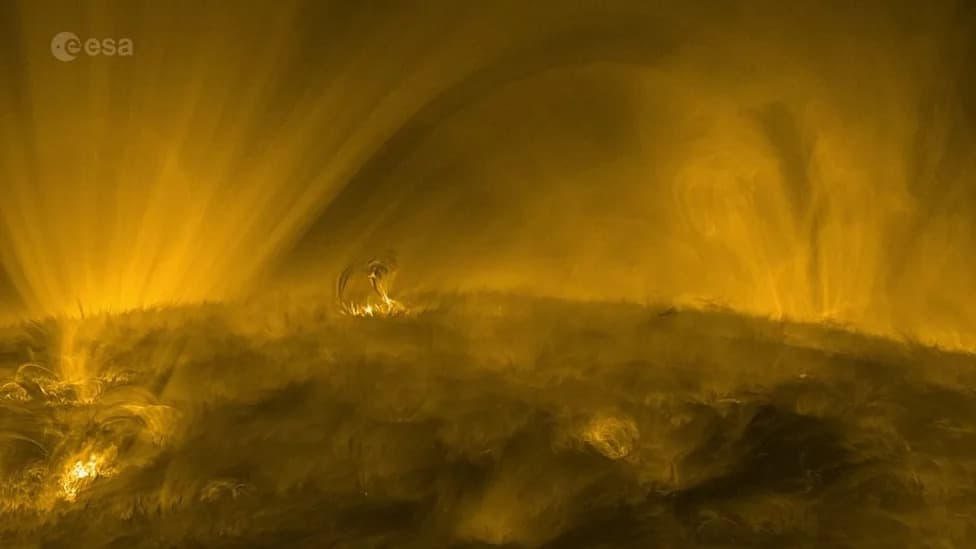
(ESA & NASA/Solar Orbiter/EUI Team)
Imagine leaving a crowded party where every few steps someone stops you for a hug, a story or a song recommendation. What should have been a short walk to the door stretches into an hour. That crowded-house analogy is a good way to picture how energy produced in the Sun’s core makes its way outward.
Random Walk Through a Dense Star
We often hear that sunlight reaches Earth in a little over eight minutes — the time it takes a photon to cross the roughly 150 million kilometres (93 million miles) of empty space between the Sun and Earth. But before photons make that rapid final dash, the energy created by nuclear fusion in the Sun’s core must work its way through an extremely dense, particle-packed interior.

YouTube Thumbnail
Rather than streaming straight outward, photons undergo a random walk: they are repeatedly absorbed, re-emitted or scattered by charged particles in the Sun’s hot plasma. Each time a photon interacts, it changes direction, so its path from the core to the surface is a long, zigzagging trek rather than a straight line.
Why It Takes So Long
If a photon could travel in a straight line from the Sun’s center to its surface (a distance of about 695,700 kilometres), it would cross that distance in roughly 2.3 seconds. In the Sun’s interior, however, the mean free path — the average distance a photon travels between interactions — is tiny, and varies strongly with depth because density and temperature change with radius.

YouTube Thumbnail
For decades many estimates assumed a nearly constant step length of about 0.5–1 centimetre, producing diffusion times of roughly 3,000–30,000 years. A 1992 paper by Romas Mitalas and Kenneth R. Sills (University of Western Ontario) showed that this simplification underestimates the effect of the Sun’s steep density gradient. Using a realistic solar density profile, they found the mean step length is less than 0.1 centimetre for more than half the Sun’s radius.
That apparently small change has a large effect on the diffusion time: recalculating with the varying density increases the estimated photon travel time from the core to the photosphere to on the order of 170,000 years. In other words, the energy we feel from sunlight likely began its random-walk journey hundreds of thousands of years ago.

Subscribe to ScienceAlert's free fact-checked newsletter
Then the Fast Lane
Once the photon reaches the Sun’s photosphere (the visible "surface"), the crowded conditions end. Photons then stream through vacuum and reach Earth in roughly 8 minutes and 20 seconds.
So when sunlight warms your face, the particular photons may have spent a very long time escaping the Sun before their short, rapid trip to Earth. That long internal journey likely began before the pyramids were built and perhaps before the last Ice Age.
Note: These figures describe typical diffusion times for energy transported by photons in the radiative zone. Other processes (convection) operate in outer layers and on different timescales. The 170,000-year estimate follows the corrected calculation by Mitalas & Sills (1992) using a realistic solar density profile.
Help us improve.