
New research shows the Sun could, in principle, produce a "superflare"—an eruption 100 to 10,000 times stronger than a normal solar flare—though such events would be extremely rare. Using AIA/SDO data (2010–2016), researchers linked sunspot area to flare-ribbon size and flare energy, then applied that relationship to historical sunspots. The Great Sunspot of 1947 covered about 0.6% of the solar disk (roughly 40× Earth’s diameter) and stored magnetic energy near the lower limit of the superflare regime. The Carrington Event (1859) and the 1947 spot emerge as the closest recorded near‑misses, underscoring risks to power grids and the need for continued space‑weather preparedness.
Earth Nearly Hit by a Trillion‑Bomb Superflare in 1947 — Could the Sun Do It Again?
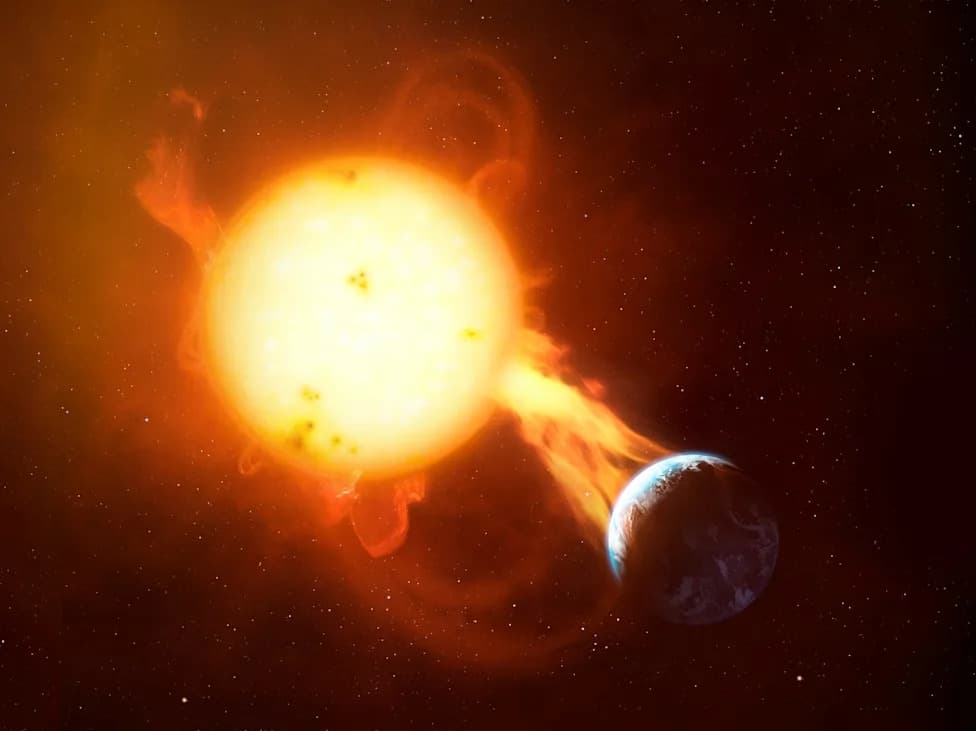
The Sun Could Unleash a Massive Superflare—SoonMARK GARLICK/SCIENCE PHOTO LIBRARY - Getty Images
New research suggests our Sun has the magnetic capacity to produce a "superflare"—an eruption 100 to 10,000 times more powerful than a typical solar flare—even though such events would be extremely rare. By linking sunspot size, flare-ribbon area and flare energy using modern observations, scientists found that the enormous 1947 sunspot carried enough stored energy to reach the lower edge of the superflare regime.
Why This Matters
Being a G‑type main‑sequence star with relatively low magnetic activity has been a major advantage for life on Earth and for our electronics‑based civilization. Even modest geomagnetic storms can induce currents that damage high‑voltage transformers and cause long regional blackouts. Understanding whether the Sun could ever produce a truly extreme event helps guide preparedness for power grids, satellites and communications systems.
"One failure could have a cascading effect across many of these networks," warns the United States Geological Survey (USGS). "Automated electronic functions could falter. Blackouts could affect not just neighborhoods, but entire regions."
What The Study Did
The team, including researchers at the Max Planck Institute and the University of Colorado Boulder, tested empirical relationships between active-region (sunspot) area, flare-ribbon area and released flare energy. They used Atmospheric Imaging Assembly (AIA) observations from NASA's Solar Dynamics Observatory covering 2010–2016 to calibrate how ribbon size scales with flare energy, and how sunspot area predicts ribbon area.
Applying the Model to History
With reliable sunspot records spanning about 400 years, the researchers applied those relationships to past large sunspots. Two events stood out: the Carrington Event of 1859 — long regarded as history's most powerful solar storm — and the Great Sunspot of 1947. According to the team's analysis, the 1947 spot covered roughly 0.6% of the solar disk (about 40 times Earth's diameter). The magnetic energy confined in a region of that size reaches the lower bound of what stellar studies call the superflare regime, even though the Sun ultimately did not produce a superflare in 1947.
"The 1947 spot, the largest in the last century, yields the highest possible flare energy within our framework," says Natalie Krivova, lead author from the Max Planck team. "This range overlaps with the lower limit of the superflare regime inferred from stellar statistics, suggesting that the Sun could, in principle, reach this level—albeit extremely rarely."
Context From Kepler
Large stellar surveys add perspective: a December 2024 analysis of 56,450 Kepler sun‑like stars found about 20% produced superflares during the observation window, with a nominal recurrence around once per century for those stars. Critics have argued that the apparent frequency may not directly apply to our Sun; this new work focuses on whether the Sun physically could reach that energy scale, not how often it would do so.
Implications And Next Steps
The result is sobering but not alarmist: the Sun appears capable, in principle, of producing a superflare, yet the combination of factors needed seems extremely rare. The study emphasizes the value of continued monitoring of solar magnetic activity, improved models of flare triggering, and practical mitigation planning for critical infrastructure such as power transformers, satellites and communications networks.
Bottom Line
The Sun almost came close in 1947. It didn’t erupt then, but the underlying magnetic potential existed. Preparing for low‑probability, high‑impact space‑weather events remains an important scientific and societal priority.
Help us improve.





















