Fermi Explorer plans to launch a small solar‑electric probe toward Alpha Centauri by the end of 2029, based on AI‑assisted trajectory analysis by Physical Superintelligence (PSI). The mission would use repeated close‑Sun perihelion burns to incrementally gain orbital energy, then coast for roughly 73,000–80,000 years to the Alpha Centauri system’s outer neighborhood. The design assumes a ~100–110 kg spacecraft with ≥1 kg payload and targets a cruise speed near 23.6 km/s. Launch and cost (target < $15M) depend on propulsion and thermal qualification and full peer review.
Fermi Explorer Proposes an 80,000‑Year Voyage to Alpha Centauri — Launch Target 2029
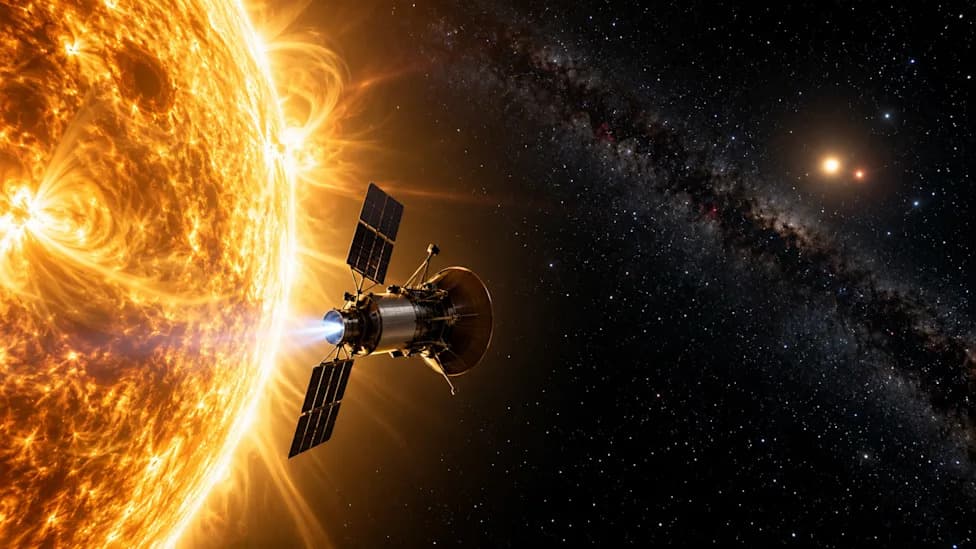
An AI-assisted mission plan could send a solar-electric spacecraft toward Alpha Centauri by 2029 on an 80,000-year journey. (CREDIT: Shutterstock)
Summary: A nonprofit, the Fermi Explorer Mission, backed by an AI analysis from Physical Superintelligence (PSI), has proposed launching a small solar‑electric probe toward Alpha Centauri before the end of 2029. Rather than exotic propulsion, the plan uses repeated close passes to the Sun to incrementally boost orbital energy and then coast on an interstellar trajectory that would take roughly 73,000–80,000 years to reach the target region.
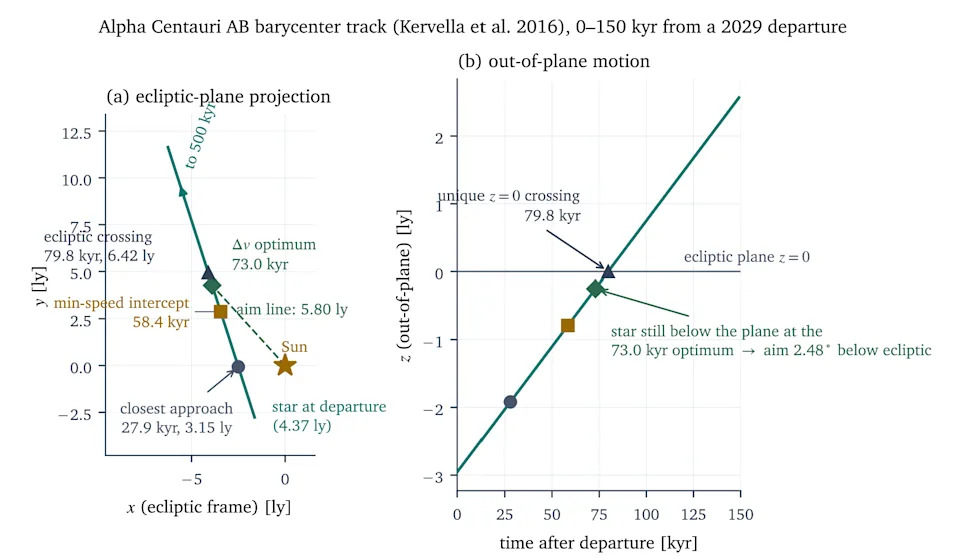
Approach geometry of the Alpha Centauri AB barycenter over the next 150,000 years. (a) Projection of the star's path onto the ecliptic plane, with the Sun, the aim line to the 73.0kyr intercept point, and the four characteristic epochs of Table 4 marked. (b) Out-of-plane coordinate 𝑓 versus time: the star currently sits about 3 ly below the ecliptic and crosses the plane 79,786 years from launch. (CREDIT: Philip Johnston et al, Physical Superintelligence PBC)
What the Plan Proposes
Fermi Explorer announced publicly that it intends to place a roughly 100–110 kilogram spacecraft on a deliberate trajectory toward the Alpha Centauri system. PSI’s July technical report—produced with AI‑assisted physics tools and supported by $58 million in seed funding led by Breakthrough Energy Ventures—identifies an optimal arrival epoch roughly 73,012 years after launch, with a useful energy window spanning about 67,000 to 80,000 years.
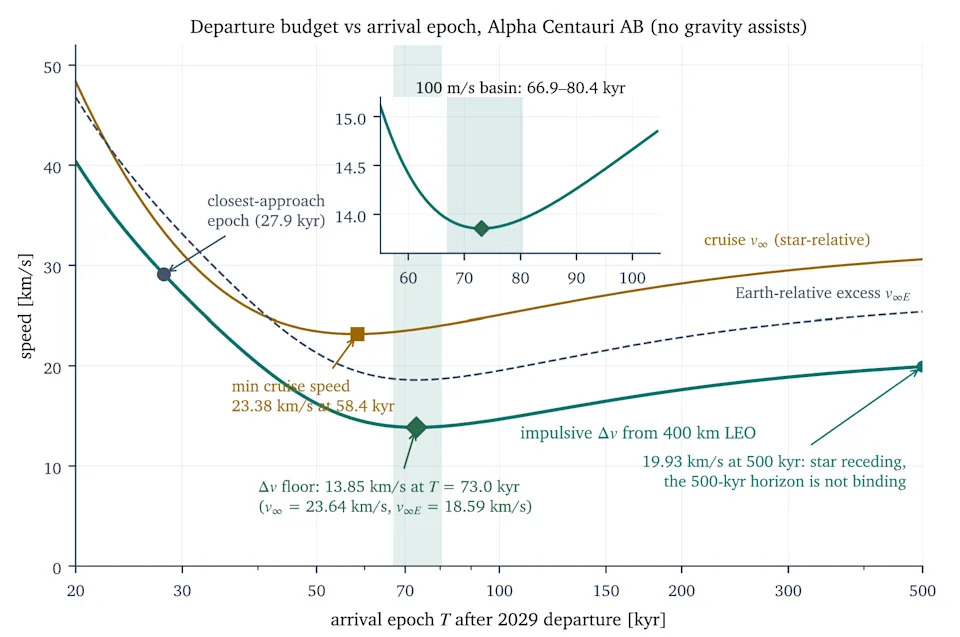
Departure budget versus arrival epoch. Impulsive Δ from a 400km low Earth orbit and required cruise v∞ as functions of arrival epoch on a logarithmic axis from 20 to 500kyr, with the optimum, minimum-cruise-speed, and closest-approach epochs and the 500kyr endpoint marked. (CREDIT: Philip Johnston et al, Physical Superintelligence PBC)
How the Trajectory Works
Alpha Centauri is about 4.365 light‑years away and is moving relative to the Sun, so the mission targets where the stars will be tens of thousands of years in the future. The architecture relies on:
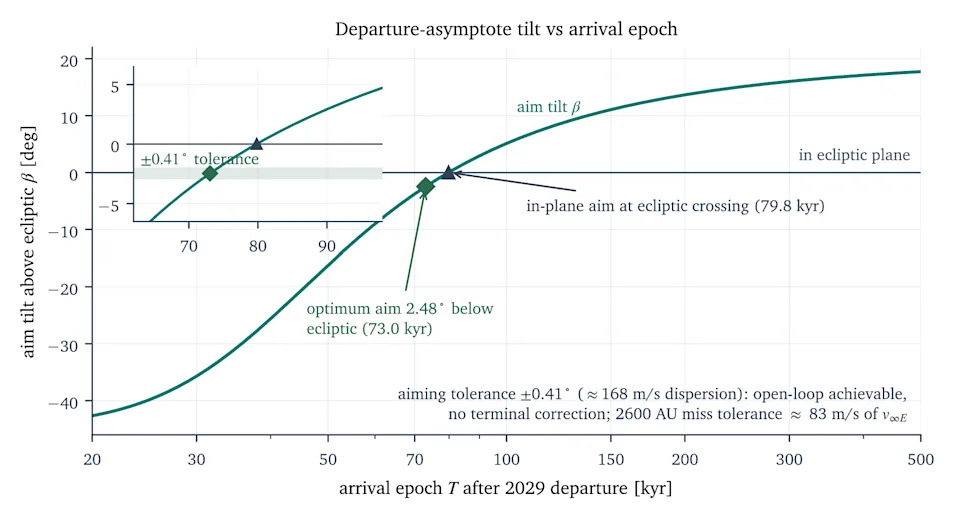
Departure aim tilt 𝑇 versus arrival epoch; the inset shows the ±0.41◦ openloop aiming tolerance band around the optimum. The vehicle borrows Earth's orbital velocity of 29.78 kms−1 in plane only, so the tilt directly prices the out-of-plane component of the departure asymptote. (CREDIT: Philip Johnston et al, Physical Superintelligence PBC)
- Solar‑Electric Propulsion: High‑efficiency, low‑thrust electric thrusters powered by solar arrays.
- Multi‑Revolution Perihelion Pumping: Repeatedly lowering perihelion to roughly 0.42 AU, where sunlight is several times stronger than at 1 AU, then firing the thruster near perihelion to maximize orbital energy gain.
- Long Passive Coast: After the initial delta‑v phase, more than 98% of the voyage would be an unpowered cruise through interstellar space.
The PSI analysis cites a required heliocentric cruise speed of about 23.64 km/s (post‑escape) and a best 12‑year electric‑propulsion delta‑v of roughly 23.98 km/s at the design thrust level. Fermi Explorer frames the mission as an ~80,000‑year journey that would pass within about 2,600 AU of the Alpha Centauri AB barycenter—effectively the system’s distant cometary neighborhood rather than a planetary flyby.
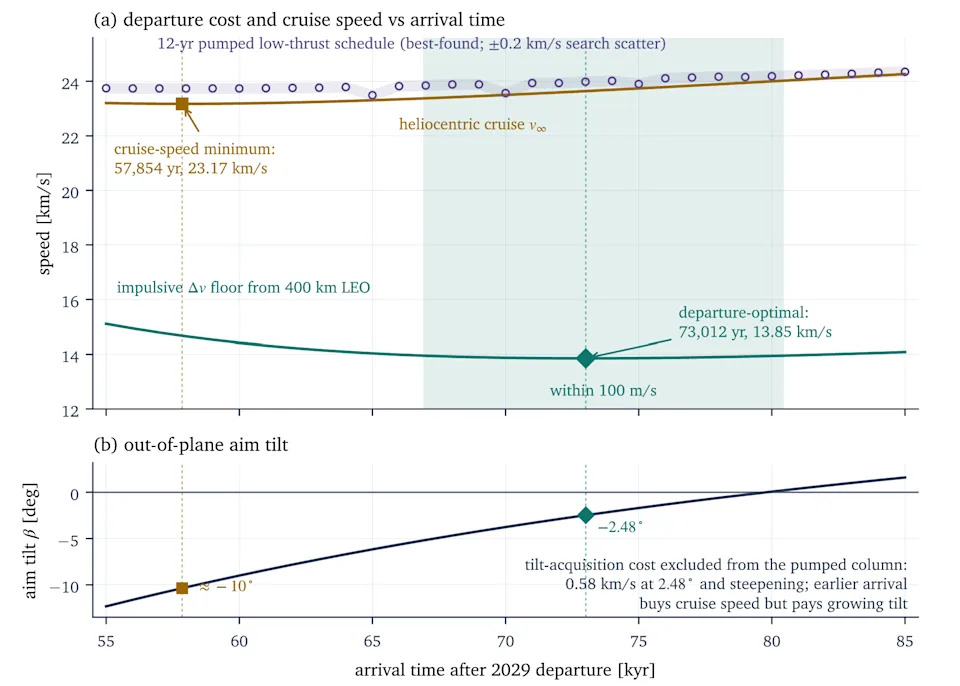
The arrival-epoch trade has two optima. (CREDIT: Philip Johnston et al, Physical Superintelligence PBC)
Spacecraft, Launch Options and Mass Budget
PSI found that a 100 kg probe launched directly into low Earth orbit would struggle to meet the mass and delta‑v budgets. Starting from a geostationary transfer orbit (GTO) reduces the Earth‑escape delta‑v requirement from about 7.6 km/s to ~4.24 km/s, enabling a feasible 100–110 kg spacecraft design with at least 1 kg of payload. Fermi Explorer says the payload would include scientific instruments, messages, and an artistic archive inspired by the Voyager Golden Records.
Engineering, Cost and Program Status
The concept deliberately avoids speculative technologies (gigawatt lasers or onboard nuclear engines) but faces significant engineering challenges: long‑duration thermal and power survivability during repeated close‑Sun passes, propulsion and thermal qualification, reliable systems for millennia of passive coast, and tight aiming tolerances. PSI reports staged internal and independent computational checks but notes the study has not undergone full human peer review.
Fermi Explorer publicly targets a program budget under $15 million; PSI analyzed a $10 million baseline and estimated conventional program costs of roughly $15.7–$16.6 million. The 2029 launch target is conditional on completing propulsion and thermal qualification work.
Context And Significance
The Fermi Explorer approach contrasts with Breakthrough Starshot, which aims to use powerful ground lasers to accelerate gram‑scale lightsails to ~0.2c and reach Alpha Centauri in decades. Fermi Explorer accepts an almost unimaginable travel time in exchange for using mature, near‑term technologies. Even if launched, the probe would likely be overtaken by faster probes developed centuries or millennia later—but its symbolic value would be profound: the first deliberate placement of human technology on a trajectory to another star using available technology.
Note: The mission remains conceptual. Detailed engineering work, full peer review of the trajectory and systems, and successful propulsion and thermal tests are required before a flight can be confirmed.
Further Reading
PSI’s technical report contains detailed trajectory plots, approach geometry diagrams and departure‑budget analyses. The study also cites relevant research on Alpha Centauri astrometry, solar‑electric propulsion development, and the Voyager missions as practical benchmarks.
Help us improve.