The article describes a new soft robotic left-heart that actively senses internal pressure and adjusts artificial muscle fibers to mimic the stiffening seen in heart failure with preserved ejection fraction (HFpEF). Published in Nature Communications, the silicone-based model reproduces multiple disease stages by dynamically changing chamber stiffness via pressure-feedback. The device offers a controllable platform between simple mechanical loops and animal models, potentially accelerating development of therapies and devices that target myocardial stiffening.
Soft Robotic Heart Recreates Mysterious Stiff-Heart Failure to Aid Research
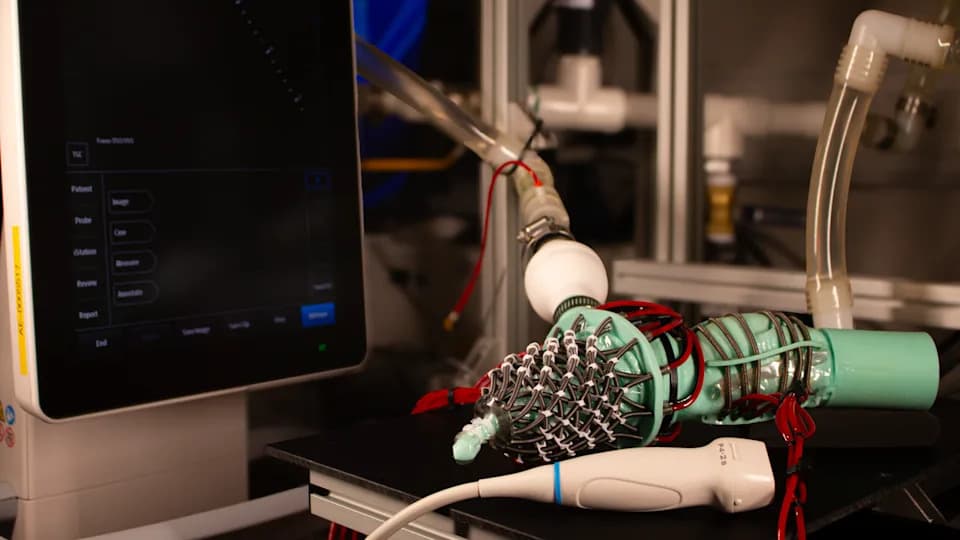
The silicone-based soft robotic heart uses artificial muscles to recreate different stages of heart failure. | Credit: Courtesy of Thanh Nho Do
Scientists have developed a soft robotic heart that offers a new experimental platform for studying a puzzling and common form of heart failure: heart failure with preserved ejection fraction (HFpEF).
What Is HFpEF?
HFpEF occurs when the heart pumps a normal proportion of its blood volume but the muscle becomes abnormally stiff and cannot relax and refill properly between beats. The condition affects more than 3 million Americans and remains poorly understood, which has hindered development of treatments that directly target the underlying mechanical stiffening of the heart.
How the Robotic Heart Works
Described June 1 in Nature Communications, the new device is the first soft robotic heart model that can actively change its mechanical response to pressure. The team molded a silicone replica of the left side of the human heart and wrapped it in artificial muscle fibers made from rubber tubing reinforced with spring coils. Pressure sensors continuously monitor the fluid pressure inside the chamber, and the system dynamically tightens or relaxes the artificial fibers in response.
This pressure-feedback loop lets researchers tune how stiff the chamber becomes by adjusting how much the fibers resist stretch as the heart fills. Earlier soft-robotic models reproduced beating movement but followed preset commands and could not adapt to changing internal conditions; this device closes that gap by allowing the prosthetic muscles to "feel" and respond to the pressures they generate.
Modeling Disease Progression
Rather than representing a single fixed state, the researchers used the device to reproduce multiple stages of HFpEF progression. In early stages, impaired relaxation between beats becomes apparent; in advanced stages, the chamber is so rigid that it cannot fill adequately before the next contraction. By simulating this trajectory, the model could help investigators test interventions designed to interrupt disease progression instead of only treating end-stage symptoms.
"HFpEF has been notoriously difficult to study and treat," said study co-author Thanh Nho Do, a biomedical engineer and associate professor at the University of New South Wales in Australia.
Why This Matters
Current laboratory approaches each have limits. Conventional mock circulation loops use rigid pumps and tubing that do not resemble a beating heart physically, while animal models capture living biology but are costly and do not always reproduce human-specific disease mechanics. The soft robotic heart offers a complementary, controllable platform that sits between simple mechanical simulators and complex biological systems.
Treatment for HFpEF presently focuses on symptom management and controlling associated conditions—such as high blood pressure, obesity and diabetes. Sodium–glucose cotransporter-2 (SGLT2) inhibitors have recently reduced the risk of hospitalization in many patients by helping remove excess fluid, but few therapies directly target myocardial stiffening. The researchers emphasize this work is an early proof of concept and plan to refine the models to better integrate with computer simulations, animal studies and clinical data.
Next steps: The team aims to develop more sophisticated robotic-heart models and use them to evaluate medical devices and therapies that could prevent or reverse the stiffening process central to HFpEF.
Help us improve.