Recent polls show Americans holding mixed views as the United States approaches its 250th anniversary. A Gallup survey found 77% believe the founders would be disappointed, while only 19% expect they would be pleased. Other polls report broad but cautious pride, worries about threats to free speech and the future of democracy, generational differences in national identity, and a partisan gap in interest in commemorations.
Most Americans Say the Founders Would Be Disappointed — Polls Show Mixed Feelings Ahead of the U.S. 250th
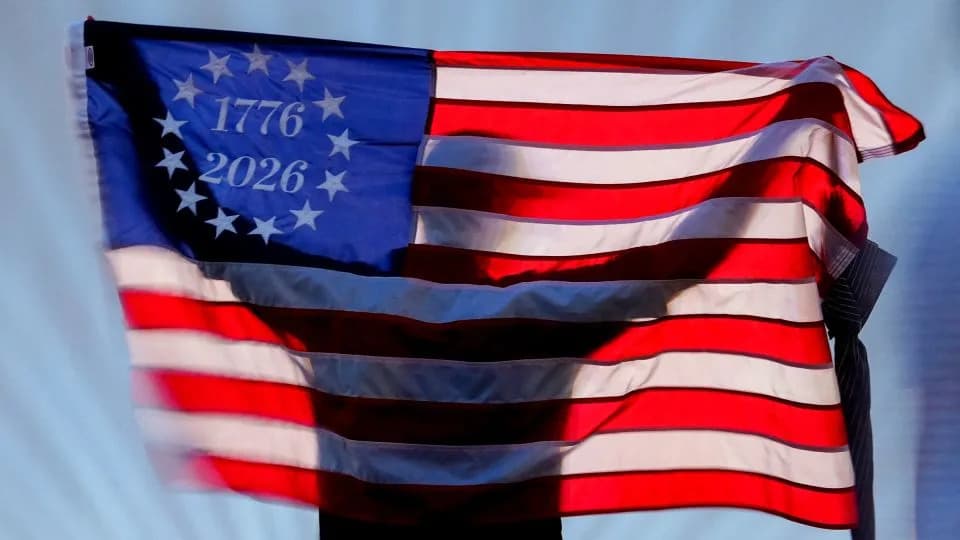
A spectator holds a US flag on the National Mall, during the UFC Freedom250 fight on the South Lawn of the White House, on June 14. - Aaron Schwartz/Bloomberg/Getty Images
A cluster of recent national surveys paints a complex picture of how Americans view their country as it approaches its 250th anniversary. A Gallup poll released this week found that 77% of respondents believe the signers of the Declaration of Independence would be disappointed with how the United States has turned out, while just 19% think the founders would be pleased. That outcome is the most negative Gallup has recorded on this question since it began asking intermittently in 1999.
What the Major Polls Reveal
Gallup: The sense that the founders would be disappointed is widely shared across the political spectrum. Republicans are slightly less pessimistic than Democrats, but no more than one-quarter in either party say the founders would be pleased.
“Our language is the same, our principles are the same, but this country is far more powerful, far more diverse, far richer in many respects than I think they could have ever imagined,” presidential historian Tim Naftali said. “We have surpassed the outer reaches of the most imaginative of them … I’m sure they would just find us rather fascinating.”
Marquette Law School: A Marquette survey released the same day shows 66% of Americans are at least somewhat proud of their country, though only a little more than half express optimism about the nation's future as a democracy. Interest in the semiquincentennial is moderate: 57% say they are at least fairly interested in the commemoration, but interest is sharply partisan — Republicans are 33 percentage points more likely than Democrats to be interested.
AP-NORC: An AP-NORC poll finds near-universal agreement that the right to vote and freedom of speech are central to U.S. national identity. Yet just under half of respondents — including a majority of Democrats — view freedom of speech as facing major threats today.
NBC and Other Long-Term Comparisons: Only 38% of U.S. adults in a recent NBC survey said they are confident the nation's best years lie ahead, down from 45% in a 1990 poll. Meanwhile, 78% say the American Dream is harder to achieve now than it was a generation ago — a result broadly consistent with a Roper poll taken more than 30 years ago.
Generational and Identity Differences
Polling by Ipsos earlier this year shows that views on national identity vary by age. Half of U.S. adults overall — and most people aged 45 and older — say being American is an important part of how they see themselves. Younger adults were more likely to say national identity is not something they think about often. When asked how the nation's story should be told, respondents were equally likely (58%) to say it's important to discuss both the country's successes and its flaws.
Historical Context
Public nostalgia for early moments in U.S. history is not new. In a 1947 Gallup poll, 13% of Americans said they would most like to have been present at the signing of the Declaration of Independence — the single most popular choice, and more than three times the share who would have preferred to witness the Gettysburg Address or Japan's World War II surrender.
What This Means Ahead of the 250th
The polls together suggest a nuanced national mood: broad pride mixed with persistent doubts about the country's direction and its ability to live up to founding ideals for all citizens. Concerns about democratic institutions, generational differences in national identity, and partisan divides over celebratory interest indicate the semiquincentennial will be commemorated in a politically charged environment.
For readers: these surveys do not predict a single national view but map competing attitudes — pride, skepticism, nostalgia and guarded optimism — that will shape how Americans remember and discuss the country's past and future as the 250th anniversary unfolds.
Help us improve.