The University of Birmingham team led by Professor Giovanni Barontini created a closed quantum “mini‑universe” from roughly 24,000 ultracold rubidium atoms and split it into observable “bright” and unobserved “dark” sectors. They defined an internal clock from entropy changes in the bright sector: entropic time advanced when entropy flowed and stalled when it did not. By reformulating the Schrödinger equation in terms of entropic time and validating numerical solutions against measurements, the experiment shows that an entropy‑based internal time can order events and support predictive quantum dynamics.
Ultracold “Mini‑Universe” Uses Entropy to Tell Time Without a Clock
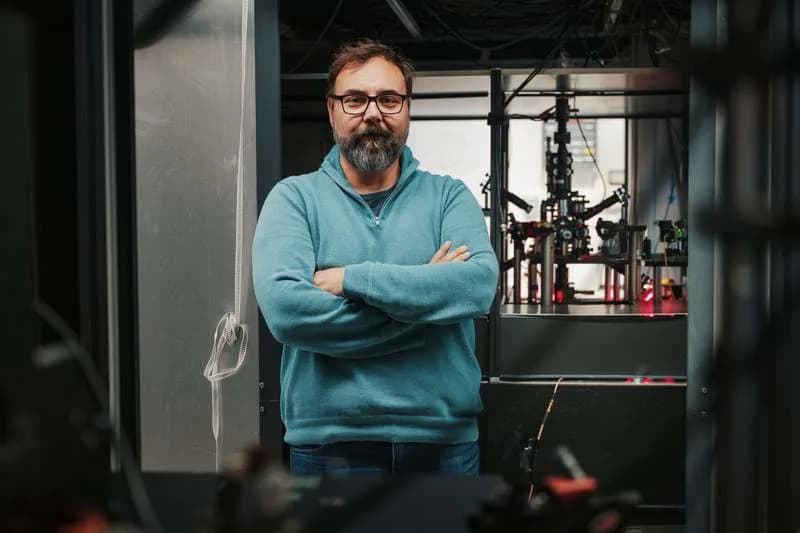
Giovanni Barontini, Professor of Physics, at the University of Birmingham, with the apparatus to trap and cool rubidium atoms in the background. (CREDIT: University of Birmingham)
A trapped cloud of ultracold atoms provided a laboratory test of a deep theoretical idea: could time emerge from internal changes inside a closed system, rather than from an external ticking clock? A team led by Professor Giovanni Barontini at the University of Birmingham built a tightly isolated quantum “mini‑universe” of about 24,000 rubidium atoms cooled to a few billionths of a degree above absolute zero to find out.

Giovanni Barontini, Professor of Physics, at the University of Birmingham, using the apparatus to trap and cool rubidium atoms. (CREDIT: University of Birmingham)
How the Experiment Worked
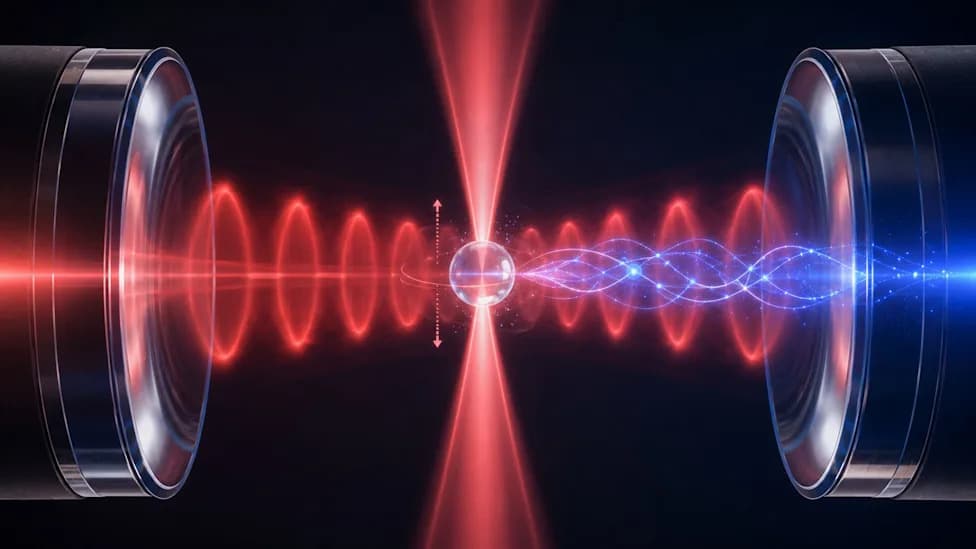
The researchers began with a Bose‑Einstein condensate (BEC), a quantum state in which atoms behave collectively. They confined the condensate in an optical dipole trap and projected a narrow light barrier that split the system into two regions: a bright sector that they imaged and a dark sector that remained deliberately unobserved. Atoms could tunnel between the two sectors while the overall system remained effectively isolated from the environment.
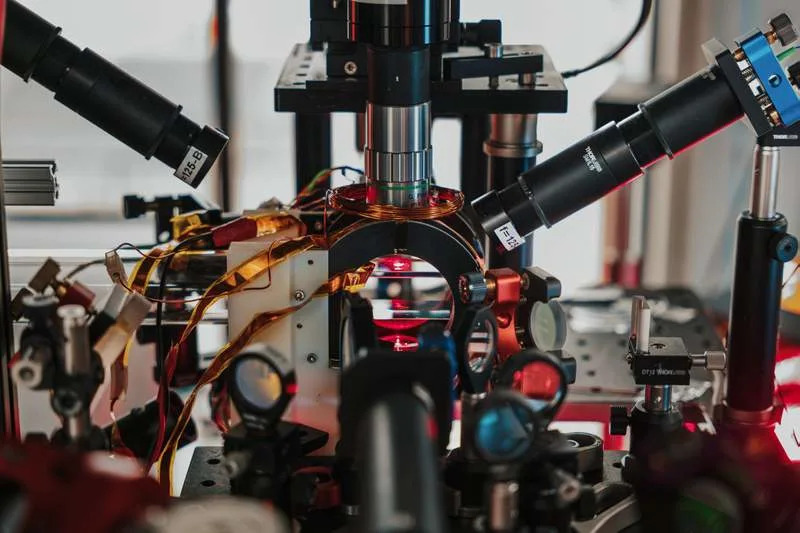
The ‘cloud’ inside the glass cell is a magneto-optical trap of rubidium atoms at a temperature of ~0.0001 degrees above absolute zero. It is only the first step to “build” the mini-universe. (CREDIT: University of Birmingham)
Over observation windows of roughly 100–120 milliseconds, the bright sector repeatedly expanded and contracted as atoms flowed in and out — a cyclic behavior the team likened to repeated miniature “big bangs” and “big crunches.” The group recorded images every 2 milliseconds and repeated runs while varying the barrier height that controls particle and entropy exchange.
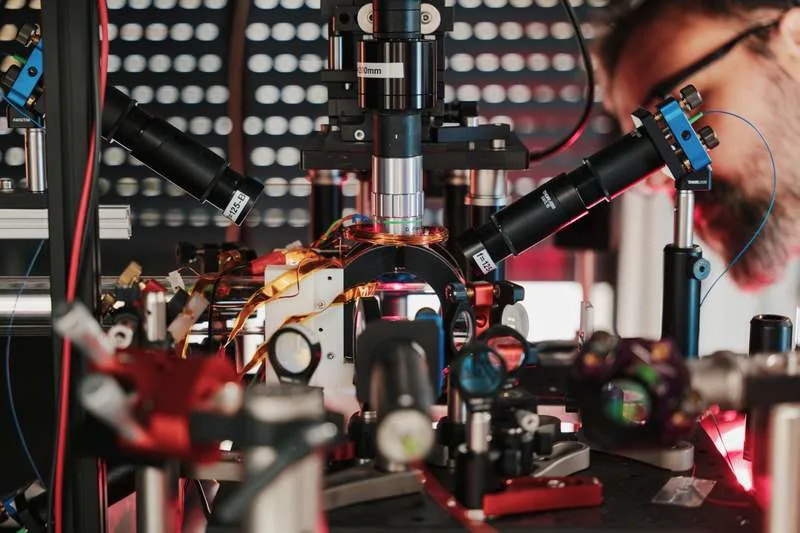
The University of Birmingham experiment to trap and cool rubidium atoms close to absolute zero. (CREDIT: University of Birmingham)
Defining Time From Inside the System
A conventional internal clock candidate — such as the center‑of‑mass position in the bright region — failed because it reversed when the region recollapsed. Instead, Barontini and colleagues defined an internal time from entropy: the spreading, or disorder, of atoms in the bright sector as they exchanged with the dark sector. When that entropy changed, the team treated the system’s internal clock as advancing; when the distribution stopped changing, the internal clock effectively stopped.
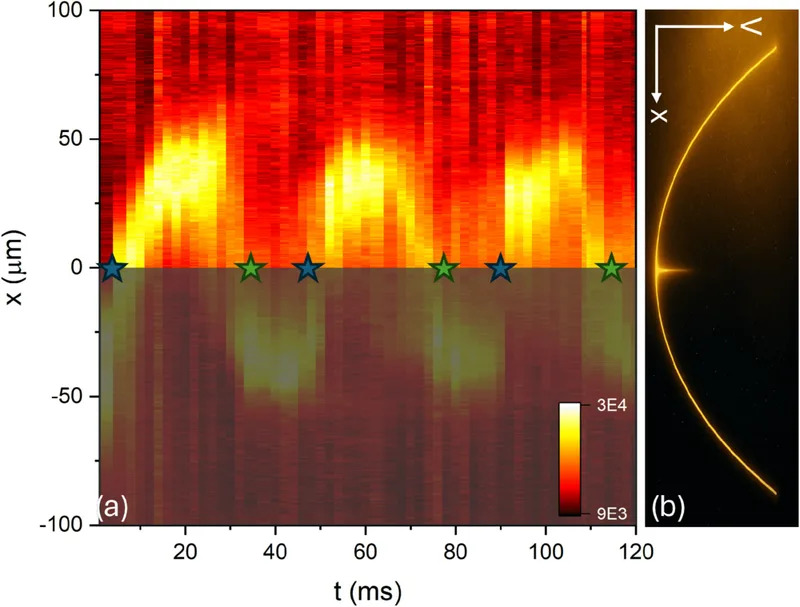
Experimental absorption images integrated along the y axis showing the evolution of our system as a function of the external laboratory time. The color scale indicates the integrated column density in arbitrary units. (CREDIT: Physical Review Research)
“In some formulations of the universe, particularly in quantum gravity, time does not appear as an explicit parameter. Yet our daily experience shows a clear flow from past to future — how does that directional ordering arise?” — Professor Giovanni Barontini
Key Observations
The data showed that this entropic time increased monotonically in nearly all experimental conditions. Its rate relative to lab time depended on how much entropy flowed: strong exchange produced a faster internal clock, while when no entropy crossed the barrier the entropic clock paused. In some runs the bright sector continued cycling by lab time but, according to the entropic clock, there were intervals with no passage of time at all. At high barrier settings the system relaxed toward a stationary, “heat‑death” state in which entropic time effectively stopped.
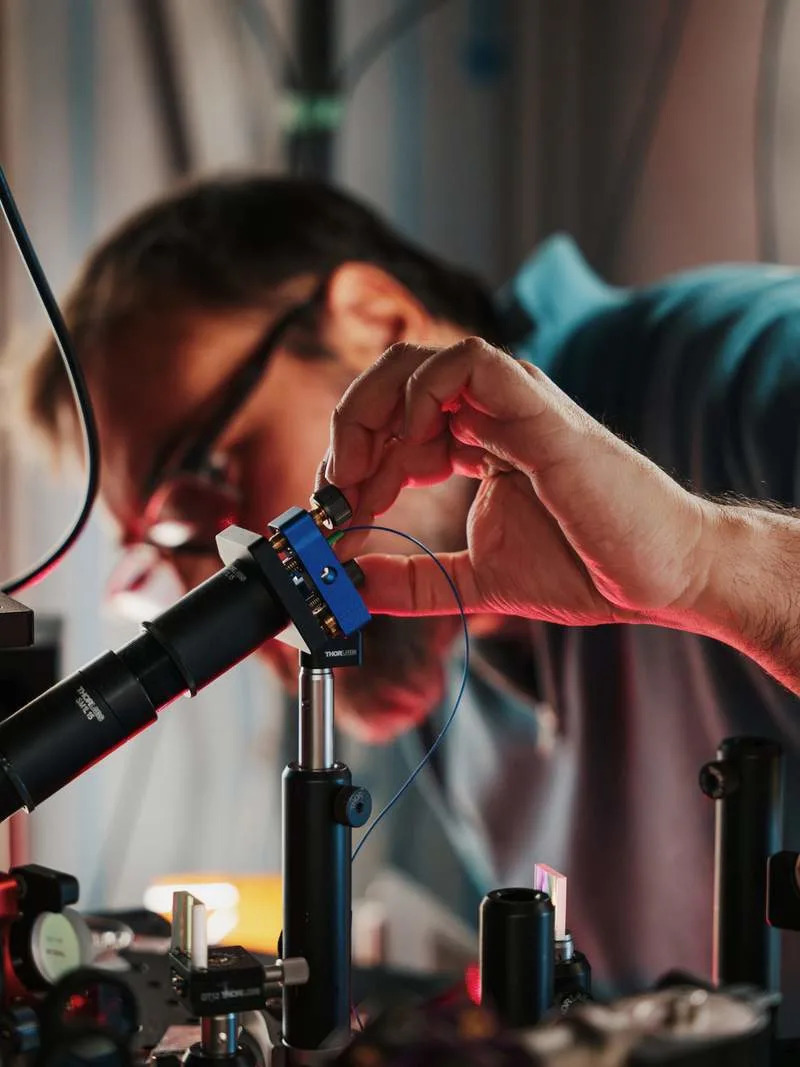
Optics to deliver the lasers on the atoms. (CREDIT: University of Birmingham)
Theory and Validation
Going beyond measurement, the team reformulated a version of the Schrödinger equation using entropic time in place of laboratory time. They derived an entropic‑time Schrödinger equation for the bright sector, solved it numerically, and found that the simulations closely reproduced experimental behavior — including the changing width of the bright region during expansion and contraction.
Why It Matters
The experiment does not claim to resolve the longstanding “problem of time” in physics, but it translates a philosophical and theoretical puzzle into controlled laboratory practice. The result demonstrates a concrete mechanism by which an internal observer could recover ordering, direction, and change in a timeless description such as those based on Wheeler–DeWitt frameworks. It also leverages thermodynamic asymmetry — the tendency of entropy to increase — to produce a practical arrow of time inside an isolated quantum system.
Cold‑atom platforms have already simulated exotic phenomena like black‑hole horizons and false‑vacuum decay. This work adds a new capability: an experimentally tunable testbed for ideas from quantum cosmology and quantum gravity. Future experiments could probe reversibility, singularities and bouncing cosmologies, comparisons of competing internal clocks, and laboratory analogues of black holes.
Caveat: A tabletop condensate is not a literal miniature universe, but it can meaningfully test whether deep theoretical ideas about time, change, and cosmic history hold up under experiment. The research is published online in Physical Review Research.
Help us improve.