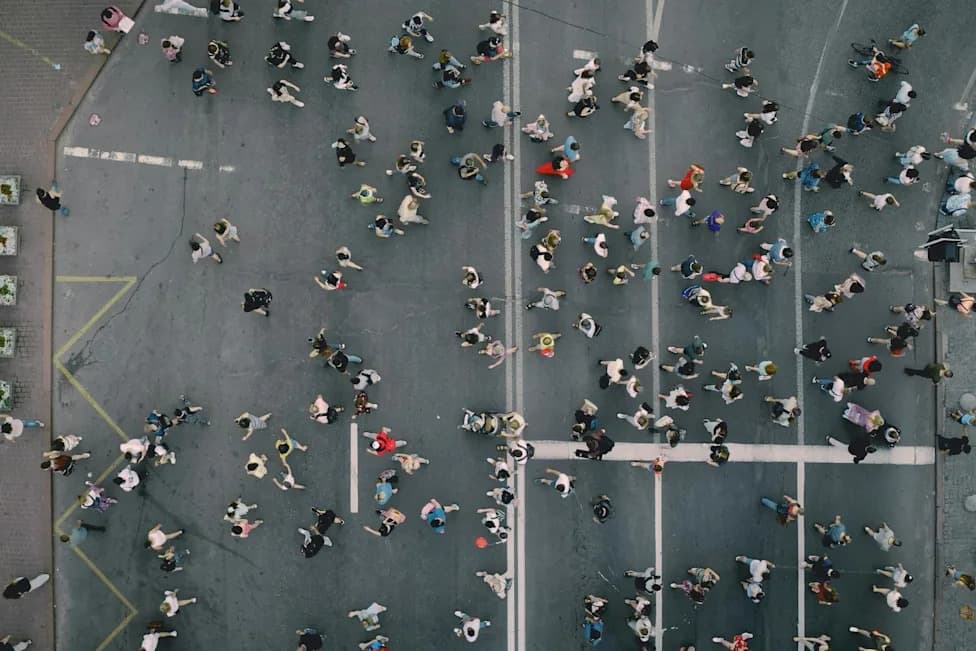
The study found a modest but statistically significant preference for counterclockwise (left) turns when people walk freely. Experiments in Spain and Japan — including a controlled trial with 209 individuals walking alone in a hexagonal enclosure — ruled out crowd influence, handedness, sex and simple vision explanations. Younger people showed a stronger leftward bias, and researchers suggest a biological or biomechanical cause deserving further study.
Why Humans Tend To Turn Left: Global Study Finds A Small But Significant Counterclockwise Bias
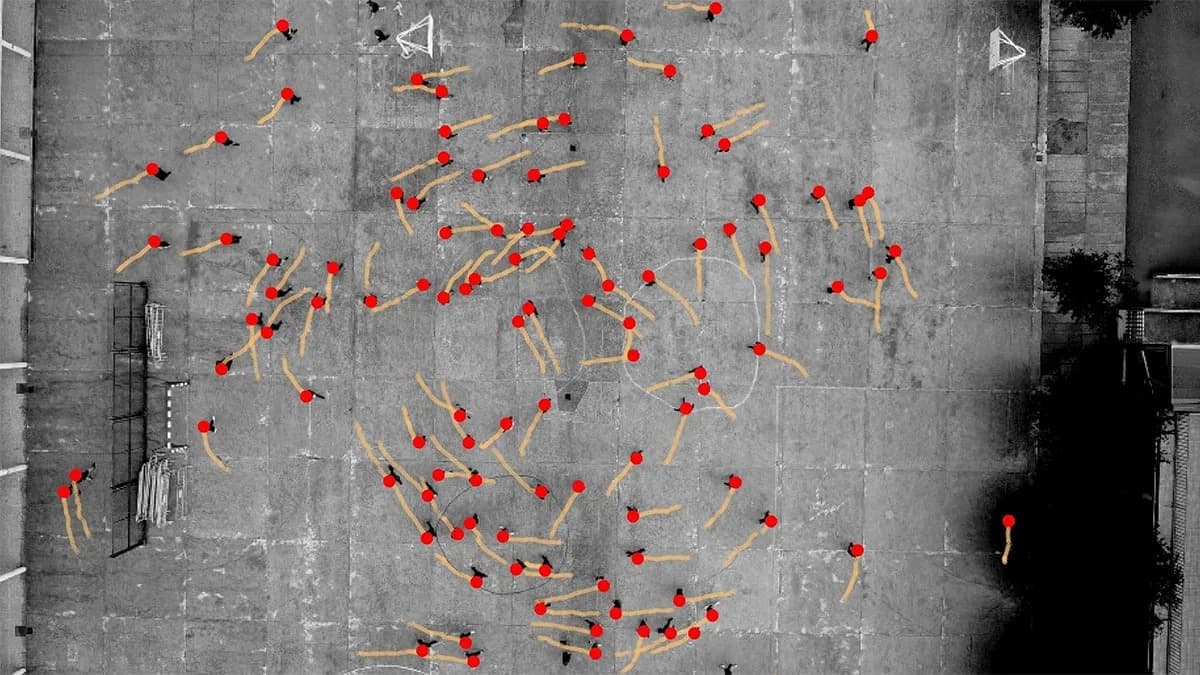
A still image from one of the experiments, showing position of people (red dots) and recent movement (the orange lines). (Echeverría-Huarte et al. CC-BY-ND)
Imagine strolling through a park or wandering a festival without a set destination. Do you veer left more often than right? An international team of researchers has found a modest but consistent preference: people tend to turn counterclockwise (left) when walking freely.
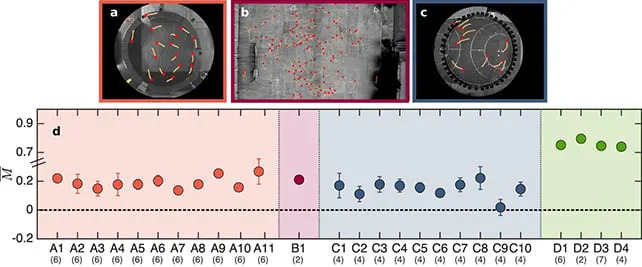
Experiments were carried out in different countries, with different people, in different settings – and the counterclockwise bias (the dots above the zero line) was consistently present. (Echeverría-Huarte et al.,Nat. Comm., 2026)
What the Researchers Did
The team ran experiments in Spain and Japan to capture behaviour across different cultural settings and environments (open and enclosed). To remove crowd effects, they included individual trials: in one controlled test, 209 participants were asked to walk alone inside a hexagonal enclosure made from chairs and tables. The study focused primarily on younger adults (no participants older than their mid-30s).
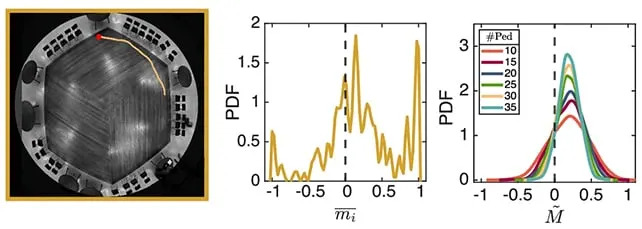
Individual tests again showed a counterclockwise bias (the graphs bunching to the right of the neutral zero). (Echeverría-Huarte et al.,Nat. Comm., 2026)
Key Findings
Across conditions the researchers observed a statistically significant counterclockwise turning bias. This tendency was not explained by dominant hand or foot, biological sex, or simple vision effects — the bias persisted when people had either the left or right eye patched. The only factor that produced a noticeable difference was age: younger participants showed a stronger leftward tendency.

YouTube Thumbnail
"This was completely unexpected. But there was a definite, measurable tendency for people to turn counterclockwise over clockwise, all things being equal," said engineer Claudio Feliciani, who was based at the University of Tokyo during the study.
What It Might Mean
While the cause remains uncertain, the experiments rule out several obvious explanations and point toward a biological or biomechanical origin. Large-scale forces such as the Coriolis effect or Earth’s magnetic field are unlikely to explain the result. The authors note similar informal observations — for example, many concert circle pits and some sporting courses tend to run counterclockwise.

Subscribe to ScienceAlert's free fact-checked newsletter
Practical Implications and Next Steps
Even a small directional bias can influence crowd flow in places like airports, stadiums, museums and train stations, and could inform better architectural design and emergency-evacuation planning. The researchers propose further work using virtual reality to control sensory inputs precisely, studies that include older adults and people with mobility differences, and investigations into whether other species show comparable turning preferences.
Publication: The study is published in Nature Communications.
Help us improve.