Quick summary: Researchers observed that crowds and individuals show a strong anticlockwise (leftward) turning bias. Across five years of experiments — indoors, outdoors, across cultures and ages, and in isolated walkers — the leftward tendency persisted. The effect is not explained by walls, cultural conventions or handedness; tiny vestibular asymmetries are a leading but unproven hypothesis. The finding affects how we model pedestrian flows and design public spaces.
Why Most People Turn Left When They Walk — And Scientists Still Don't Know Why
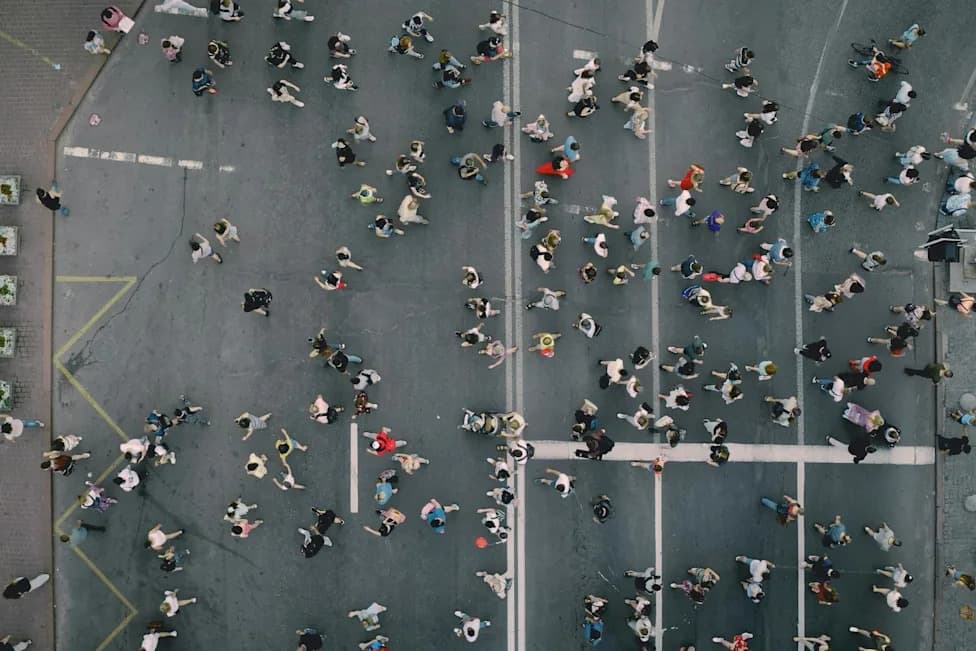
Goinyk Production/Shutterstock
In 2020, researchers noticed a strange, consistent pattern while studying pedestrian movement under social‑distancing rules: groups allowed to wander inside a bounded area tended to rotate, almost always anticlockwise, and few participants seemed aware of it. That unexpected observation launched a five‑year investigation into why humans favor leftward turns.
From Anecdote to Experiment
The phenomenon is simple to observe: put a crowd in a closed space with no clear destination and, over time, the group slowly develops a leftward swirl. Physicists call such patterns "emergent behavior" — collective effects that arise from many small interactions. The researchers tested two broad causes: interactions with the environment (walls) and interactions between people.
Did Walls Or Handedness Cause It?
A prior neuroscience study suggested a subtle link between handedness and turning preference: right‑handers lean left and left‑handers lean right. To explore this, volunteers were first asked to walk straight to a wall and choose which way to turn. Knowing each person’s bias allowed the team to assemble groups dominated by left‑ or right‑turners.
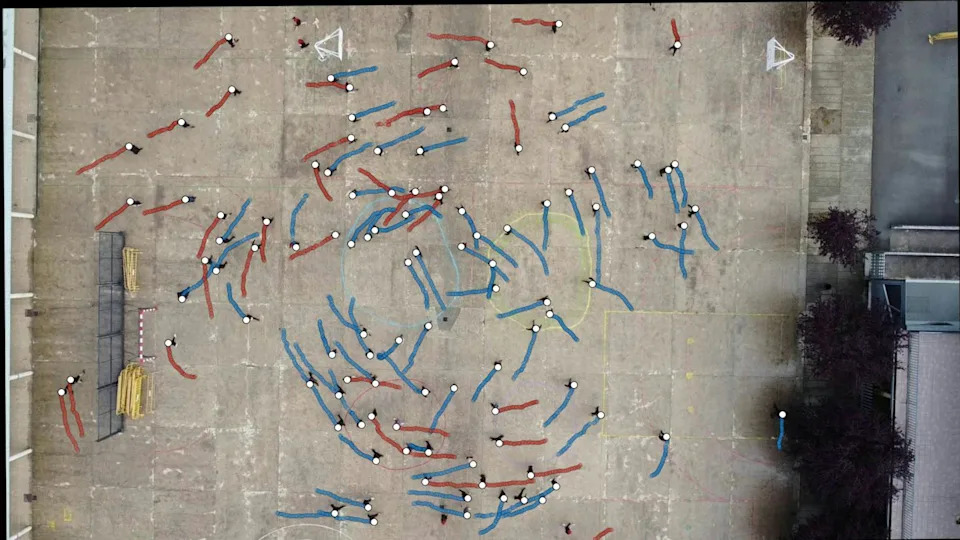
An image from one of our studies, where the general trend towards a counterclockwise spiral (in blue) can be clearly seen. Author's own
If walls amplified individual turning preferences, groups of right‑turners should have produced clockwise rotation. They did not. The anticlockwise bias persisted regardless of the mix of turning preferences or handedness.
What About Open Spaces?
To rule out walls entirely, researchers moved the experiment outdoors to a 3,000 m² school playground and released more than 100 teenagers to wander freely. The leftward rotation not only survived without boundaries, it became stronger — showing that walls were not the main cause.
Social Habits And Cultural Norms
Another idea was that local pedestrian conventions — the side people habitually dodge on when passing others — drive the effect. In many European countries people tend to step right; in Japan people generally step left. If such conventions determined group rotation, Japanese crowds should rotate clockwise.

When the experiment was repeated in Tokyo, the result contradicted that hypothesis: Japanese groups also rotated anticlockwise. The team also studied nursery‑school children, who have had little time to absorb adult cultural habits; their leftward tendency was actually the strongest observed.
An Individual Bias
With environmental and social explanations largely excluded, attention turned to purely individual causes. More than 200 volunteers walked alone in an empty arena; even in isolation a clear majority showed anticlockwise motion. Feeding single‑walker data into a computational model reproduced the crowd swirl, indicating the group pattern arises directly from individual biases rather than emerging from social interactions.
Still No Clear Cause
The researchers tested correlations with handedness, dominant foot, dominant eye, sex and other candidate factors and found none that explained the effect. Experiments with blindfolded walkers, who often drift in circles, hint at a deeper origin — perhaps tiny asymmetries in the vestibular (inner ear) system that slightly distort one’s sense of straight‑ahead — but no definitive mechanism has been identified.
Why It Matters
Knowing the bias is intrinsic to individuals rather than produced by crowds matters for modeling pedestrian flow and designing public spaces such as airports, train stations and museums, where efficient movement matters. Similar leftward tendencies appear across other species — schooling fish and army ants show related spiralling behaviors — suggesting the underlying cause may be evolutionarily old.
Bottom line: A robust anticlockwise bias appears in lone walkers and in crowds worldwide, yet its root cause remains an open scientific puzzle.
Originally published in The Conversation. Research funding acknowledgments: Iñaki Echeverría Huarte and Iker Zuriguel Ballaz received funding from project PID2023‑146422NB‑I00 (MICIU/AEI/FEDER). Angel Garcimartín Montero received funding from the Agencia Estatal de Investigación.
Help us improve.