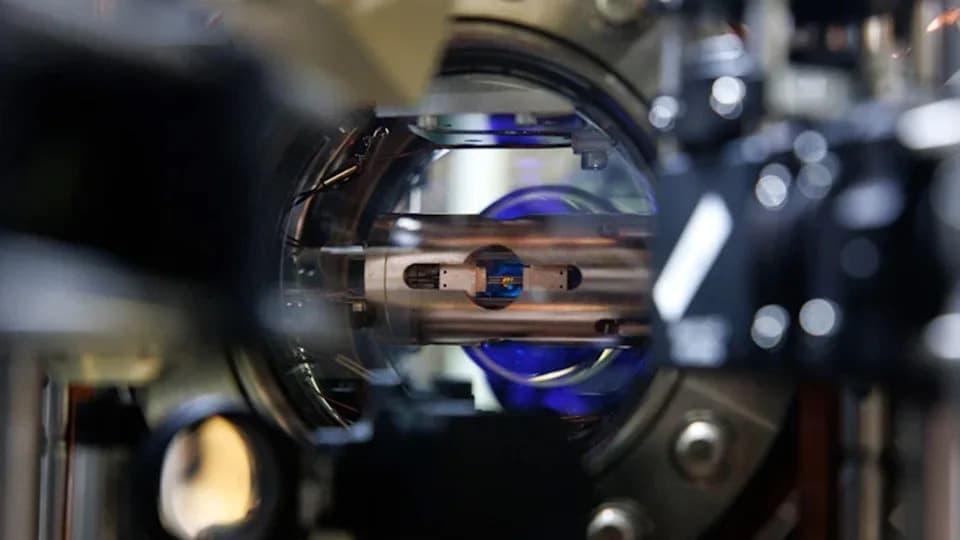
Researchers have built and demonstrated the first working nuclear clock using thorium-229 nuclei driven by vacuum-ultraviolet lasers. The thorium-229 isomeric transition lies at about 8.4 eV and was excited while embedded in a calcium fluoride crystal. The prototype does not yet surpass the best optical atomic clocks, but its validated architecture points to future gains in long-term stability and unique applications in searching for ultralight dark matter and probing shifts in fundamental constants.
World's First Nuclear Clock Ticks: Laser-Driven Thorium-229 Timekeeper Demonstrated
Researchers have demonstrated the first working nuclear clock, using laser-driven transitions inside the nucleus of thorium-229 to generate a stable time signal. Unlike conventional atomic clocks that monitor electron energy levels, this device exploits a uniquely low-energy nuclear isomeric transition that can be addressed with vacuum-ultraviolet light.
How the Nuclear Clock Works
The key is thorium-229, whose ground and isomeric nuclear states are separated by about 8.4 electron volts (eV) — an unusually small energy gap for a nuclear transition and one that lies within reach of ultraviolet lasers. A team at JILA (a joint institute of the University of Colorado Boulder and NIST) measured the transition frequency in 2024 with sufficient precision to allow direct laser excitation.
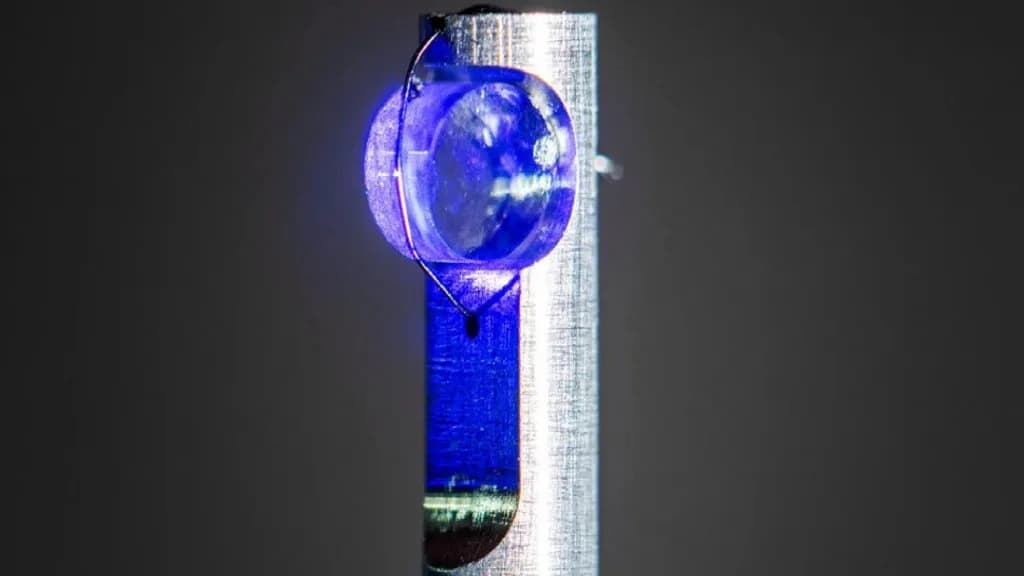
In the demonstration, thorium-229 nuclei were embedded in a calcium fluoride (CaF2) crystal that is transparent at the required wavelength. Researchers used vacuum-ultraviolet excitation to repeatedly drive and interrogate the nuclei. The clock signal arises from the coherent, periodic absorption and emission of photons by many nuclei oscillating together, which improves the readout signal and measurement statistics.
Why This Matters
Because a nucleus is thousands of times smaller than an electron orbit, nuclear energy levels are far less sensitive to external electromagnetic disturbances. That reduced sensitivity could allow nuclear clocks to achieve superior long-term stability compared with present electron-based optical clocks once technical challenges are overcome.
The prototype is not yet more accurate than the best optical atomic clocks. The team notes that improvements — including narrower laser linewidths, higher-quality host crystals, and better control of systematic shifts — should raise the clock's precision in future iterations.
Broader Scientific Opportunities
Thorium-229 nuclear clocks also open new avenues for fundamental physics. Because nuclear levels couple directly to the strong and weak forces as well as electromagnetism, such clocks are sensitive to certain variations in fundamental constants (for example, the fine-structure constant) in ways electron-based clocks are not. This sensitivity makes them promising instruments to search for ultralight dark matter candidates that could produce tiny, periodic fluctuations in constants as Earth moves through a dark matter field.
Comparing a thorium-229 nuclear clock against high-performance optical atomic clocks over time can reveal oscillations or slow drifts in fundamental constants, testing ideas about dark matter, dark energy and whether fundamental constants evolve over cosmological timescales.
Overall, the JILA demonstration validates the nuclear-clock architecture and marks a major milestone toward a new class of timekeepers with unique scientific applications.
Help us improve.