The Education Freedom Tax Credit gives taxpayers a dollar-for-dollar federal credit (up to $1,700) for donations to approved scholarship-granting organizations (SGOs). While the credit has been promoted as a means to expand private school choice, experts and nonprofits argue SGOs could also direct funds to district public schools for tutoring, afterschool programs, supplies and enrichment. Critics warn the program could divert public dollars to private education and widen disparities unless Treasury and states impose strict guardrails. Final rules and state opt-in decisions will determine how broadly public schools can benefit.
‘A Sea Change’: How a New Federal Tax Credit Could Channel Dollars to Public Schools

Federal, state and local revenues have long been the three primary funding sources for U.S. public school districts. Now experts say district leaders should start planning for a possible fourth source: the federal Education Freedom Tax Credit, created last year as part of legislation known colloquially as the One Big Beautiful Bill Act.
How the Tax Credit Works
Beginning next year, taxpayers who donate to an approved scholarship-granting organization (SGO) can receive a dollar-for-dollar federal tax credit up to $1,700. SGOs have historically directed scholarships to private and religious schools, but under this program they could also be structured to support students enrolled in district-run public schools.
Why Some Public-School Supporters See Opportunity
Marguerite Roza, director of Georgetown University’s Edunomics Lab, argues the credit could benefit district schools because 90% of U.S. children and their families have experience with public schools. Rather than solely fueling private school enrollment, SGOs could fund tutoring, afterschool and summer learning programs, supplies, field trips, technology and other enrichment that many local education foundations already try to provide.
“These SGOs could have broader appeal to the average taxpayer,” Roza said during a recent webinar.
Early Moves, Pilots and Nonprofit Plans
Several nonprofits and foundations are already positioning themselves to become SGOs. EducationSuperHighway, for example, has shifted toward offering scholarships for high-quality literacy tutoring for first graders who are behind in reading. Other groups, including the Afterschool Alliance, have outlined plans to use the credit to expand afterschool and summer learning opportunities.
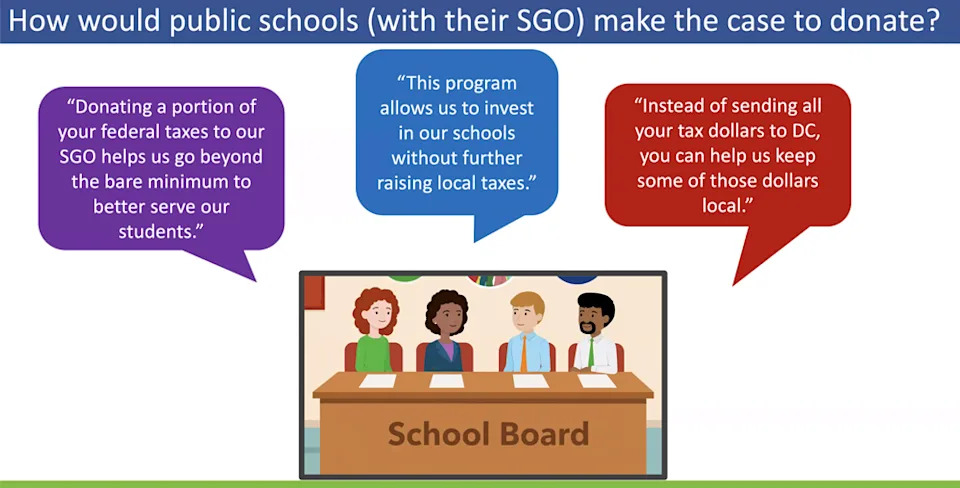
Georgetown University’s Marguerite Roza said many districts wouldn’t have a hard time making a case for why taxpayers should donate to an affiliated SGO. (Edunomics Lab)
Political and Practical Pushback
Critics warn the credit could primarily subsidize private education and undermine public schools. Jessica Levin of the Education Law Center said during a webinar that the tax credit risks diverting funds that should be used for public goods to unregulated SGOs and private tuition. Some public-school advocates — who previously campaigned against the legislation — remain skeptical that the administration will make the program easy for districts to benefit from.
“The federal tax credit will give tax money that should be used on public goods, like public education, to unregulated SGOs,” Levin said.
Equity Concerns
Observers warn that SGOs could widen disparities between wealthy and less-wealthy districts. Donations are likely to flow where taxpayers directly benefit, meaning affluent communities could raise large sums while poorer districts receive little. Additionally, to claim the full $1,700 credit a donor must contribute that amount annually; many lower-income residents do not owe enough federal tax to take full advantage.
What Depends on Federal and State Rules
Treasury officials reportedly confirmed in a closed meeting that public school students would be eligible for scholarship funds, but federal rules are still being drafted. So far, 31 states have indicated they will opt in; states that participate must approve lists of SGOs that can receive donations. How narrowly SGOs may limit scholarships to specific districts or schools, and what compliance and reporting requirements will apply, remains to be determined.
Voices From the Field
Some Democratic governors, including Colorado’s Jared Polis, New York’s Kathy Hochul and North Carolina’s Josh Stein, have opted or signaled plans to opt into the program. District leaders such as Scott Smith of Cherry Creek School District say they remain cautious about the administration’s priorities but are prepared to pursue any funds that benefit students equitably.
Practical Steps Districts Can Take Now
- Explore whether existing public-school foundations or nonprofits can apply to become approved SGOs.
- Start planning targeted, evidence-based programs (tutoring, summer learning, device distribution) that could attract donors.
- Develop transparency and accountability systems to track donations, eligibility and program outcomes.
- Engage the community with clear messaging about how SGO-funded scholarships would supplement — not replace — core services.
The coming federal regulations and state decisions will shape whether this policy becomes a significant new revenue stream for district schools or primarily a mechanism to expand private school choice. Many stakeholders emphasize that strong guardrails, clear reporting and an equity focus will determine its ultimate impact.
Help us improve.