Scientists sequenced a sloth genome and discovered active transposable elements — "jumping genes" — conserved for about 30 million years. Many of these elements are linked to mitochondrial function and metabolic pathways, which may help explain sloths' extremely low metabolism. Researchers say sloth cell lines could provide natural models to study ageing, metabolic disease and tissue preservation, with potential applications from critical care to long-duration space travel.
Sloth "Jumping Genes" May Reveal Secrets To Healthy Ageing And Extremely Low Metabolism

Scientists mapping the sloth genome found long-conserved “jumping genes” tied to mitochondria and the animal’s ultra-slow metabolism. Could that discovery point to new ways to understand ageing and diseases linked to energy production? Philipp Schulze/dpa
Researchers sequencing a sloth genome have uncovered active transposable elements — commonly called "jumping genes" — that appear to have been conserved for roughly 30 million years. The new findings link these genetic elements to mitochondrial function and metabolic pathways, offering a possible genetic explanation for the sloth's famously slow metabolism and suggesting new natural models to study ageing and energy-related disease.
How the Study Was Done
Scientists from the Wellcome Sanger Institute, the Leibniz Institute for Zoo and Wildlife Research (IZW), Hospital Sirio Libanes and collaborators collected tissue samples from a captive sloth and extracted DNA. Sequencing was performed at the Max-Planck Institute for Molecular Cell Biology & Genetics in Germany. Using comparative genomics, the team aligned the sloth genome with those of other mammals — including an anteater and an armadillo — to identify features unique to sloths within the Xenarthra clade.
Key Findings
The researchers found multiple active copies of transposable elements (transposons) that are still capable of moving within the genome. While humans retain remnants of transposons that are mostly inactive, the sloth transposons appear to have arisen in the common ancestor of modern sloths around 30 million years ago and been conserved across sloth lineages.
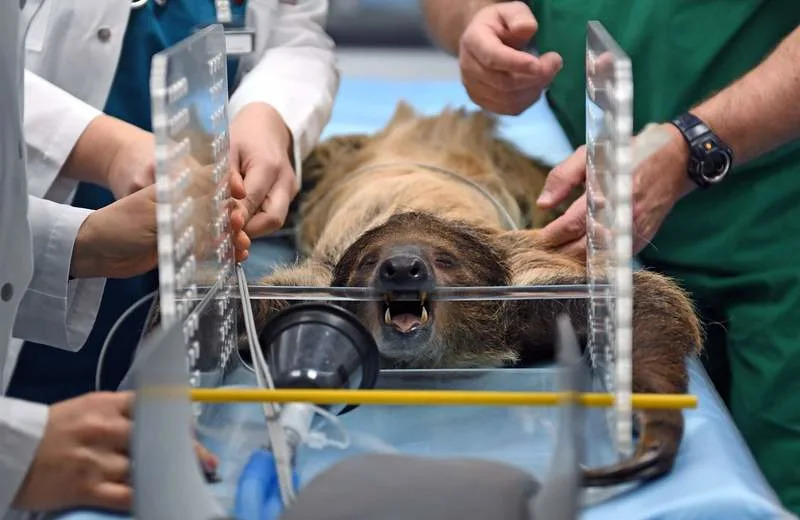
Scientists mapping the sloth genome found long-conserved “jumping genes” tied to mitochondria and the animal’s ultra-slow metabolism. Could that discovery point to new ways to understand ageing and diseases linked to energy production? (File photo) Hendrik Schmidt/dpa
Importantly, many of these sloth-specific transposons are associated with genes involved in mitochondrial function and metabolic pathways. Because mitochondria produce cellular energy, the team hypothesizes these elements could have contributed to the evolution of sloths' extremely low metabolic rates.
Why It Matters
Dr Pedro Galante, co-lead author at Hospital Sirio Libanes in Sao Paulo, notes that "many human conditions — including diabetes, ageing-related disorders, neurodegeneration, and muscle wasting — involve problems with energy production and mitochondrial function." He suggests that sloth cell lines could become a natural model for studying how organisms cope with chronic low-energy states and what goes wrong in disease.
Dr Marcela Uliano-Silva, senior bioinformatician at the Wellcome Sanger Institute: "Evolution has run billions of experiments. By studying unusual animals like sloths, we sometimes uncover biological solutions humans never evolved."
Dr Camila Mazzoni, head of evolutionary and conservation genomics at IZW: "Sloths have the slowest metabolism of any mammal, yet they remain healthy. Our findings suggest they may have evolved genetic back-up systems that support this lifestyle."
Next Steps
The team emphasizes that further functional experiments are needed to test how these transposons affect mitochondrial performance and metabolic regulation. If causal links are established, sloth-derived cell models could inform research on tissue preservation, critical care, ageing, metabolic disease, and even biological strategies for long-duration space travel.
Bottom line: Conserved, active "jumping genes" in sloths are tied to energy-production pathways and could help scientists explore how organisms manage prolonged low-energy states — with potential relevance to human ageing and medicine.
Help us improve.