Robert F. Kennedy Jr. drew renewed attention after posting a video of himself picking up two black snakes, prompting recollections of earlier animal-related episodes. Over the years he has acknowledged placing a dead bear cub in Central Park, been linked to reports of removing a whale's skull and dissecting roadkill, and had a dead parasitic worm reported in his brain after memory complaints. Wildlife officials emphasize caution around wild animals, while commentators say the incidents reinforce his eccentric public image.
RFK Jr.'s Animal Antics Go Viral: Snakes, A Dead Bear And A ‘Brain Worm’
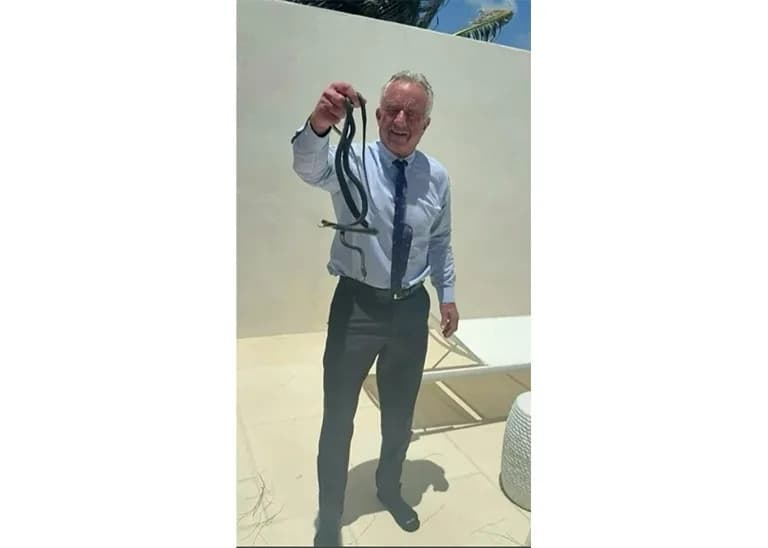
US Secretary of Health Robert F. Kennedy Jr. grabs two snakes with his bare hands, the latest example of his adventures involving animals (Handout)(Handout/@RobertKennedyJr / X/AFP)
A viral video of U.S. Health Secretary Robert F. Kennedy Jr. lifting two writhing black snakes by the tail has renewed attention on a series of unusual and sometimes macabre episodes involving animals that have followed the controversial official for years.
Background and controversy
Kennedy is a divisive figure in public life. He has long expressed skepticism about vaccines and has repeatedly promoted claims that many experts say are unfounded, including linking childhood immunizations to autism. He has also argued that fluoride in public drinking water is unsafe. Those positions have made him a lightning rod for criticism even as he serves in a senior public-health role.
Notable animal-related episodes
Beyond his policy views, multiple reports and personal accounts have documented offbeat interactions with wildlife that have reinforced an eccentric public image.
Central Park bear cub (2024)
In 2024 Kennedy acknowledged in a video that about a decade earlier he had placed a dead bear cub in New York City's Central Park, propped with a bicycle to make it appear the animal had been struck while biking. He said he had found the bear after it was hit by a car upstate and initially intended to skin it, but later abandoned that plan. Authorities said the incident puzzled investigators for years.
Whale skull
>According to an account recounted by his daughter, Kennedy once used a chainsaw to remove the head of a dead whale that washed ashore in Massachusetts and then strapped the skull to the roof of the family minivan to take it home for study.
Roadkill examination
A 2026 biography recounts an anecdote in which Kennedy said he amputated the penis of a road-killed raccoon to study it later.
Parasitic worm in the brain
The New York Times reported that a physician found a dead parasitic worm in Kennedy's brain after he complained of memory loss; Kennedy has said he recovered with no lasting effects. The report was widely covered in major outlets and attributed to medical records and reporting.
Latest: Snake-handling
In the newly circulated clip posted to X, Kennedy—dressed in a shirt and tie—picks up two thin black snakes by their tails from an outdoor patio corner and holds them up while smiling. At one point he appears to be bitten; an off-camera voice is heard saying, "Bobby, Bobby, please." His caption referenced his wife and U.S. health official Mehmet Oz's patio. The reptiles appear to be black racers, a common, non-venomous species in Florida.
Public reaction and expert guidance
Wildlife agencies urged calm and caution: snakes generally try to avoid people, and the Florida Fish and Wildlife Conservation Commission advised giving wild animals space. Commentators and columnists have used these episodes to underscore Kennedy's unconventional relationship with animals and to question the optics of such behavior for a senior health official.
"He has a relationship with animals that most of us only dream of. Nightmares are also dreams," wrote Washington Post columnist Monica Hesse, reflecting on the strange mix of curiosity and shock these stories inspire.
This account synthesizes widely reported incidents and quoted sources; where possible the article notes attributions to Kennedy's statements, published biographies, or reporting by major outlets such as The New York Times.
Help us improve.