The White House urged Congress to pass long-delayed rail safety legislation after the 2023 Norfolk Southern derailment in East Palestine, Ohio, which released over one million gallons of hazardous materials. The House committee is weighing whether to attach rail provisions to a five-year, $580 billion highway bill. Proposals would require wayside defect detectors, minimum two-person crews and higher fines; supporters call them essential safety fixes, while railroads and some Republicans warn of higher costs.
White House Pushes Congress to Pass Rail Safety Bill After East Palestine Disaster
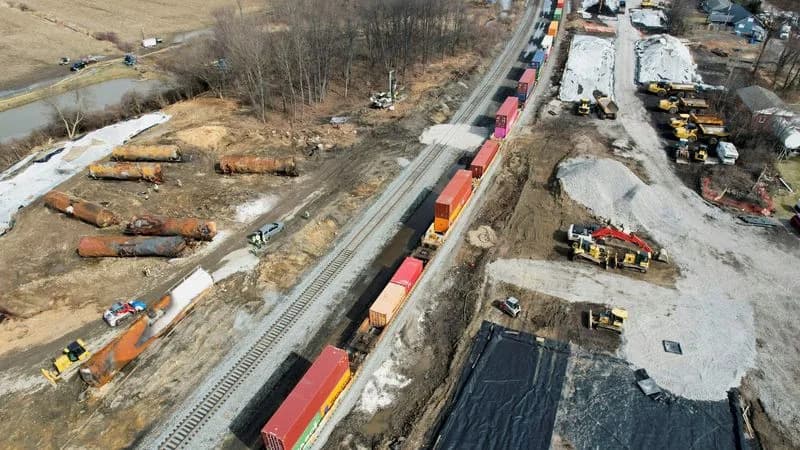
FILE PHOTO: General view of the site of the derailment of a train carrying hazardous waste, in East Palestine, Ohio, U.S., March 2, 2023. REUTERS/Alan Freed/File Photo
The White House on Thursday renewed its call for Congress to approve long-stalled rail safety legislation in response to the 2023 Norfolk Southern derailment in East Palestine, Ohio — an accident that ignited, burned and released more than one million gallons of hazardous materials into the surrounding area.
Why the Bill Matters
Supporters say the proposed measures would close critical safety gaps for trains carrying hazardous materials, strengthen monitoring of railcar components and impose stiffer penalties for violations. The U.S. House Transportation and Infrastructure Committee is debating a separate five-year, $580 billion highway package and is considering attaching the rail safety provisions to that bill.
Points Of Contention
Backers — including President Donald Trump and many Democrats — argue the legislation is a necessary response after investigators concluded the 2023 crash was caused by a catastrophic failure of an overheated wheel bearing. In 2024, Norfolk Southern reached a $310 million settlement with the Justice Department that included commitments to install additional devices to detect overheated bearings earlier.
Rep. Troy Nehls (R-TX): "The derailment exposed serious weaknesses in the freight rail industry safety practices, particularly when it comes to transporting hazardous materials."
Rep. Sam Graves (R-MO), Committee Chair: "It's going to ripple across the entire supply chain," warning the bill could add billions in shipping costs over the next decade.
Key Provisions
The legislation under consideration would:
- Require enhanced safety procedures for trains transporting hazardous materials;
- Mandate installation and use of wayside defect detectors to identify overheated bearings and other problems;
- Establish a minimum two-person crew requirement on certain trains;
- Increase fines and civil penalties for safety violations.
Jennifer Homendy, chair of the National Transportation Safety Board, has warned that many safety recommendations issued after the East Palestine derailment remain unaddressed more than three years later. "People living in the community of East Palestine and all Americans deserve no less than a comprehensive approach that addresses critical rail safety issues," she said.
The Association of American Railroads, which represents major freight carriers, criticized the bill as a vehicle for labor and operational mandates that would raise costs across the supply chain while doing little to measurably improve safety outcomes, setting up a contentious debate in Congress.
As lawmakers weigh safety gains against potential economic impacts, the outcome will determine whether federal rail safety policy is tightened through standalone legislation or attached to the wider highway package.
Help us improve.