The Rail Passengers Association on Sept. 9 urged the Surface Transportation Board to deny the proposed Union Pacific–Norfolk Southern merger, arguing the application fails to make a prima facie case and omits critical passenger-service analysis. In a 63-page filing, the RPA faults the applicants for lacking timetable-based operating models, passenger dispatch plans and transparent capacity workpapers. The group warns 41 of 63 FRA-selected corridors could depend on post-merger Union Pacific operations and asks the STB to impose enforceable conditions — including five years of oversight — if the deal moves forward.
RPA Urges STB To Reject Union Pacific–Norfolk Southern Merger, Citing Passenger-Service Gaps
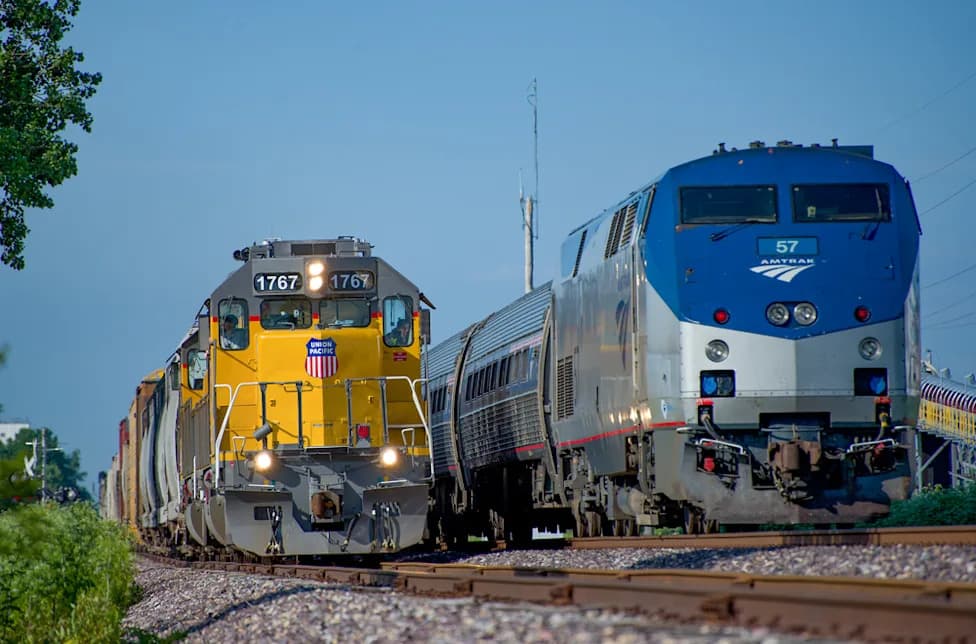
A Union Pacific train with locomotive problems creeps into a siding south of Elkhart, Ill., delaying an Amtrak Lincoln Service train on June 15, 2013. The Rail Passengers Association has asked the Surface Transportation Board to deny the UP-Norfolk Southern merger request, saying the merger application inadequately addresses passenger issues. Steve Smedley
WASHINGTON — The Rail Passengers Association (RPA) on Wednesday, Sept. 9, asked the Surface Transportation Board (STB) to deny the proposed merger between Union Pacific (UP) and Norfolk Southern (NS), arguing the applicants failed to make a prima facie case and largely ignored how the merger could affect existing and future passenger rail service.
RPA Says Application Falls Short
In a detailed 63-page filing, the RPA contends the UP–NS application treats passenger obligations only as a duty to preserve current service levels — a standard the association calls too narrow — and that the application does not even meet that limited threshold.
"That standard is too narrow, and the evidence offered to satisfy even that minimal standard is insufficient," the filing states.
RPA CEO Jim Mathews said in an accompanying press release that the merging carriers have not provided the information the STB needs to make an informed decision. "On passenger rail, they still haven't done that," Mathews said. "They tell us there is enough capacity. They tell us existing agreements will continue. What they still haven't shown is how the additional freight trains they project will actually operate alongside scheduled passenger trains."
Specific Deficiencies Identified
The RPA argues the application omits several passenger-specific elements the law requires and the STB requested, including:
- A timetable-based operating model showing how passenger and freight trains will be scheduled together.
- A passenger-focused dispatching plan to protect on-time performance.
- Transparent capacity workpapers that allow meaningful public review and independent verification.
- A serious assessment of federally selected passenger projects that could depend on the combined carrier.
The association also supports a motion to deny filed by a coalition of shippers' organizations and notes similar objections from BNSF Railway and CSX. The STB has said it will set a procedural schedule for the merger and will address motions to deny separately once that schedule is established.
Corridor Impact And Delay Concerns
The RPA points to the Federal Railroad Administration's Corridor Identification and Development (Corridor ID) program, which in 2023 selected 63 routes for potential development. The filing states that 41 of those 63 routes (more than 62%) would, at least in part, depend on post-merger Union Pacific operations.
On current performance, the RPA says both UP and NS already exceed regulatory targets for host-railroad-caused delays. The amended merger application projects increases of two to 10 additional freight trains per day on 42 Amtrak route segments; applicants claim sufficient capacity on 31 of those segments but provide little supporting detail.
"Applicants' burden cannot be satisfied by repeatedly writing 'sufficient' next to increases of this size," the RPA wrote. "The same traffic projections support Applicants' claimed merger benefits. Their operating consequences must receive equally rigorous treatment."
Conditions Sought If Merger Proceeds
If the STB does not deny the merger, the RPA asks the board to impose at least a dozen enforceable conditions to protect passenger service. Key requests include:
- Enforceable performance standards tied to on-time metrics and delay-causing incidents.
- Predetermined triggers and timelines for corrective action if standards are missed.
- Preservation of capacity and priority for Corridor ID projects that depend on the combined carrier.
- Public reporting of passenger performance and transparent capacity analyses.
- At least five years of continuing STB oversight of passenger-related conditions after any approval.
"The burden belongs to the railroads proposing the merger," Mathews said. "With this much of the country's current and future passenger network potentially affected, passengers should not have to take adequate capacity on faith."
Trains has asked Union Pacific and Norfolk Southern for comment on the RPA filing.
To report news or errors, contact [email protected].
Help us improve.