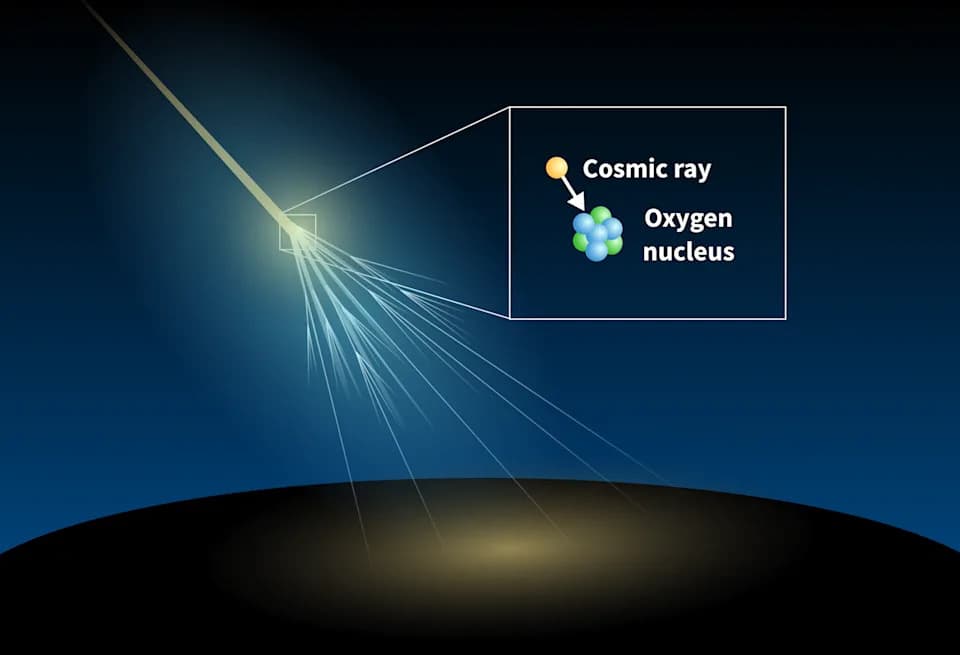
New simulations suggest the most energetic cosmic rays detected on Earth may be atomic nuclei heavier than iron, which lose energy more slowly across cosmic distances than lighter particles. The 2021 Amaterasu event — about 40 million times more energetic than collisions at the Large Hadron Collider — arrived from a void-like region, deepening the mystery. If some ultrahigh-energy cosmic rays are ultraheavy nuclei, violent events such as neutron-star mergers or massive-star collapses become likely sources. The findings appeared in Physical Review Letters on May 7.
New Study Suggests Ultraheavy Atomic Nuclei Could Explain the Most Energetic Cosmic Rays
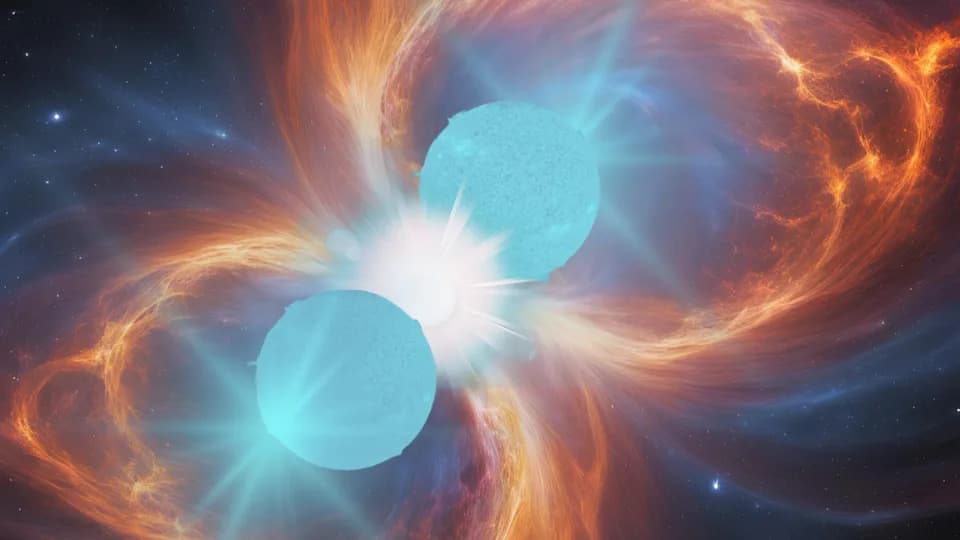
An illustration shows two neutron stars colliding and merging. | Credit: Robert Lea (created with Canva)
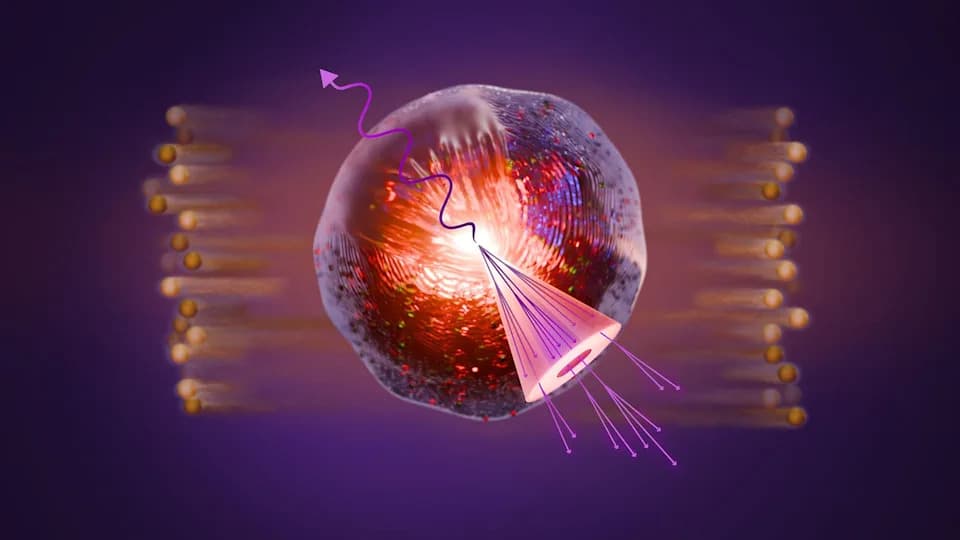
On Earth, machines like the Large Hadron Collider accelerate particles to near-light speed, but space produces cosmic rays with energies millions to tens of millions of times greater. A striking example is the 2021 'Amaterasu' event, a single cosmic-ray particle that struck Earth with roughly 40 million times the energy of LHC collisions. A new study proposes that some of the highest-energy cosmic rays may be atomic nuclei heavier than iron — a possibility that could point to specific, violent astrophysical sources.
Why Ultraheavy Nuclei Matter
Amaterasu — considered the second-most energetic cosmic ray ever recorded after the 1991 'Oh-My-God' particle — arrived from a sky region that looked like a void, with no obvious nearby source. That mystery prompted researchers led by Kohta Murase (Penn State) to revisit what kinds of particles can survive long intergalactic journeys at extreme energies.
The team's simulations tracked how particles of different masses lose energy as they travel across cosmic distances. They found that atomic nuclei heavier than iron (so-called ultraheavy nuclei) lose energy more slowly at the extreme energies of events like Amaterasu than protons or intermediate-mass nuclei do. That slower energy loss makes ultraheavy nuclei more likely to reach Earth still carrying ultrahigh energies.
'The origins and acceleration mechanisms of ultrahigh-energy cosmic rays have been among the biggest mysteries in the field for more than 60 years,' Murase said. 'Ultrahigh-energy cosmic rays can only be accelerated by some of the most powerful sources in the universe. When we detect individual cosmic-ray particles such as the Amaterasu particle here on Earth, we can often use their energies, arrival directions, and expected magnetic deflections to infer their possible cosmic sources.'
Possible Sources and Implications
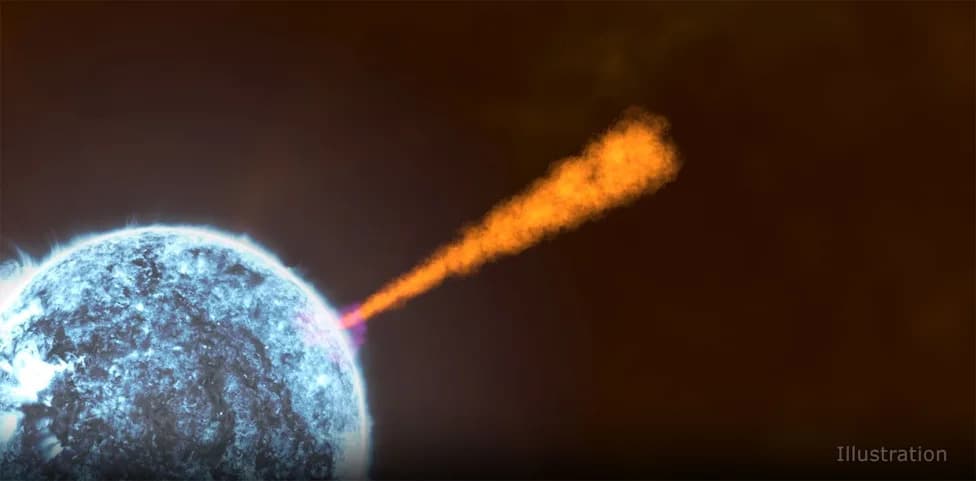
The most promising sites for producing and accelerating ultraheavy nuclei include the explosive deaths of massive stars that collapse into black holes or strongly magnetized neutron stars, as well as binary neutron-star mergers — events already known to generate powerful gravitational waves and gamma-ray bursts. If some ultrahigh-energy cosmic rays are indeed ultraheavy nuclei, those sources become stronger candidates.
The composition of arriving cosmic rays affects how much their paths are bent by magnetic fields, which in turn affects how well we can trace them back to sources. The team also derived limits on what fraction of ultrahigh-energy cosmic rays could be ultraheavy nuclei, and noted that a significant ultraheavy component could help explain an observed north–south difference in the ultrahigh-energy cosmic-ray spectrum.
Murase emphasized that the results do not imply all ultrahigh-energy cosmic rays are ultraheavy nuclei, but that even a subset of such events being ultraheavy would change search strategies for their sources. The study was published on May 7 in Physical Review Letters.
Help us improve.