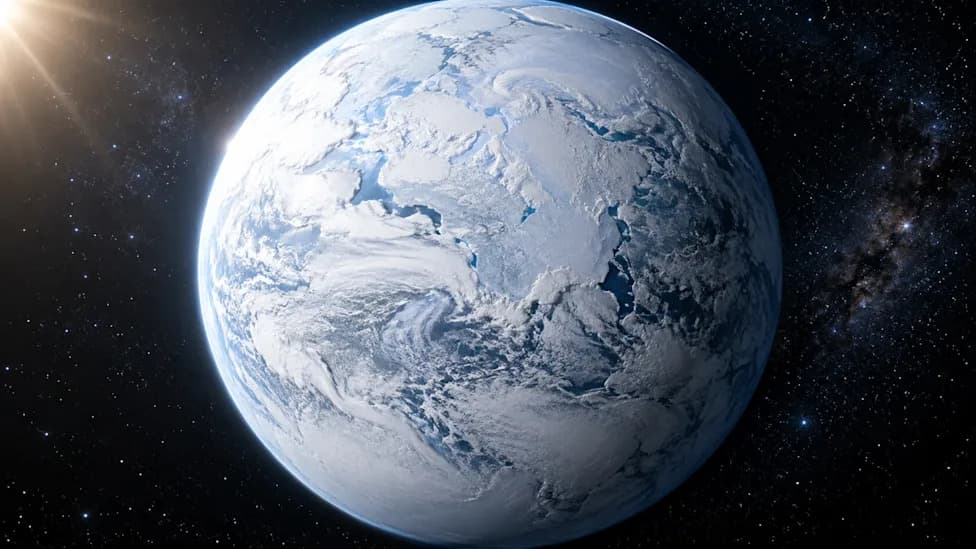
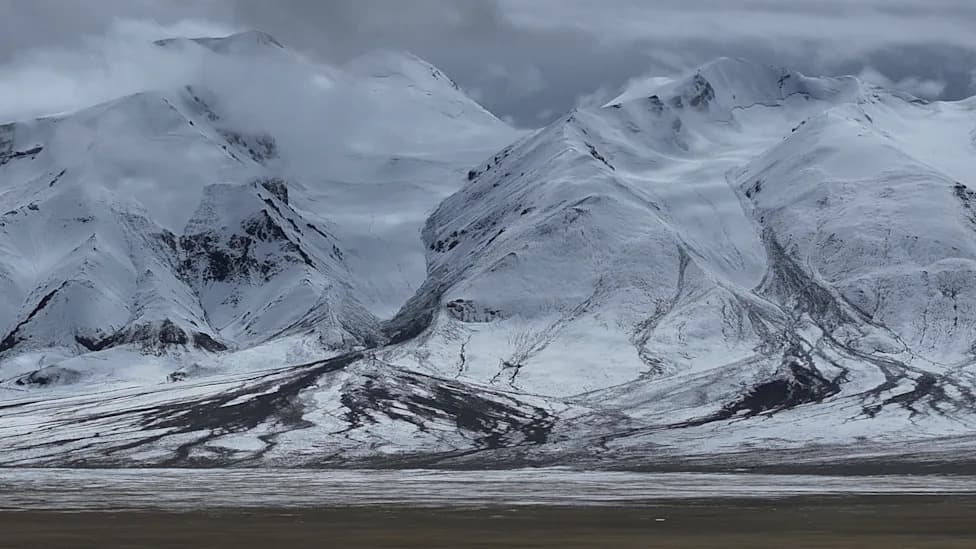
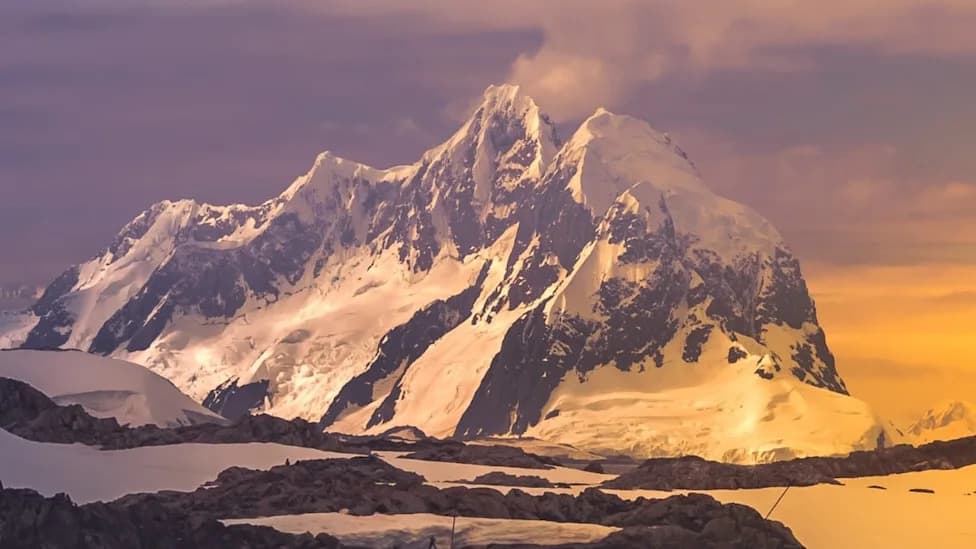
The Harvard team argues the Sturtian glaciation (~717–661 Ma) was not a single continuous Snowball Earth but a repeating sequence of global freezes and warm interglacials driven by weathering of the Franklin Large Igneous Province. Their coupled climate–carbon model produces a limit cycle in which basalt weathering triggers glaciation and later volcanic CO2 causes deglaciation, potentially repeating for ~56 million years. This scenario helps resolve both the CO2 accumulation paradox and the oxygen problem and matches sedimentary hints of intermittent open water. The authors call for global, high‑precision stratigraphy and geochronology to test the hypothesis.
Harvard Study: 'Snowball Earth' Repeatedly Thawed During a 56‑Million‑Year Sturtian Glaciation
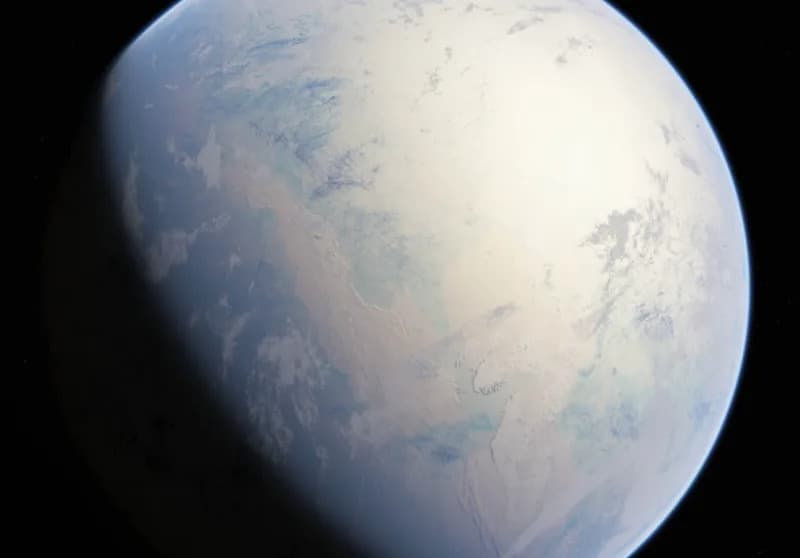
Artist's rendition of a fully-frozen snowball Earth. (CREDIT: Wikimedia / CC BY-SA 4.0)
Earth scientists at Harvard’s John A. Paulson School of Engineering and Applied Sciences propose a revised view of the Sturtian glaciation: rather than a single, uninterrupted global freeze, Earth likely oscillated between full Snowball conditions and warmer, ice‑free intervals for roughly 56 million years during the Cryogenian (about 717–661 million years ago).
New Model and Key Authors
Graduate student Charlotte Minsky, with Robin Wordsworth, David T. Johnston and Andrew H. Knoll, published the analysis in Proceedings of the National Academy of Sciences (PNAS). Using a coupled climate–carbon model, the team tested an alternative explanation for a central paradox: why a Sturtian interval of ~56 million years persisted when simple models predict a fully frozen Earth should deglaciate within a few million years as volcanic CO2 accumulates.
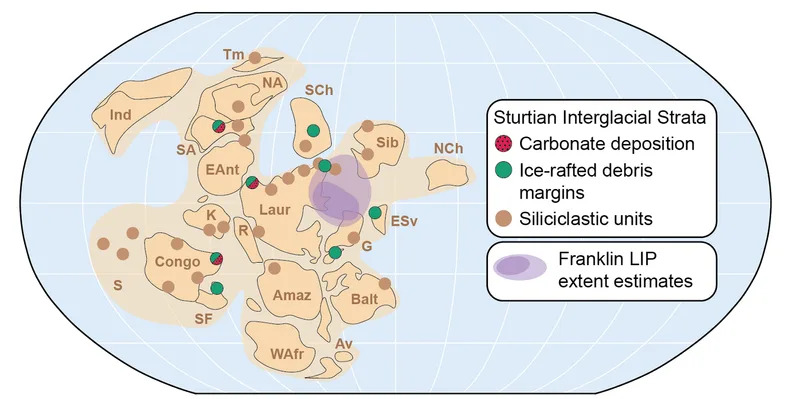
Sturtian stratigraphic successions including evidence of intermittent open water: syn-glacial carbonate deposition sites and ice-rafted debris margin sites. (CREDIT: PNAS)
Problems With a Continuous Snowball
Two longstanding issues motivate the new hypothesis. First, energy‑balance calculations suggest a hard Snowball Earth would thaw after ~3.8 million years of volcanic CO2 buildup; slushball or waterbelt variants are even less stable because they need less CO2 to melt. Second, a continuous global freeze would have rapidly drained oxygen from the atmosphere and ocean as reduced volcanic gases reacted away remaining O2 while marine productivity collapsed—yet geological and isotopic records do not show a prolonged, planet‑wide anoxic state lasting tens of millions of years.
Limit‑Cycle Hypothesis Driven by Franklin Basalt Weathering
At the core of the proposed mechanism is the Franklin Large Igneous Province (LIP), which erupted around 717 million years ago in what is now northern Canada. The team argues that weathering of fresh Franklin basalt could have drawn down atmospheric CO2 enough to trigger glaciation. Once ice advanced, continental weathering would slow or stop, allowing volcanic outgassing to rebuild CO2 and eventually cause deglaciation. As ice retreated, newly exposed basalt would again draw down CO2 and push the planet back into another Snowball state, producing a self‑sustaining limit cycle of alternating Snowball episodes and hot interglacials.
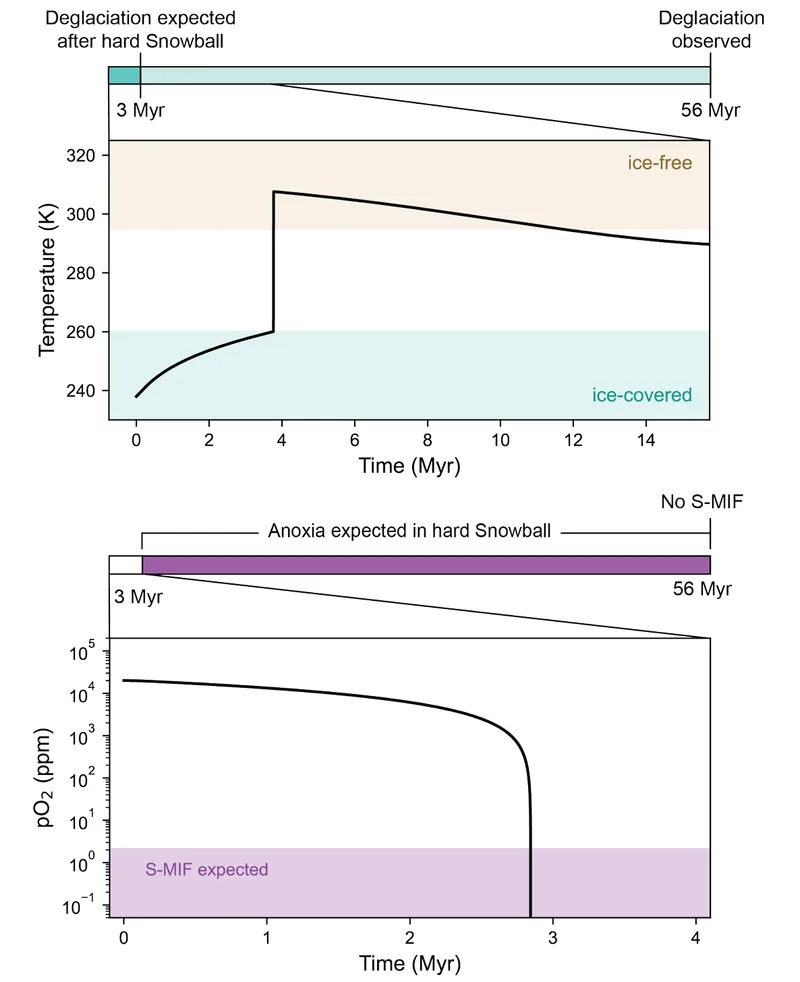
Canonical Snowball Earth scenarios fail to reproduce the duration and oxygenation of the Sturtian glaciation. (CREDIT: PNAS)
Model Parameters and Plausibility
In one highlighted configuration the model uses an initial Franklin LIP area of ~4.5 million km² and weathering rates comparable to modern basaltic volcanic fields (for example Réunion). To reproduce a 56‑million‑year sequence, the model requires an ~18‑million‑year decay timescale for the weathering perturbation — consistent with an initial basalt thickness of roughly 2 km (Neoproterozoic estimates range from 1–4 km). The authors estimate that, under background Neoproterozoic conditions, as little as 0.4 teramoles of extra carbon weathering per year could sustain these limit cycles, and Franklin basalt weathering would exceed that threshold in many plausible parameter combinations.
Biological and Sedimentary Implications
The limit‑cycle picture eases the “oxygen problem.” Individual frozen intervals still lasted millions of years but not long enough to fully exhaust atmospheric oxygen each time. Warm intervals would also supply phosphate from basalt weathering, stimulating marine productivity and helping to replenish oxygen before the next freeze—offering a mechanism for the persistence of aerobic metabolisms and early eukaryotic groups through the Cryogenian.
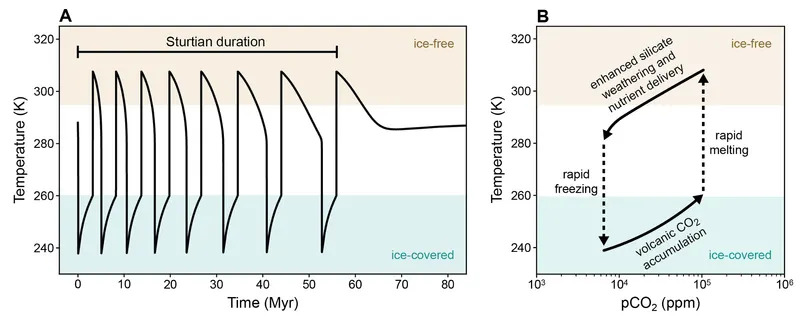
The limit cycle scenario. A) Modeled equilibrium surface temperature under a persistent carbon cycle imbalance, showing a series of self-terminating Snowball events alternating with hot interglacials. B) Climate hysteresis loop showing the trajectory of temperature as a function of atmospheric pCO2. (CREDIT: PNAS)
Moreover, the hypothesis aligns with some sedimentary observations: intermittent ice‑rafted debris, mudstones, sandstones and occasional carbonates have been interpreted as signs of episodic ice retreat or low‑latitude open water during the Sturtian. A global, repeating limit‑cycle mechanism provides a coherent driver for those features and may explain the lack of a clear sulfur mass‑independent fractionation signal that would be expected after a long, continuous collapse of atmospheric oxygen.
How To Test The Idea
The clearest empirical test is to demonstrate globally synchronous, repeated glacial and interglacial sequences throughout the Sturtian interval. That will require targeted sequence stratigraphy and high‑precision geochronology from well‑preserved rock successions worldwide. Records from higher paleolatitudes would be especially diagnostic: open water only at low latitudes could still fit waterbelt scenarios, but evidence for ice‑free conditions far from the equator would indicate true global deglaciation between Snowball phases.
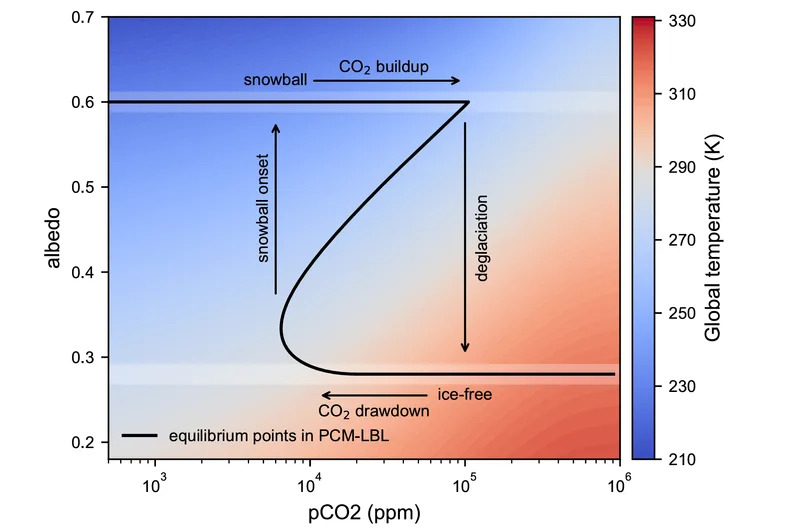
Equilibrium surface temperature as a function of atmospheric pCO2 and planetary albedo has multiple stable states: a Snowball branch (high albedo, low temperature) and an ice-free branch (low albedo, high temperature), separated by unstable solutions. (CREDIT: PNAS)
The study leaves open whether the later Marinoan glaciation (≈650–635 Ma) could represent the tail end of the same limit‑cycle regime; matching that gap would require additional constraints on the silicate weathering feedback.
Context: Other Major Icehouse Intervals
The Sturtian is one of several major deep freezes in Earth history. For context: the Huronian (≈2.4–2.1 Ga) coincided with the Great Oxidation Event; the Cryogenian (≈720–635 Ma) included Sturtian and Marinoan glaciations; the Ordovician–Silurian glaciation (≈460–430 Ma) links to a major extinction; a long Late Paleozoic icehouse lasted from ≈360–260 Ma; and the Quaternary ice age began ≈2.58 Ma and continues today with the Holocene interglacial.
Reference: Minsky et al., Proceedings of the National Academy of Sciences (PNAS).
Help us improve.