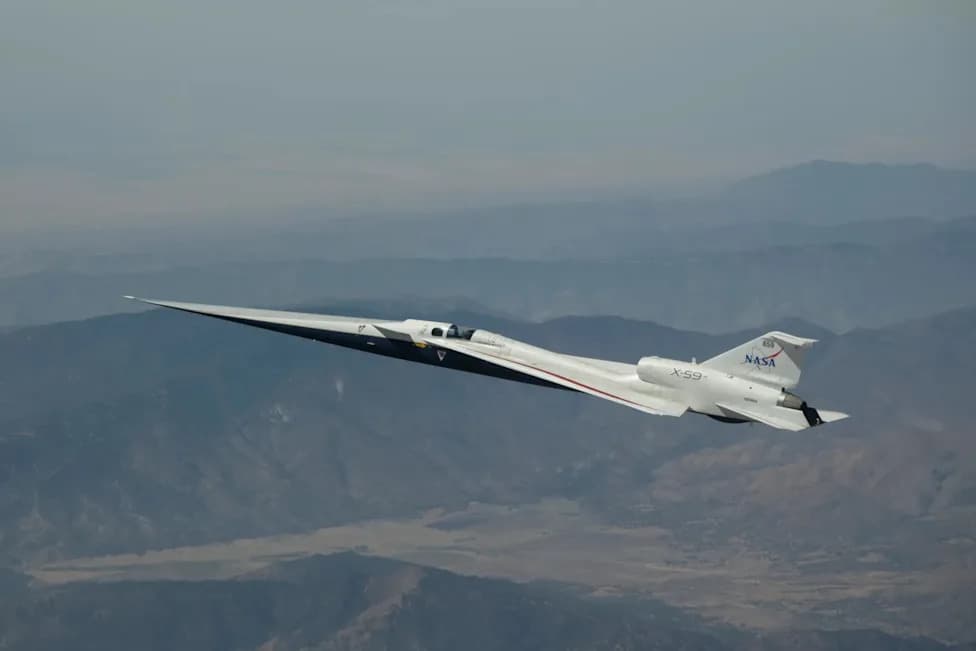
NASA intensified testing of the Lockheed Martin–built X-59 on April 14, pushing the demonstrator to Mach 0.98 during an envelope-expansion flight over the Mojave Desert. The test included rollercoaster pitching, bank-to-bank rolls, flutter excitation, and gear-extension checks to collect data on stability, structure and handling. The X-59’s long, slender nose and aerodynamic shaping aim to turn loud sonic booms into much quieter "sonic thumps," with planned community overflights to measure public response.
NASA’s X-59 Nears Supersonic Speed at Mach 0.98 as Envelope Tests Intensify
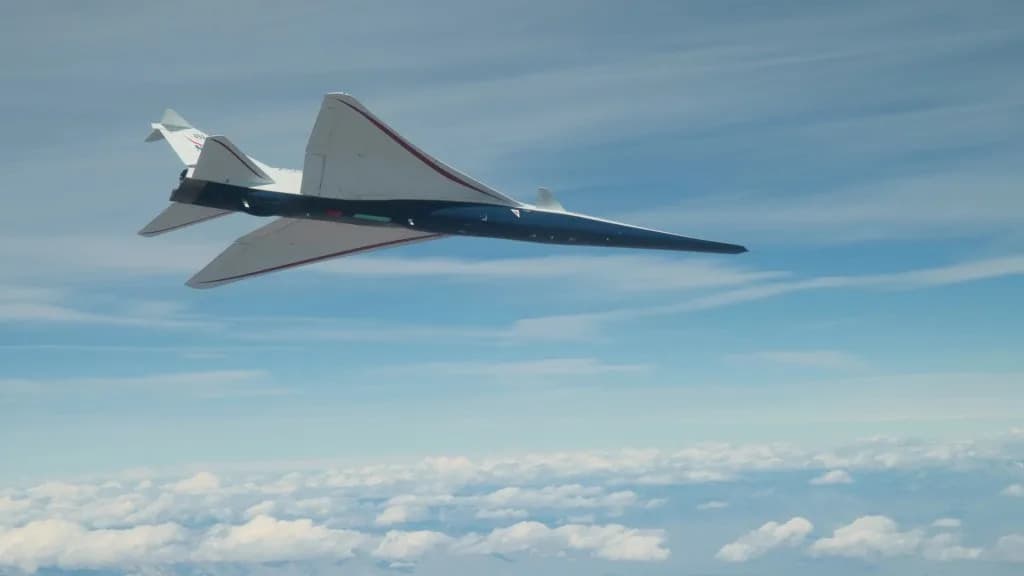
NASA has advanced testing of its experimental X-59 supersonic demonstrator, pushing the aircraft to near-supersonic speed during a flight over California’s Mojave Desert.
On April 14, engineers performed an envelope-expansion test flight that included a sequence of controlled maneuvers designed to probe the X-59’s aerodynamic, structural and handling limits. A pilot executed a rollercoaster maneuver (pitch up and down), bank-to-bank rolls (left and right), a deliberate flutter-excitation sequence to introduce controlled vibrations into the airframe, a wings-level push and a gear-extension check. NASA released video of the flight and is now analyzing the data.
What the flight achieved — During the test the Lockheed Martin–built X-59 reached Mach 0.98 (near the speed of sound, roughly 767 mph at sea level), providing engineers with critical measurements needed to validate the aircraft’s stability, control and quieter sonic signature concepts.
Design and purpose — The X-59 is 99.7 feet (30.39 meters) long with a 29.5-foot (9-meter) wingspan. Its long, slender nose — nearly one-third of the aircraft’s length — and specialized shaping are engineered to reshape the shock waves that produce sonic booms, transforming them into much quieter “sonic thumps.” NASA’s goal is to demonstrate technology that could allow future supersonic aircraft to operate over populated areas without the disruptive, traditional booms.
Program background — NASA awarded a roughly $518 million contract to Lockheed Martin nearly a decade ago to develop the X-59. The aircraft first flew on October 28, 2025, logging about an hour in its maiden sortie at modest speeds (about 230 mph / 370 km/h) and reaching approximately 12,000 feet (3.6 km). Since then, the agency has methodically expanded the flight envelope — flying higher and faster while collecting data at each step.
Why envelope testing matters — Envelope-expansion flights intentionally push an aircraft beyond its previously validated limits to define safe operating boundaries and to characterize aerodynamic loads, stability, control responses and structural behavior under demanding conditions.
Next steps — After completing analysis of the April 14 data, NASA plans additional envelope tests as part of a broader campaign that will eventually include community overflights. Those flights are designed to gather public-response data on the X-59’s quieter sonic signature and inform potential regulatory changes that could permit routine supersonic flights over land.
NASA: "The envelope expansion phase of any experimental aircraft is critical, not just for pushing the aircraft higher and faster, but for understanding how the aircraft operates in flight."
As testing continues, the X-59 represents a major step toward a future where supersonic travel could be faster and less disruptive to communities beneath flight paths.
Help us improve.