The latest study argues that tectonic stresses and lithospheric structure — not a deep mantle plume — primarily heat and drive Yellowstone's magma system. A 3D model that integrates past plate motions, current mantle structure and lithosphere data shows two opposing forces (westward crustal stretching and downward pull from the sinking Farallon slab) opening pathways for melt to rise. Independent experts say the model explains observed melt migration beneath the caldera and could improve eruption forecasts and be applied to other large caldera systems.
Yellowstone’s Supervolcano Likely Fueled by Crustal Forces, Not a Deep Mantle Plume
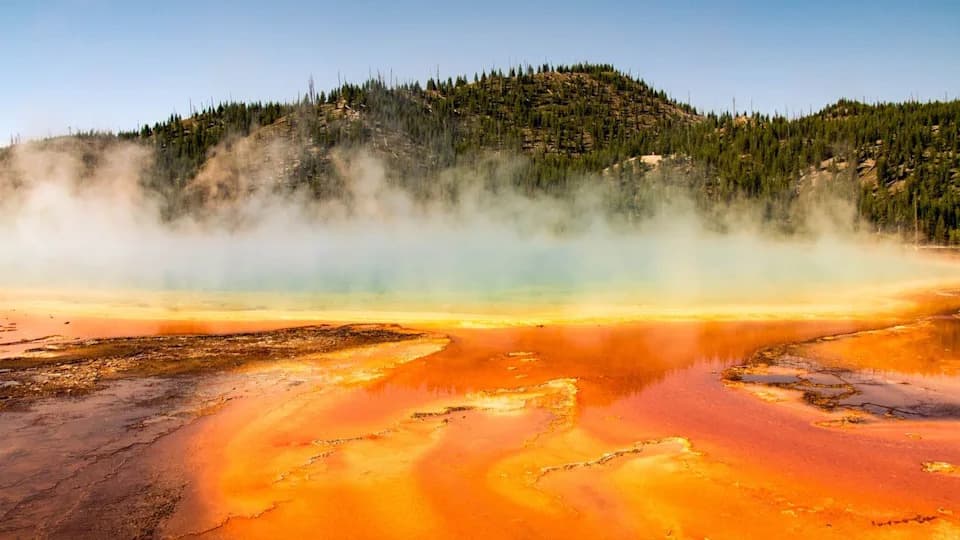
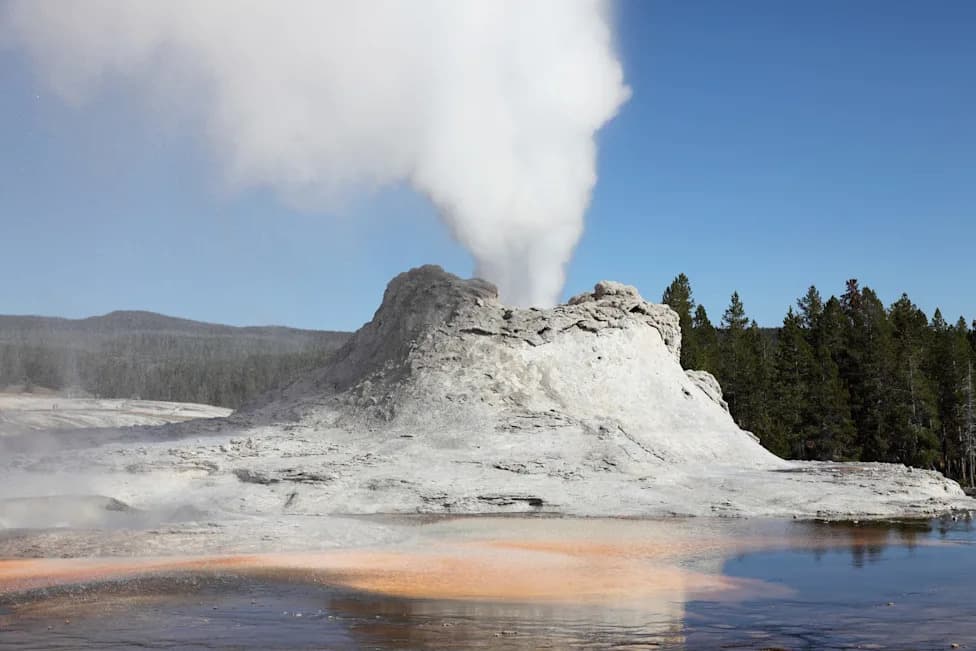
New research suggests Yellowstone's magma plumbing system doesn't work the way we thought it did. . | Credit: evenfh via Getty Images
New research suggests Yellowstone's iconic supervolcano is powered primarily by tectonic and lithospheric processes rather than by a single deep, rising mantle plume. The finding changes how scientists think the volcano's "magma plumbing" operates and could improve forecasts of future activity.
"Our work changes the [understanding of how] the magma plumbing system works, so future eruption models have to take this into account," said Lijun Liu, a geologist with the Institute of Geology and Geophysics at the Chinese Academy of Sciences, in comments to Live Science.
The Yellowstone region sits where Earth's crust is relatively thin and has produced intense volcanism. Over the last 2.1 million years the area has erupted three times on a major scale; the most recent supereruption occurred about 631,000 years ago and excavated the Yellowstone caldera — a bowl-shaped depression more than 30 miles (50 kilometers) across.
Scientists have debated whether Yellowstone is driven by a deep mantle plume — a column of very hot rock rising from near the core-mantle boundary — or by shallower tectonic and lithospheric forces. The new study, published on April 9 in Science, supports the latter explanation.
The researchers built a three-dimensional model that integrates the history of tectonic plate motions across western North America, present-day mantle structure beneath Yellowstone, and observational data describing the lithosphere (Earth's rigid outer shell). Their simulations show that tectonic forces alone can heat magma reservoirs and create pathways that let melt migrate upward toward the surface.
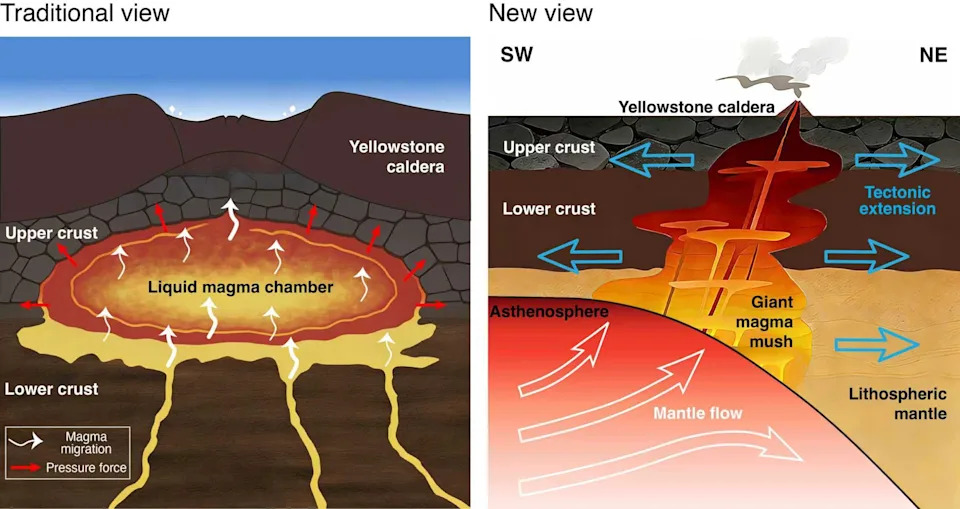
The traditional view of buoyant magma rising to form a liquid crustal chamber, seen on the left. And the new plumbing system suggested shown on the right. | Credit: Dr. Zebin Cao
According to the study, two opposing tectonic influences shape Yellowstone's magma system. Variations in lithospheric density produce westward stretching of the outer crust — an effect Liu likens to pulling and thinning dough. Simultaneously, the remnants of the ancient Farallon plate (the Farallon slab) are sinking beneath central-eastern North America, pulling the base of the crust downward and tilting the volcanic plumbing beneath Yellowstone.
Where these forces meet, they actively open the lithosphere beneath Yellowstone, linking shallow crustal reservoirs with deeper layers below the lithosphere and allowing melt to ascend. Independent geophysical work has shown magma generation in the upper mantle to the southwest of Yellowstone, with melt migrating northeastward beneath the crust toward the caldera; the new model explains how that migration path can form.
"Before this paper, to my knowledge, there has not been a study explaining why the magmas that fuel the Yellowstone volcanic system follow this path of migration," said Ninfa Bennington, a volcano seismologist at the Hawaiian Volcano Observatory, who was not involved in the new research.
Implications for Forecasting and Other Volcanoes
Understanding whether heat and melt come from a deep plume or from tectonic and lithospheric processes matters because the source affects how the system might behave in future. Jamie Farrell, chief seismologist at the Yellowstone Volcano Observatory (not involved in the study), noted that improved knowledge of heat sources and plumbing geometry "will allow for a better estimation of what we can expect in the future." He added that as the active magmatic track moves eastward over geologic time, it will encounter colder, thicker crust — a change that could alter eruptive behavior.
Liu and other researchers say the tectonic-model approach could be applied to other large caldera systems such as Toba (Southeast Asia), Taupo (New Zealand) and active volcanic regions in northeastern China to help explain how their magma systems are supplied.
While this study does not rule out all plume-related processes everywhere, it provides a robust, testable alternative: tectonics and lithospheric structure can create the heat and pathways needed to feed Yellowstone's supervolcano. That insight refines the scientific picture of one of Earth's most famous and closely monitored volcanic systems.
Help us improve.