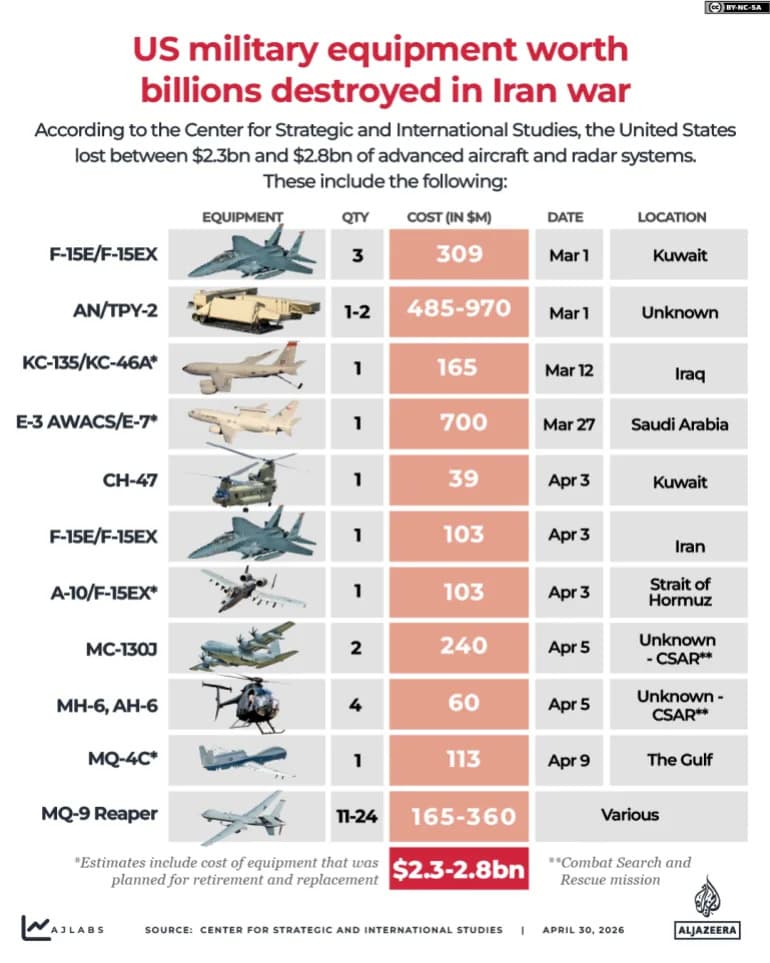
CSIS estimates US equipment losses in the Iran conflict at $2.3–$2.8 billion, largely due to Iranian missile and drone strikes and one friendly-fire incident. Major losses include a $700 million E-3 AWACS destroyed at Prince Sultan Air Base and one or two THAAD-linked radars valued at $485–$970 million. Restricted access to commercial satellite imagery has complicated damage assessments, and analysts warn political limits hamper full transparency. Both sides have suffered damage, but neither appears decisively defeated.
CSIS: US Military Hardware Losses in Iran Conflict Total $2.3–$2.8bn After Missile, Drone and Friendly-Fire Strikes
[Al Jazeera]
The Washington, DC–based Center for Strategic and International Studies (CSIS) has estimated that US military equipment losses in the conflict with Iran total between $2.3 billion and $2.8 billion. The tally, first published by Al Jazeera, attributes most losses to Iranian missile and drone strikes, alongside a notable friendly-fire incident.
Major Losses and Incidents
Two incidents account for a large share of the estimated damage. On March 1, at least one — and possibly two — powerful THAAD-linked missile-defence radars were destroyed; CSIS places the cost of those losses between $485 million and $970 million. Less than a day after a high-profile US Cabinet meeting, an Iranian strike on March 27 at Prince Sultan Air Base in eastern Saudi Arabia destroyed an E-3 AWACS airborne early-warning aircraft, valued at approximately $700 million.
Some losses were self-inflicted: in early March three F-15 fighter jets were shot down in a friendly-fire incident over Kuwait. CSIS’s accounting excludes damage at other regional US bases and does not list specialised equipment or naval assets.
Sources, Methods and Limits
Mark Cancian, a senior adviser in CSIS’s Defence and Security Program who led the calculations, said efforts to assess base damage have been hampered by restricted access to commercial satellite imagery. Cancian noted that Planet Labs has blocked public and media access to its images at the request of the US government since February 28, while Iranian imagery remains available. "We can see from the overhead photographs what buildings were struck," he said, but it is often difficult to determine what was inside damaged structures.
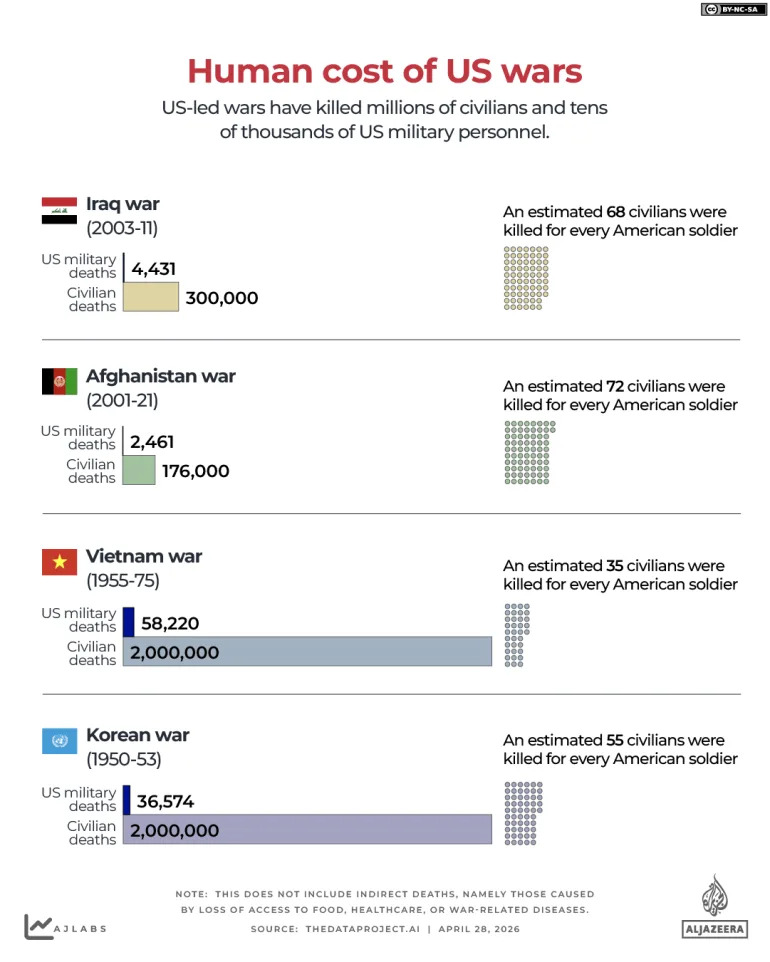
INTERACTIVE - CIVILIAN CASUALTIES IN US WARS - APRIL 24, 2026 copy 3-1777366845
Strategic Consequences
Security analyst Omar Ashour of the Doha Institute cautioned that political considerations limit how transparently the US can report losses. He argued that while the US has won operational battles historically, those successes do not always translate into strategic outcomes — citing Vietnam and Afghanistan as examples. Ashour also noted that the US deployed far fewer troops to the region in this conflict than were used in the 2003 Iraq invasion: less than one-tenth of the ground force and without the same carrier presence.
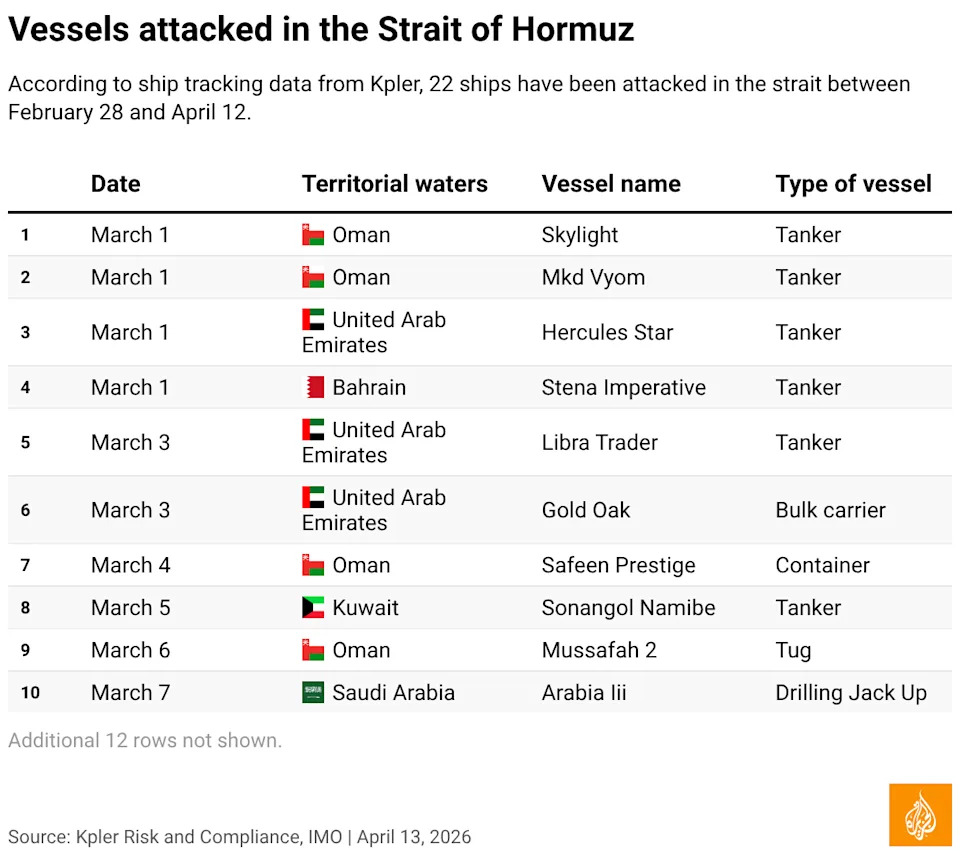
Cancian added that Iran’s decision to strike Gulf states hosting US forces may have been a strategic miscalculation that drew those states closer to Washington. He also criticized the initial US posture in the Strait of Hormuz, saying forces were not positioned early enough to keep the shipping lane fully open; on April 13, the US announced a naval blockade of Iranian ports and vessels attempting passage.
Mutual Damage, No Decisive Defeat
Ashour emphasised that Iran has also suffered significant degradation to its conventional forces from US and allied operations, but that its missiles, munitions and drone capabilities remain resilient. "They were degraded. But it’s far from defeated, and they’re far from down," he said.
Key sources: CSIS analysis (Mark Cancian) and reporting by Al Jazeera. Dates and values cited are those reported by CSIS and publicly available reporting.
Help us improve.