New research in JGR: Solid Earth suggests Mount Etna represents a distinct type of volcanism driven by melts from a partially molten low-velocity zone at the top of the mantle. Structural folding and deformation of the overlying lithosphere where the African Plate meets Eurasia appear to create pathways that allow that melt to reach the surface. Early eruptions were silica-rich due to crustal contamination; later eruptions tapped smaller volumes of alkali-rich mantle melt. The findings stress the importance of magma–lithosphere interactions for volcanic activity worldwide.
Mount Etna May Represent a New Type of Volcano — Mantle Melt and Tectonic Folding Offer an Explanation
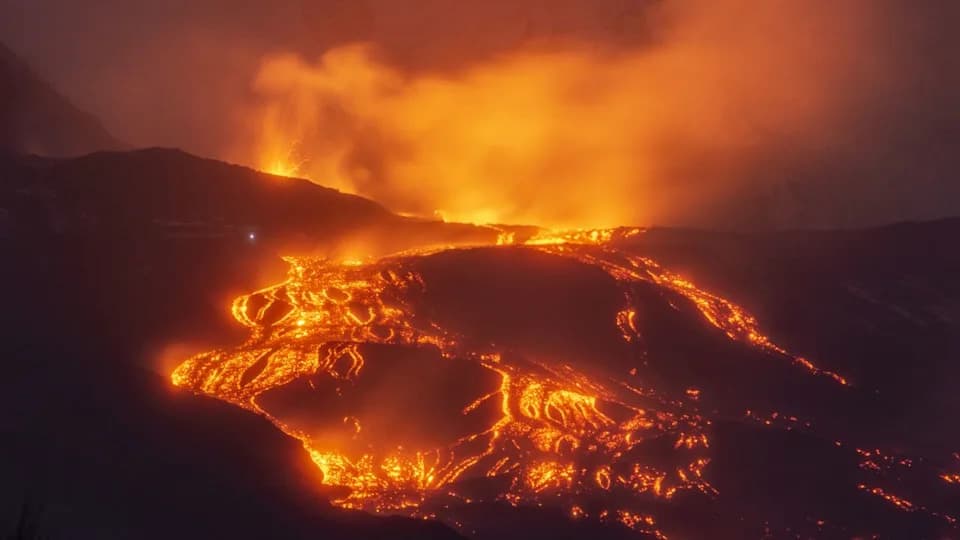
Mount Etna's strange lava has long perplexed scientists. Now they know why it's so weird. . | Credit: Anadolu via Getty Images
New research published April 7 in JGR: Solid Earth argues that Mount Etna — one of the most active volcanoes on Earth — does not fit neatly into the three classic volcano categories and may instead represent a previously unrecognized mode of volcanism driven by mantle melts and structural deformation of the lithosphere.
A Volcano That Defies the Usual Categories
Traditionally, volcanism has been grouped into three types: mid-ocean ridge volcanism (where tectonic plates pull apart), intraplate or hotspot volcanism (mantle plumes producing chains like Hawaii), and subduction-zone volcanism (where an oceanic plate sinks beneath a continent and triggers melting). Mount Etna’s setting and chemistry, however, do not match any of these neatly.
How Etna Is Different
Located on Sicily close to the African–Eurasian plate boundary, Etna sits almost on the plate interface rather than inland as typical subduction-zone volcanoes do. Geochemically, many of Etna’s lavas resemble hotspot-derived melts even though there is no clear hotspot under the volcano. Its eruptive history is also atypical: early eruptions produced relatively large volumes of silica-rich magmas, while later activity yielded smaller-volume, alkali-rich (potassium- and sodium-rich) lavas.
What the New Study Found
Sébastien Pilet and colleagues analyzed the geochemistry of lava layers spanning Etna’s eruptive history. They conclude much of Etna’s magma originates in a partially molten layer at the top of the mantle known as a low-velocity zone (so named because seismic waves slow when passing through melt-bearing regions). Such zones are probably widespread, but their melts seldom reach the surface.
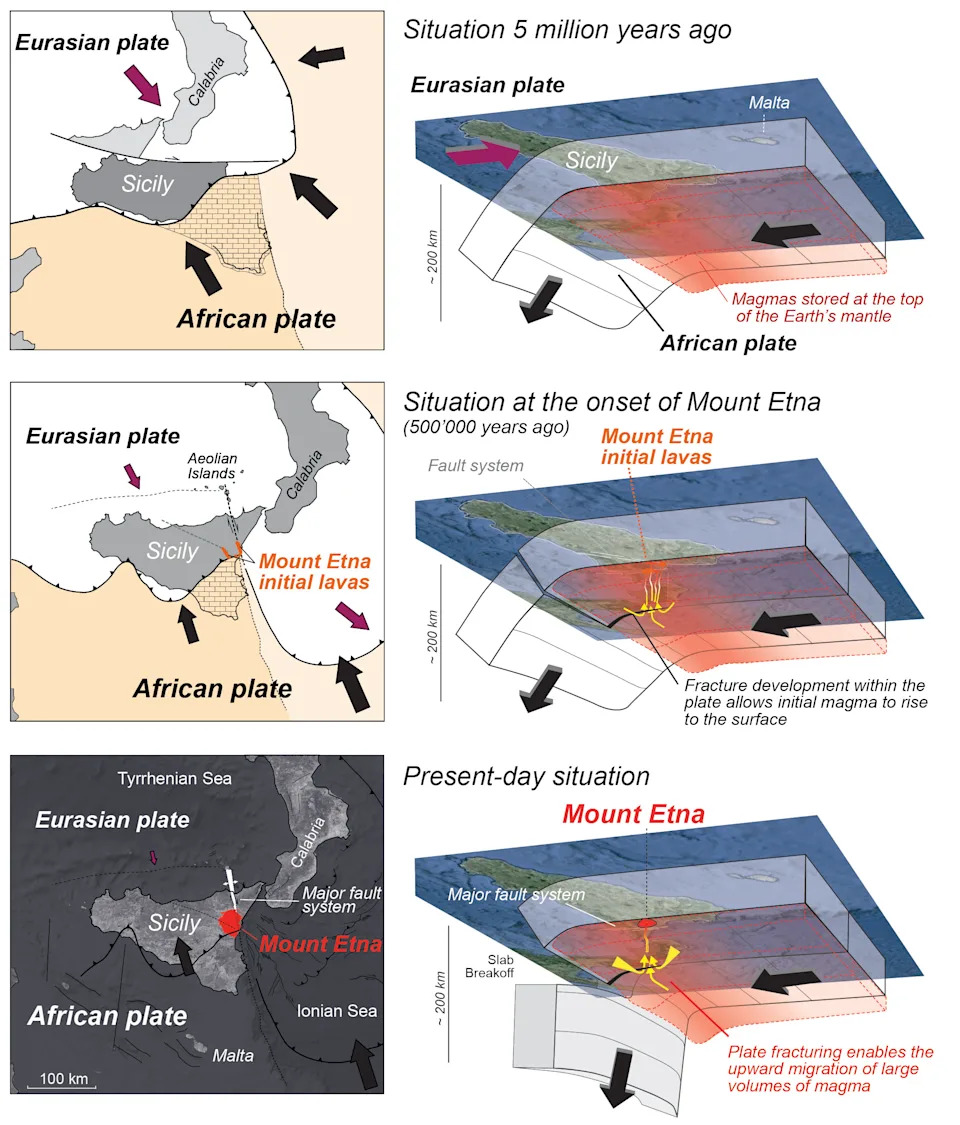
Mount Etna formation model, with the volcano starting to grow around 500,000 years ago. | Credit: University of Lausanne
"This actually represents a new type of volcanism," said Sarah Lambart, a petrologist at the University of Utah who was not involved in the study.
Pilet and co-authors suggest the decisive factor that allows melt from the low-velocity zone to reach the surface at Etna is structural deformation of the overlying lithosphere. The African plate is not subducting smoothly beneath Eurasia; parts of it are stalled and folded. These folds and faults create mechanical pathways for melt to ascend — pathways that would otherwise be absent.
Explaining the Two-Phase Eruptive History
According to the researchers, the earliest magmas traveled from the low-velocity zone up through the African plate and interacted with silica-rich continental crust on the way, producing abundant silica-rich lavas. Later, a more direct conduit from the mantle delivered alkali-rich melts from the low-velocity zone with less crustal contamination, but in smaller volumes.
Broader Implications
The work highlights an underappreciated role for lithospheric structure and magma–lithosphere interaction in controlling volcanic behavior. If low-velocity mantle melts are more widespread than previously appreciated and structural features can enable their ascent, similar processes might operate at other sites worldwide.
"The lithosphere might actually have a very important role in contributing one way or another to the magmatic activity we are seeing everywhere, not only Mount Etna," Lambart said.
Study: Pilet et al., JGR: Solid Earth (April 7). The research is based on geochemical analyses of Etna’s lava record and interpretations of regional tectonics and mantle structure.
Help us improve.