Researchers led by Niayesh Afshordi examined Quadratic Quantum Gravity and found it can remain well behaved at the extreme energies of the Big Bang. The model naturally yields an inflation-like expansion and may remove the need for an initial singularity predicted by general relativity. Next steps include testing the theory's robustness and deriving observable signatures—chiefly primordial gravitational waves and CMB imprints—to compare with future data.
Could Quantum Gravity Rewrite the Big Bang? A 'Quadratic' Model Reproduces Inflation Without a Singularity
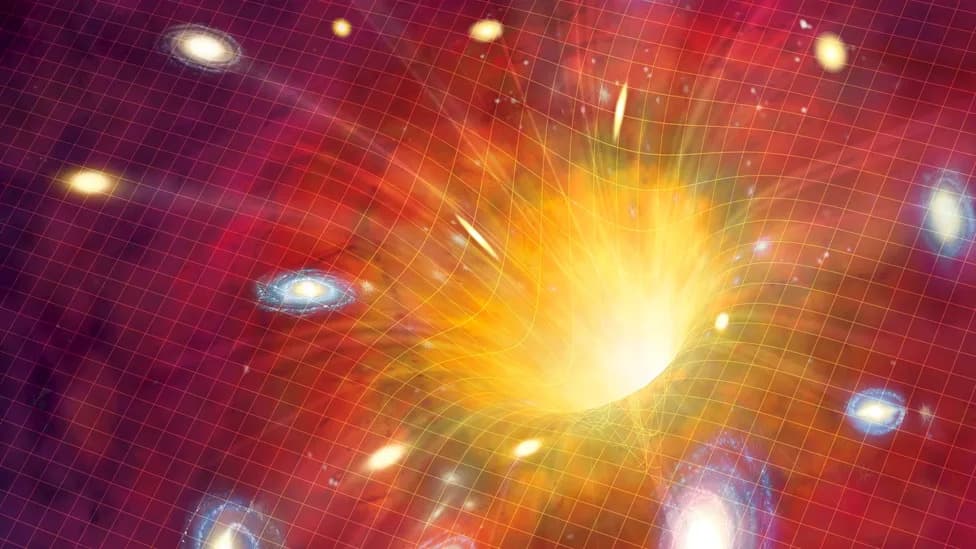
An illustration shows matter rushing forward from a singularity at the dawn of time during the Big Bang. | Credit: Robert Lea (created with Canva)
Scientists have proposed a revised description of gravity that could change how we understand the universe's first moments. A team led by Niayesh Afshordi (University of Waterloo and Perimeter Institute) explored a candidate theory called Quadratic Quantum Gravity and found it remains well behaved under the extreme densities and temperatures of the Big Bang. The model naturally produces an inflation-like phase and may eliminate the need for an initial singularity predicted by classical general relativity.
Why This Matters
General relativity, Einstein's theory of gravity, describes the large-scale universe with extraordinary accuracy but breaks down at very small scales and at the extreme energies present at the universe's origin. Where relativity predicts a singularity — a point of infinite density, curvature and temperature — physicists expect quantum effects to become important. A consistent quantum theory of gravity would bridge this gap between the very large and the very small.
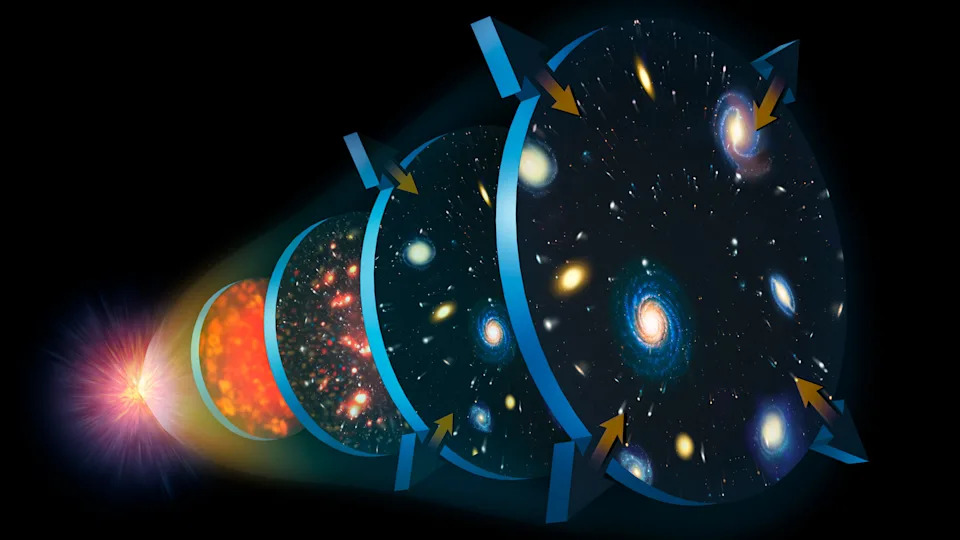
An illustration depicts the rapid expansion of the cosmos since the Big Bang. | Credit: TKTK
What the Team Found
Working within a quantum-consistent extension of gravity, the researchers showed that an inflation-like expansion can emerge directly from gravity rather than requiring a separate inflation field. In this framework, gravity is "ultraviolet complete," meaning the theory remains self-consistent up to arbitrarily high energies. According to Afshordi, this minimal extension of Einstein's equations can reproduce current observational constraints and, in some cases, fits the data as well as or better than several standard inflationary models.
"General relativity works extraordinarily well in many settings, but when we run it back to the Big Bang, and apply it to the inside of black holes, it predicts a singularity... That is usually a sign that the theory is being pushed beyond where it can be trusted," Afshordi said. "Our approach asks whether some of that early-universe behavior could come directly from gravity itself, once gravity is extended in a way that remains better behaved at extremely high energies."
Next Steps and Observational Tests
The authors emphasize two main next steps: further theoretical study to test the robustness of their conclusions beyond simplified settings, and the derivation of sharper observational predictions. The most promising observational probes are primordial gravitational waves (tiny ripples in spacetime produced during the universe's infancy) and subtle imprints in the cosmic microwave background (CMB). Detecting the right pattern of primordial gravitational waves or specific CMB signatures could help distinguish this gravity-driven inflation scenario from more conventional inflationary models.
The research has been published in Physical Review Letters. The team plans to refine the model's predictions so upcoming experiments and observations can test whether Quadratic Quantum Gravity describes our cosmic origins.
Help us improve.