New research on the Methana volcanic field, ~60 km southwest of Athens, reconstructs roughly 700,000 years of activity and shows volcanoes can remain dormant for more than 100,000 years while accumulating magma underground. Superhydrous, water-rich magmas can stall and crystallize in subsurface chambers, slowing ascent by 100–1,000x and enlarging reservoirs without surface eruptions. Although Methana is not considered an immediate major hazard, the study suggests many seemingly inactive volcanoes worldwide may still be building dangerous magma chambers beneath the surface.
Methana’s Long Sleep: Volcanoes Can Hibernate 100,000+ Years While Building Substantial Magma Chambers
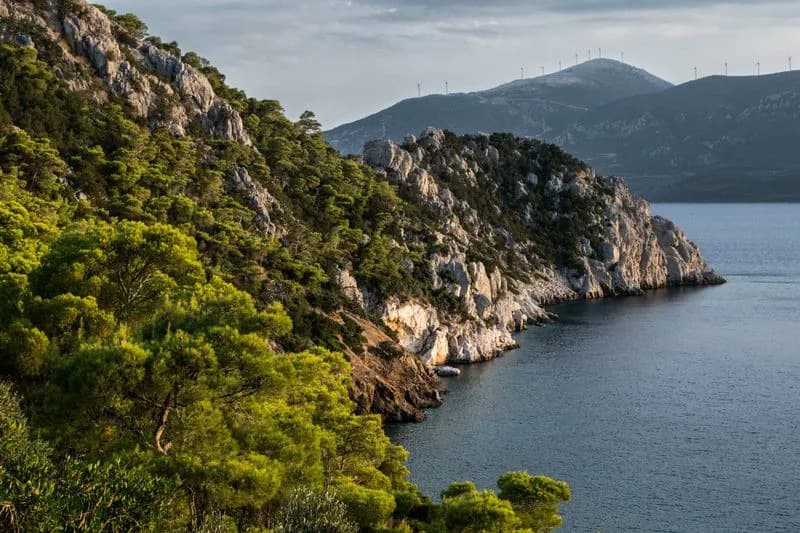
Brown lava rock from the youngest eruption on Methana is seen extending into the sea, with limestone visible behind, Greece, August 5, 2019. Razvan-Gabriel Popa/Handout via REUTERS/File Photo
New research on the Methana volcanic field, about 60 km (37 miles) southwest of Athens, shows that volcanoes can remain dormant for more than 100,000 years while quietly accumulating large volumes of magma beneath the surface. The study, led by ETH Zürich volcanologist Răzvan-Gabriel Popa and published in Science Advances, reconstructs roughly 700,000 years of Methana's history and overturns the common assumption that a 10,000-year gap implies extinction.
A Long, Quiet Build-Up
The researchers found eruption episodes separated by long pauses. The single longest quiescent interval — from about 280,000 to 168,000 years ago — did not mark the end of activity but corresponded to extensive magma accumulation at depth. To build this timeline, the team dated more than 1,250 zircon crystals from volcanic rocks and, where zircon was absent, analyzed other minerals such as ilmenite to trace the magma system's behavior during quiet intervals.
How Superhydrous Magma Keeps Volcanoes 'Sleeping'
In subduction-zone settings like Methana, the mantle can produce very water-rich, or superhydrous, magmas. As these magmas rise, they exsolve gas and trigger crystallization, which makes the melt much more viscous and sticky. According to Popa, this process slows magma ascent dramatically — by a factor of about 100 to 1,000 — causing it to stall and crystalize in chambers rather than erupt.
'This long period of quiescence at Methana happened during prehistory, so we are piecing it together based on chemical evidence preserved in rocks and minerals. Picture the volcano as the tip of an iceberg: most of the igneous system is underground,' Popa said.
Detecting Silent Magma Buildup
Although such accumulation is invisible at the surface, modern instruments can reveal it. Deep magma growth often produces small earthquakes detectable by seismometers, and the ground can bulge by a few centimetres per year — measurable by GPS and satellite-based techniques. Tracking crystals such as zircon also provides a detailed record of magmatic processes and timing.
Risk and Wider Implications
Methana sits relatively close to Athens, but researchers currently judge the site not to pose a significant short-term hazard; future activity would likely involve lava flows similar to past eruptions. Still, the findings imply that many volcanoes considered dormant worldwide — in regions such as Italy, the Americas, Japan and parts of Eastern Europe — may be quietly building magma reservoirs that could be mobilized under the right conditions.
The team plans follow-up studies, including a campaign at Ciomadul in Romania's Eastern Carpathians, a volcano that has been quiet for about 30,000 years but may still host an active magma chamber.
Takeaway: Quiet does not necessarily mean extinct — long periods of surface silence can hide active, growing magmatic systems beneath.
(Reporting by Marta Serafinko in Gdansk, Poland; editing by Will Dunham)
Help us improve.