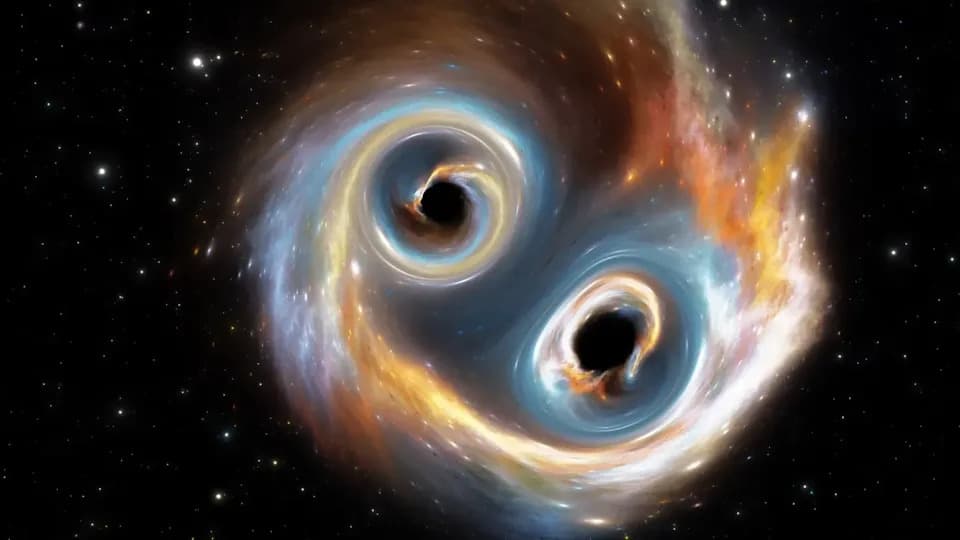
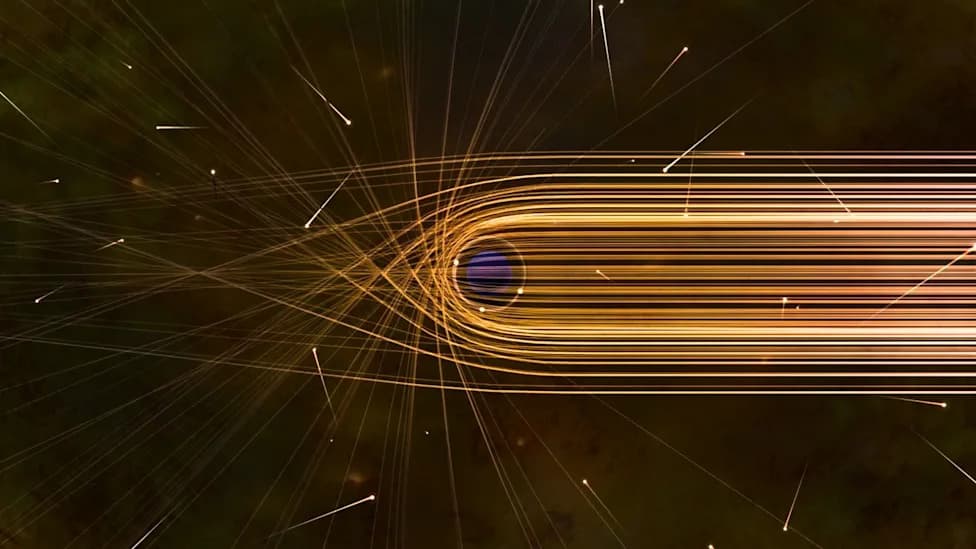
The black hole information paradox—how information can be conserved if black holes evaporate—might be resolved if space-time has three additional compact dimensions. A new paper suggests a G2-manifold geometry produces a torsion field that halts evaporation and leaves tiny, long-lived remnants capable of storing about 1.515 × 1077 qubits. Direct tests are far beyond current colliders, but indirect signatures could appear in the CMB or gravitational-wave data.
Could Seven Hidden Dimensions Solve the Black Hole Information Paradox?
Can Extra Dimensions Fix the Black Hole Paradox?DrPixel - Getty Images
For decades physicists have wrestled with the black hole information paradox: Hawking radiation implies black holes slowly evaporate and vanish, yet quantum mechanics forbids the destruction of information. A recent paper in General Relativity and Gravitation proposes a provocative solution—our familiar four-dimensional space-time may be embedded in a seven-dimensional geometry whose extra, compact dimensions generate a torsion field that halts complete black hole evaporation and leaves a stable remnant storing the missing information.
Seven Dimensions and a Twisted Geometry
Study co-author Richard Pinčák of the Slovak Academy of Sciences explained that the model adds three tiny, tightly curled spatial dimensions to the three we see plus time. Those extra dimensions form a G2-manifold, a specific mathematical structure whose geometry can both curve and twist space-time. That twisting produces a torsion field—distinct from ordinary curvature—that can alter the late-time behavior of evaporating black holes.
How Remnants Preserve Information
According to the authors, as a black hole emits Hawking radiation over incredibly long timescales, the torsion field becomes dominant when the hole shrinks to an extreme microscopic scale. The process then stalls, leaving a tiny, stable remnant that does not evaporate away completely. Although extraordinarily small—roughly ten billion times smaller than an electron—the remnant could, in their estimate, store an enormous amount of information, on the order of 1.515 × 1077 qubits, thereby addressing the information-loss problem.
Implications Beyond Black Holes
Intriguingly, the same geometric mechanism may also help with particle-physics puzzles. The torsion-induced potential in the model resembles the shape of the electroweak potential responsible for giving mass to W and Z bosons, suggesting a possible link between extra-dimensional geometry and the origin of the electroweak scale or related mass-hierarchy issues.
Observational Challenges and Possible Signatures
The hypothesis faces major experimental hurdles. Excitations or particles associated with the extra dimensions would inhabit energy scales roughly eleven orders of magnitude beyond the reach of CERN’s Large Hadron Collider, so direct detection at current colliders seems unlikely. However, the authors point out that the specific seven-dimensional geometry and its torsion field might have left indirect fingerprints: subtle imprints in the Cosmic Microwave Background (CMB) or distinctive gravitational-wave signals from stable black hole remnants could provide observational clues.
Bottom line: This seven-dimensional torsion proposal is speculative but concrete enough to guide future theoretical work and suggest indirect observational tests. If true, the universe’s geometry itself would play a central role in preserving quantum information.
Whether cosmological or gravitational-wave measurements will eventually reveal such fingerprints remains an open question. For now, the model joins a diverse set of proposals—ranging from holography and firewalls to remnants and multiverse scenarios—illustrating how geometry, high-energy theory, and observational cosmology continue to intersect in attempts to resolve one of physics’ deepest paradoxes.
Help us improve.