Frank Merle, a leading analyst of highly nonlinear systems, won this year’s Breakthrough Prize in Mathematics and a $3 million award for his work on singularities — or "blowups" — in equations modeling lasers, fluids and quantum systems. By attacking nonlinear structure directly, he highlights solitons — localized, shape-preserving waves — as organizing elements that simplify chaotic dynamics. Merle proved blowup can occur in certain laser models and in compressible Navier–Stokes equations despite viscosity, and he identified key mechanisms that allow blowup in supercritical nonlinear Schrödinger equations.
Master of Chaos: Frank Merle Wins $3M Breakthrough Prize for Taming 'Blowup' Equations
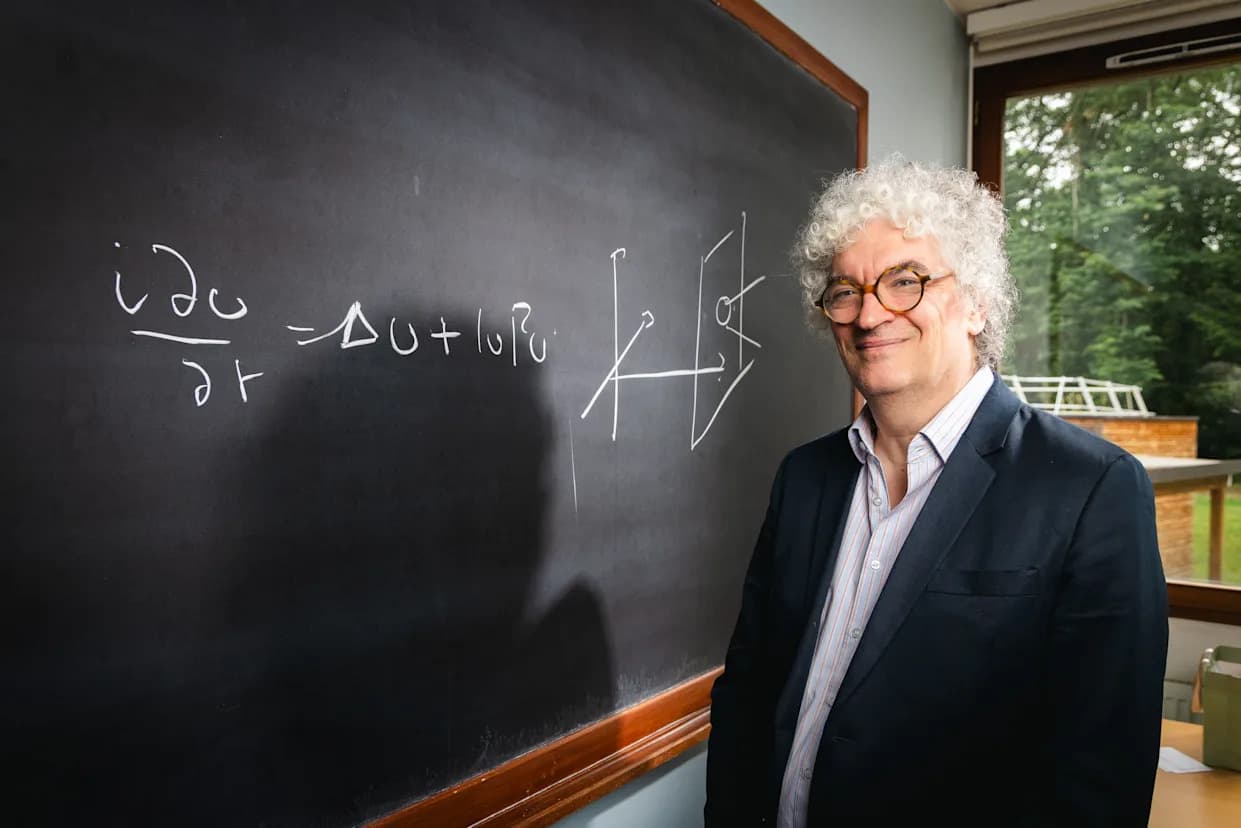
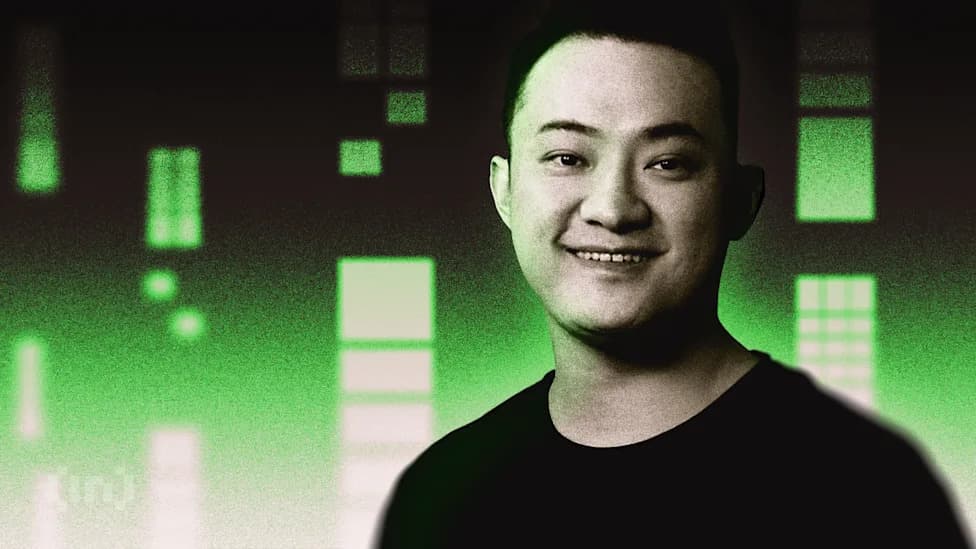
Frank Merle studies nonlinear equations, which respond in dramatic ways to tiny shifts in their inputs.(IHES/Christophe Peus)
Frank Merle studies systems whose behavior can shift violently in response to tiny changes — the highly nonlinear mathematics that can explain how a calm atmosphere over an empty plain might suddenly spawn a tornado.
By contrast, a linear relation such as y = 2x means y simply doubles when x doubles. Most real-world equations are far more sensitive: in strongly nonlinear systems, outputs can jump from near zero to arbitrarily large values almost without warning. Determining whether a set of equations can produce such extreme behavior — known in mathematics as a singularity or blowup — is a difficult and central problem in the field.
Merle has made remarkable progress in characterizing and controlling these blowups across models for lasers, fluids and quantum mechanics. Rather than beginning with a well-behaved linear approximation and nudging it toward nonlinearity, he attacks the full nonlinear structure directly. “I have a slightly different view of the world,” he says. “I see the world as a more catastrophic place to live.”
Engaging the chaos led Merle to an unexpected clarity. Much of his work centers on coherent structures called solitons — localized waves that preserve their shape and energy as they move. Imagine a single rogue wave racing across a vast, swirling ocean without losing form: solitons play a similar organizing role inside complicated nonlinear systems. Merle argues that many complex behaviors can be understood as collections of interacting solitons, so that apparent disorder conceals an underlying simplicity.
Today Merle was awarded this year’s Breakthrough Prize in Mathematics, which carries a $3 million purse. Scientific American spoke with him about his approach to some of nature’s most tangled equations. The following is an edited transcript of that interview.
What does this prize mean to you?
“It was a shock and it took me a while to recover. It’s a tremendous honor. When I introduced this viewpoint on nonlinear problems many colleagues were skeptical that it would yield significant results. But one problem yielded to the methods, then another, and slowly the community recognized the body of work.”
What was your new way of seeing nonlinear problems?
“I concentrated on the nonlinear structure itself. Most prior work started from linear, well-understood models and pushed slightly into nonlinear territory. My starting point was never linear — I focused on the nonlinear features from the outset.”
Why solitons?
“Solitons are intrinsically nonlinear: they are special solutions that do not radiate their energy away and that maintain shape. When you observe physical quantities in a nonlinear system they can appear chaotic, but over time stable structures can emerge that are largely independent of initial conditions. That emergent entity is the soliton. From the mathematics side, its emergence is not obvious, yet it happens.”
Merle emphasizes the soliton resolution conjecture, the idea that long-term dynamics of many nonlinear systems decompose into a finite collection of solitons plus dispersive radiation. Though believed since the 1970s, rigorous results have been scarce; Merle’s methods have pushed that frontier forward for important classes of equations.
What about blowup — why study it?
“Depending on the equation, blowup can be desirable or harmful; either way we need to understand its mechanics. For models of laser focusing, blowup corresponds to extreme concentration and can be useful. In fluids, blowup is tied to turbulence, which is often undesirable but ubiquitous and therefore essential to understand.”
Merle and collaborators proved that certain laser models indeed admit blowup under appropriate conditions. He stresses that a mathematical blowup does not mean a literal physical infinity — physical models are approximations, and different physics can appear at extreme scales — but the mathematical result pinpoints regimes where more detailed physics must be considered.
Fluids and the Navier–Stokes question
Merle’s work on fluid models addressed compressible Navier–Stokes equations. It was known that idealized, frictionless (inviscid) models can form singularities; Merle’s results show that adding viscosity (friction) in the compressible setting does not always prevent blowup. He notes that the Millennium Prize problem posed by the Clay Mathematics Institute concerns the incompressible Navier–Stokes equations, so that question remains open.
Nonlinear Schrödinger equations
The nonlinear Schrödinger equation combines a linear dispersive term with a nonlinear interaction. In so-called supercritical regimes the nonlinear term can dominate and drive blowup. Merle recounts how multiple near-misses in earlier attempts revealed a subtle missing element — once identified and controlled, that element unlocked a proof that blowup can occur in these regimes. “Sometimes the process of doing mathematics is nonlinear too,” he says: small, hard-to-control phenomena can compound into decisive behavior.
Why this matters
Beyond pure mathematical interest, understanding blowup and soliton interactions informs optics, fluid dynamics and quantum models, and it guides when and how simplified equations must be replaced by more complete physics. Merle’s work both sharpens the theory and clarifies the limits of common approximations.
What’s next? Merle continues to develop techniques to describe fine structures near singularities, to broaden the classes of equations for which soliton resolution can be rigorously proven, and to explore connections between blowup mechanisms across different physical models.
Help us improve.