What You Need To Know: Solitons are nonlinear, self‑reinforcing waves that travel at constant speed without changing shape. In a recent lab demo, The Action Lab used a mechanical sled in a 20‑foot channel to produce a stable soliton that traversed the tank and reflected back with negligible change. First observed by John Scott Russell in 1834, solitons inform both natural long rides like tidal bores and ambitious engineered ideas such as Greg Webber’s circular wave pool.
Lab Recreates a 'Never‑Ending' Soliton Wave — Could Surfers Really Ride It?
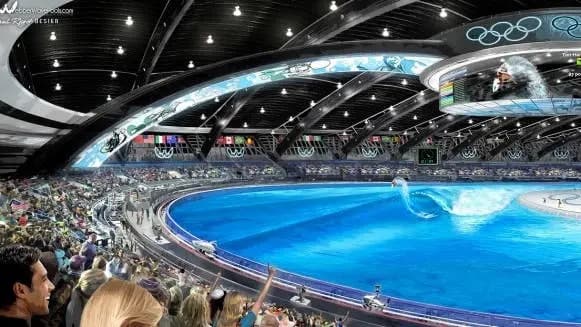
Greg Webber's non-linear, circular wave pool concept.Webber Wave Pools
Imagine catching one flawless wave and never having it end. That intriguing possibility is rooted in a well‑known but counterintuitive physics phenomenon called a soliton — a nonlinear solitary wave that can travel long distances without changing shape.
What Is a Soliton?
Solitons are self‑reinforcing wave packets in which the natural tendency of a wave to spread out (dispersion) is exactly balanced by nonlinear steepening. As a result, a soliton maintains its shape and speed as it propagates. The National Center for Biotechnology Information provides a technical overview describing solitons as persistent, shape‑preserving wave pulses.
The Lab Demonstration
In a recent demonstration, the YouTube science channel The Action Lab recreated this phenomenon in a controlled setting. Using a mechanical sled traveling through a 20‑foot (≈6.1 m) water channel, the presenter generated a stable soliton pulse. Unlike ordinary waves that disperse quickly, that localized pulse traversed the tank, reflected from the far end, and returned with almost no change in shape or speed.
From 19th‑Century Canals to Modern Tanks
The effect was first noted nearly two centuries ago. In 1834, Scottish naval architect John Scott Russell observed a "Great Translation Wave" in a shallow canal: a single pulse that continued at a steady speed without dispersing. Russell’s observation anticipated later mathematical and experimental work on solitary waves.
Natural Analogues and Engineering Possibilities
There are natural phenomena that produce exceptionally long rides — for example, tidal bores can create continuous surfs that travel for miles along river mouths. Still, recreating an endlessly circling, surfable wave in a built environment poses engineering challenges.
Traditional linear wave lagoons are inherently constrained by their finite length: a wave must eventually reach the edge. Over the years, designers have proposed imaginative workarounds. One high‑profile idea was Greg Webber’s circular "infinity" wave concept, which envisioned a peeling wave that could circle an island indefinitely. That particular design has not been implemented commercially, but it remains influential in wave‑pool research.
The Road Ahead
Laboratory demonstrations of solitons like the Action Lab experiment help researchers and designers better understand the physics of localized, long‑lived pulses. As wave‑generation technology and pool engineering advance, hybrid solutions — from improved linear machines to genuinely circular or continuously regenerated systems — could one day make an effectively endless surf possible.
For now, surfers can marvel at the surprising physics of solitary waves and the clever experiments that recreate them in the lab. Maybe one day a built environment will let riders chase a wave that truly never ends.
Help us improve.