At Yale Law School, Justice Ketanji Brown Jackson delivered a reasoned critique of the Supreme Court’s expanding "shadow" or emergency docket, urging greater judicial restraint and transparency. She warned that frequent, unexplained emergency interventions can undermine lower courts, produce real-world harms, and damage the Court’s institutional legitimacy. Despite a bench dominated by six Republican appointees, Jackson said she remains optimistic that her approach may gain traction over time.
Justice Ketanji Brown Jackson Challenges the Supreme Court’s 'Shadow' Emergency Docket
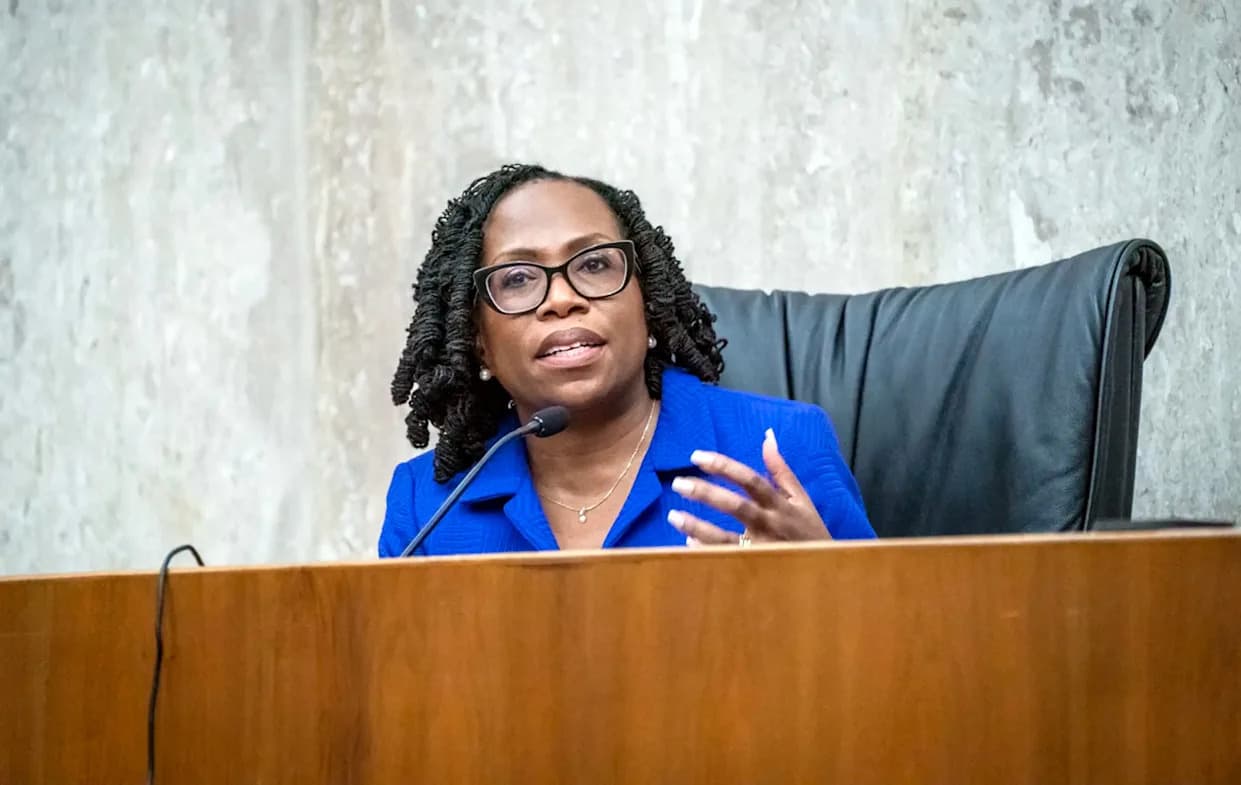
Supreme Court Justice Ketanji Brown Jackson gives a joint lecture at the Ceremonial Courtroom in Washington on March 9, 2026.(Maxine Wallace / The Washington Post via Getty Images)
Justice Ketanji Brown Jackson used a public lecture at Yale Law School to deliver a clear, measured critique of the Supreme Court’s growing reliance on what critics call the “shadow docket,” a practice she prefers to label the “emergency docket.” In a talk titled "Equity and Exigency: A First-Principles Solution for the Supreme Court’s Emergency Docket," she argued for renewed judicial restraint and greater transparency when the Court grants expedited relief.
Jackson positioned her view between the evocative term 'shadow docket' and the gentler 'interim docket' favored by Justice Brett Kavanaugh, stressing that semantics matter but so do principles: the Court must preserve its institutional role and public legitimacy by explaining its emergency interventions.
Her remarks followed recent comments by Justice Sonia Sotomayor, who said there is 'disagreement among us' over the emergency docket and warned of a 'shift in paradigm' after an unprecedented number of urgent appeals during the Trump administration. Sotomayor later apologized for a separate remark about a colleague that drew public attention.
Reflecting on the Court’s behavior since the era when she clerked for Justice Stephen Breyer, Jackson said the Court has become 'noticeably less restrained' and more willing to intervene before lower courts have developed a record. She warned this shift often bypasses the careful fact-finding and deliberation lower courts provide.
"Things are different now," Jackson said. "Today the Court routinely opts to enter the fray, and it fails to acknowledge the harms that follow when the Supreme Court of the United States consistently and casually divests the lower courts of their equitable authority."
Jackson emphasized that the Court’s expedited, unexplained orders can create real-world harms and erode confidence in the judiciary. She praised a dissent she joined last year that criticized the majority for sending the message that while most litigants must follow procedural rules, the administration seems to have the Court 'on speed dial.'
Drawing on her experience as a former district court judge, Jackson argued that routinely intervening in ongoing lower-court matters disrespects those courts’ authority and withholds the reasoned opinions that give the Supreme Court its persuasive power. She said summary orders without explanation deprive the public and lower courts of the Court’s 'work product'—the legal reasoning that underpins its authority.
Jackson acknowledged the political reality of a Court composed of six Republican and three Democratic appointees, which can leave her isolated even among the liberal justices. Still, in a question-and-answer session she described herself as 'at core a very optimistic person' and expressed hope that greater judicial restraint could gain wider acceptance over time.
Her Yale lecture is both a critique and a call to action: to preserve the Court’s legitimacy, Jackson urged clearer standards for emergency relief, fuller explanations for summary orders, and a return to deference for the lower courts when situations are not truly exigent.
Help us improve.