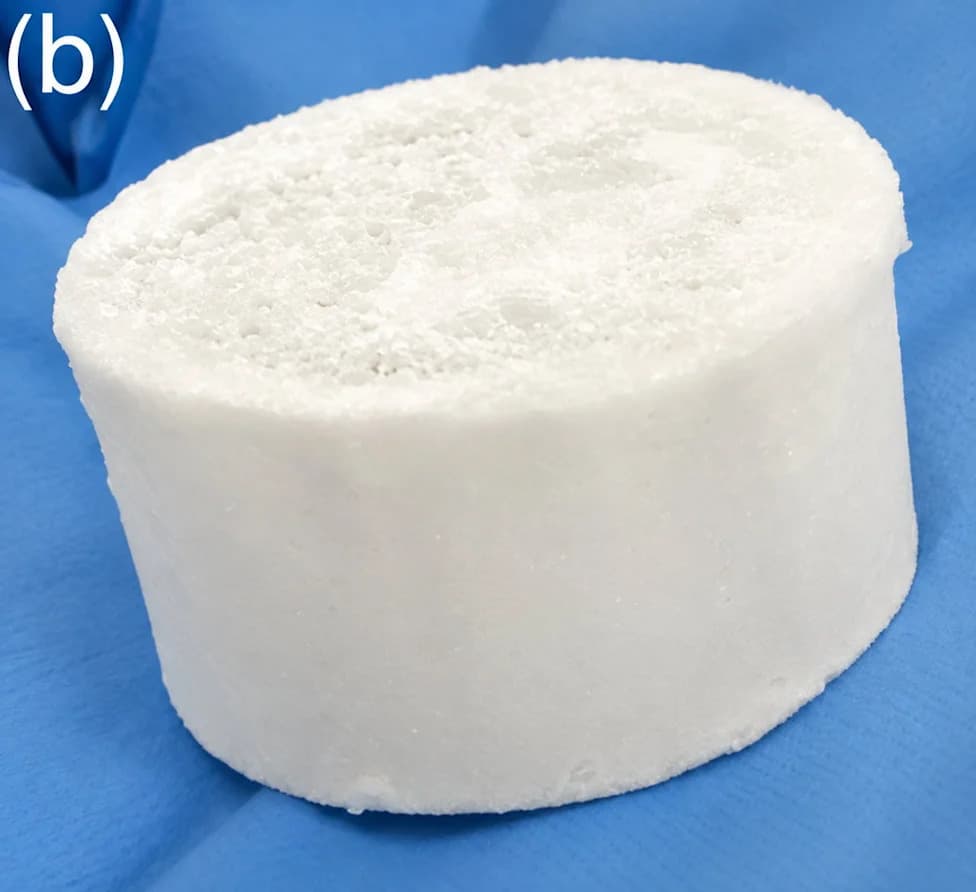
Wageningen University researchers report a new material class called compleximers that combines the slow melting of glass with the impact resistance of plastics. The team replaced permanent covalent crosslinks with long-range ionic interactions and added hydrophobic components to stabilize the network. Compleximers are easier to repair and potentially more recyclable than traditional thermosets, and the findings challenge existing ideas about the glass transition.
Bizarre 'Compleximers' Break the Rules of Both Glass and Plastic

Researchers at Wageningen University have created a startling new class of materials called compleximers that are moldable like window glass yet absorb impacts like many plastics. A few grams of one formulation now sit in a Wageningen lab, and the team led by physical chemist Jasper van der Gucht explains the chemistry in a report in Nature Communications.
Both silica glass and most plastics are considered glassy materials: when their liquids cool they do not form ordered crystals but instead become amorphous solids with a rigid feel and disordered atomic arrangements. For decades, experiments suggested a link between a glassy material's melting behavior and its impact tolerance: slow-to-melt glasses typically shatter under shock, while faster-melting, more abrupt glass-formers (many plastics) tend to resist impact better.
What Makes Compleximers Different?
Van der Gucht's team found that compleximers defy that trend. They designed polymer networks that replace permanent covalent crosslinks—typical of thermoset plastics—with long-range ionic interactions between charged segments of polymer chains. The researchers also added hydrophobic components to protect the network from water-driven disassembly. The result: materials that are slow to flow or melt like traditional glass but absorb impacts without shattering like many plastics.
The team proposes that ionic attractions act over longer distances than conventional covalent crosslinks. Those extended interactions may keep the polymer network compact when heated, preventing the rapid expansion and flow that normally accompany melting. That could explain how compleximers combine slow melting with improved toughness.
"Just by heating it with a heat gun, you can repair a scratch or a crack," says Jasper van der Gucht, describing how compleximers can be reshaped or fixed more easily than typical thermoset materials.
Matthew Tirrell, a chemical engineer at the University of Chicago who was not involved in the study, notes that ionic interactions could enhance the mechanical properties of glass-forming materials and make them easier to process. Beyond practical applications, the discovery offers physicists a new testing ground for theories of the glass transition: finding long-range interactions that alter melting behavior could help build more general models of how glassy solids form.
Potential Applications
Because compleximers are designed as a more easily recyclable alternative to conventional thermosets—and because they can be repaired with localized heat—they may find use in durable protective gear (helmets, padding), coatings, and other products that require both toughness and reworkability. Further research will explore durability, large-scale processing, and environmental stability.
Help us improve.