A team of researchers has synthesized a novel 13‑carbon ring that adopts a half‑Möbius electronic topology: two conjugated subunits (with 13 and 11 electrons) realign after a spontaneous 90° twist to form a delocalized 24‑electron system. This structure is chiral, yielding two enantiomers that can be switched with a small external voltage. The findings—confirmed by advanced quantum calculations—were published March 5 in Science and open pathways to new topological molecular materials and nanoscale electronic devices.
Scientists Create First 'Half‑Möbius' Molecule — A New Topology With Unusual Electronic Behavior

An illustration of a Mӧbius strip — a ribbon twisted 180 degrees then joined up with itself. Chemists have created a novel 'half-Mӧbius' molecule with truly unusual properties. | Credit: Jorg Greuel via Getty Images
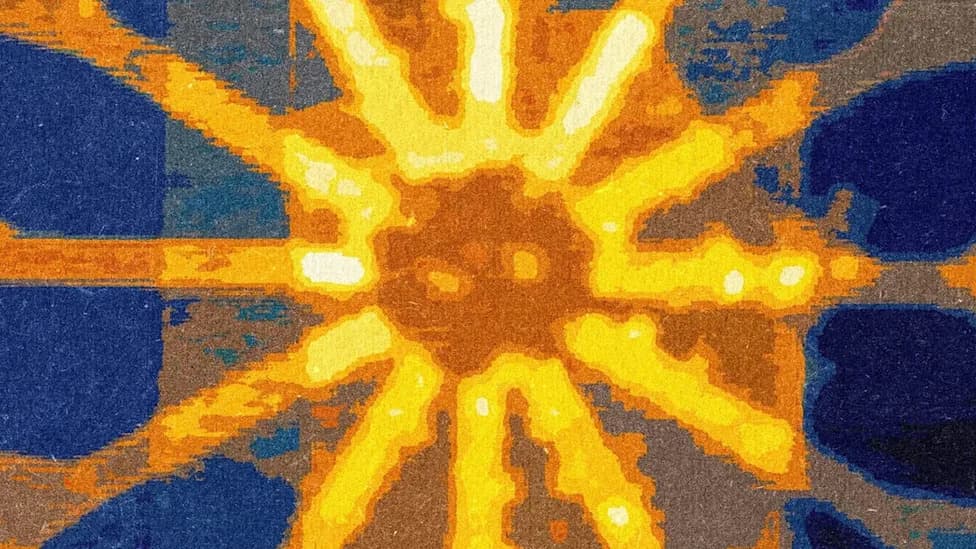
Researchers have synthesized an unusually twisted ring molecule whose electrons adopt a configuration never before seen in chemistry. The team calls this new arrangement a half‑Möbius topology, an intermediate electronic geometry that sits between conventional planar conjugation and a full 180° Möbius twist. The work—combining precision on‑surface synthesis, atomic‑scale imaging and advanced quantum calculations—was published March 5 in Science.
What Is a Half‑Möbius Molecule?
A Möbius strip is made by twisting a band 180° and joining the ends, producing a single continuous surface with striking mathematical and physical properties. In molecules, such topologies alter how electronic orbitals line up and how electrons delocalize around a ring. The newly reported half‑Möbius is distinct: the electronic orbitals between two subunits are rotated by 90°, producing a characteristic electronic structure that is neither planar nor fully Möbius.
How the Molecule Was Built
The researchers assembled a 13‑carbon ring with chlorine atoms bonded at positions 1 and 7. Those chlorines divide the ring into two conjugated subunits that initially hold uneven electron counts—13 electrons on one side and 11 on the other. Because electrons favor pairing, the molecule spontaneously distorts: the ring twists by 90°, lifting one chlorine atom up and pushing the other down to align the two subunits and allow electronic mixing.
“At this point, we don't have two separate systems any longer; we have one 24‑electron system,” said Igor Rončević, co‑lead author and lecturer in computational and theoretical chemistry at the University of Manchester.
Key Properties And Findings
The 90° twist produces a single, delocalized 24‑electron system with electronic and magnetic properties distinct from both conventional planar rings and full Möbius systems. The constrained twist also makes the molecule chiral: it exists as two mirror‑image enantiomers (left‑ and right‑twisted forms). Remarkably, the team demonstrated that a small external voltage can reversibly switch a single molecule between these enantiomeric forms—an ability that is extremely difficult to achieve by ordinary chemical methods.
Methods And Validation
Experimental observations (on‑surface synthesis and atomic‑scale characterization) were supported by detailed, state‑of‑the‑art quantum calculations to map the molecule’s unusual electronic structure. The collaboration was co‑led by Leo Gross of IBM Zurich and Igor Rončević of the University of Manchester.
Why This Matters
The half‑Möbius topology expands the palette of molecular architectures available to chemists and materials scientists. Potential implications include new families of tunable electronic and magnetic materials, molecular switches for nanoscale devices, and the exploration of more complex topological motifs (for example, multiple half‑twists or braided structures).
Looking ahead: the team plans to refine the theoretical framework and to explore additional half‑Möbius architectures and their functional uses in molecular electronics and materials science.
Help us improve.