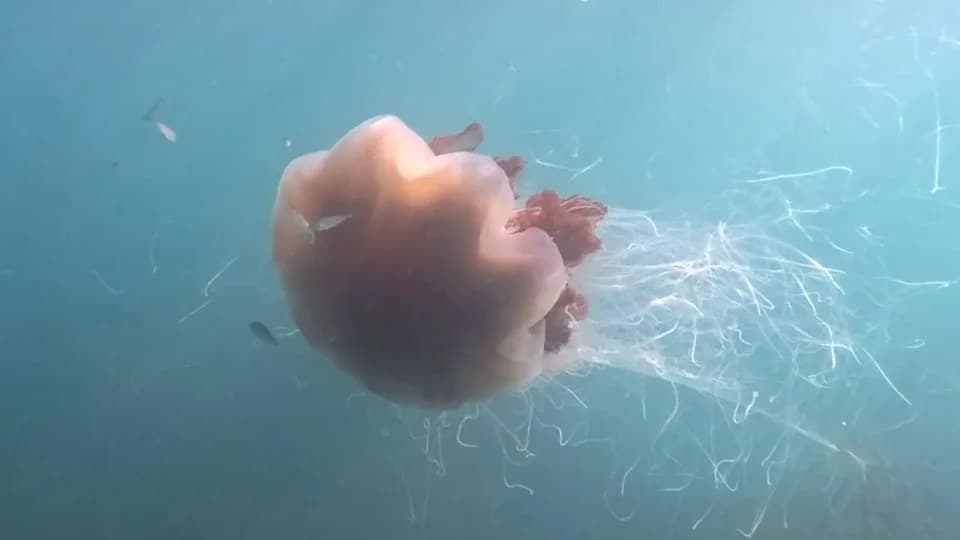
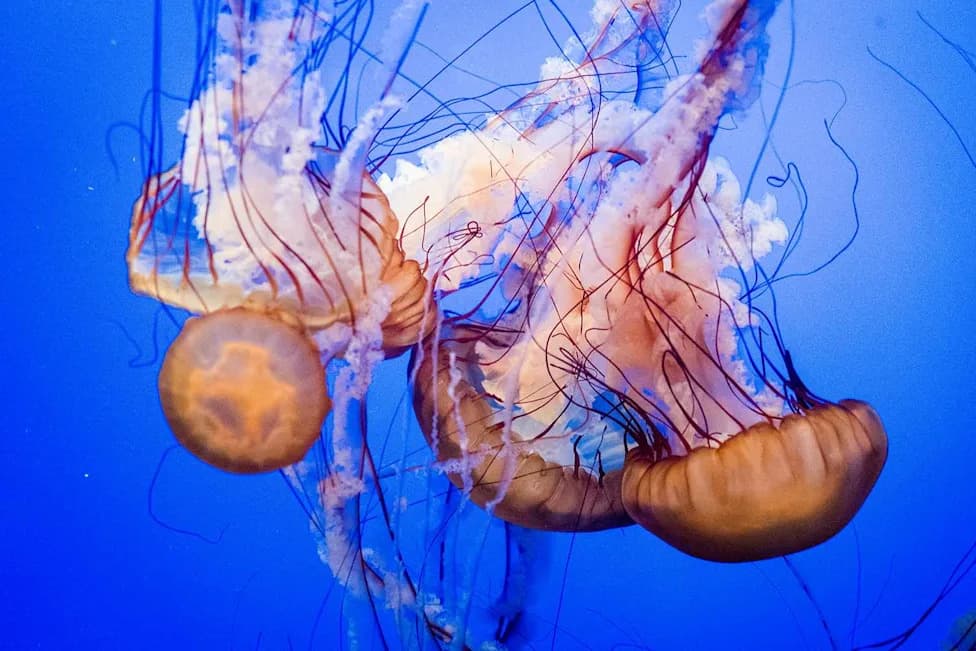
The lion's mane jellyfish (Cyanea capillata) holds the record for the longest animal, with tentacles recorded at about 36.6 m (120 ft) and a bell roughly 2.1 m (7 ft) wide. Its tentacles, which can number over 1,000, are lined with nematocysts that discharge in under 700 nanoseconds. Made of about 94% water and lacking bones or a centralized brain, the jellyfish sacrifices swimming efficiency for an extended capture zone suited to cold, prey-scarce waters. Researchers note decadal pulses in jellyfish populations and possible links to warming, overfishing and nutrient runoff, though global trends remain debated.
The Longest Animal on Earth Is Brainless and Boneless — Meet the Lion's Mane Jellyfish
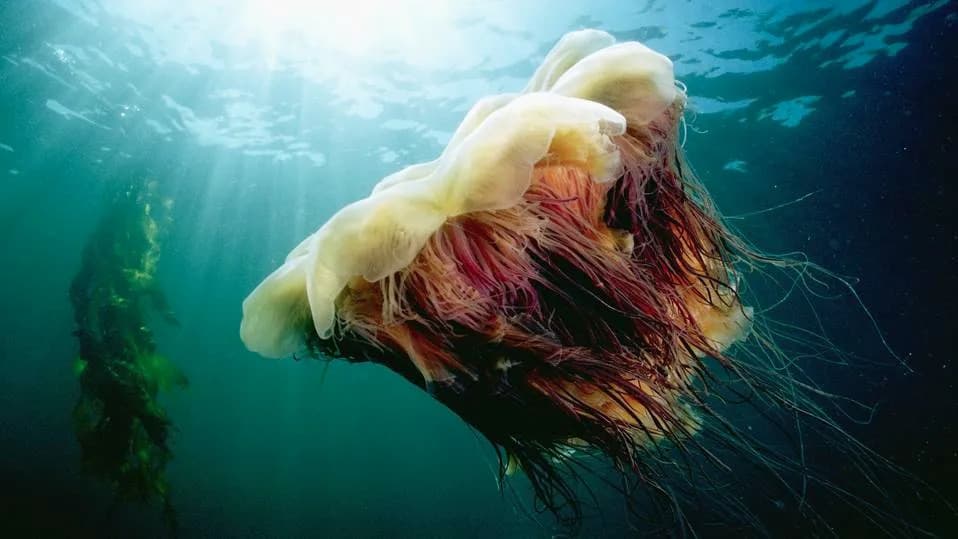
The longest animal on Earth isn’t what you think. It’s a drifting, gelatinous predator whose reach reshapes how we define size, survival and life in the ocean.getty
The longest animal ever recorded is not a whale or a giant squid but a drifting, gelatinous predator whose extraordinary reach forces us to rethink what 'large' means in the ocean: the lion's mane jellyfish.
Record Size
In 1865, a dead specimen washed ashore in Massachusetts with a bell measuring about 2.1 m (7 ft) across and tentacles trailing roughly 36.6 m (120 ft) behind it. That span exceeds any other known animal in length, including the blue whale, making Cyanea capillata the record holder for reach.
Form and Function
The lion's mane bell is divided into eight lobes and can vary in color from pale orange in juveniles to bright crimson or deep purple in large adults. Each lobe carries about 70 to 150 tentacles arranged in rows, and total tentacle counts in large individuals commonly exceed 1,000. Those threads are lined with nematocysts, specialized stinging cells used to capture and subdue prey.
Speedy Stingers
Nematocysts are not passive: they act like tiny pressurized harpoons. When triggered by touch or chemical cues they discharge in under 700 nanoseconds and fire at roughly 18 m/s (about 40 mph), injecting venom into whatever contacted the tentacle. This discharge is one of the fastest mechanical events known in biology.
Hunting Strategy and Trade-Offs
The lion's mane is largely a passive predator. Its slow bell contractions provide only modest propulsion, so the jellyfish relies on currents to travel. It uses its long tentacles as a vast, drifting net: positioning itself above prey, unfurling its threads and slowly sinking to entangle fish and zooplankton. In cold, nutrient-poor Arctic waters where prey can be sparse, reach often matters more than speed.
Extensive tentacles improve capture area but degrade swimming performance. A 2019 study in the journal Fluids found that long tentacles and oral arms can reduce propulsion efficiency by about 80–90% compared with a tentacle-free state, because they disrupt the vortex dynamics around the bell.
Biology and Energetics
Structurally simple, the lion's mane is approximately 94% water, radially symmetrical and built from only two tissue layers. It lacks bones, cartilage and a centralized brain. Its body consists of a muscular bell, a digestive cavity and an extensive trailing array of stinging threads, all held together by mesoglea, a gelatinous matrix that is itself mostly seawater.
This architecture is metabolically cheap: mesoglea requires far less energy to build and maintain than dense muscle, bone or large organs. That economy helps explain how these animals can reach enormous sizes without the caloric demands that constrain big, dense animals.
Ecological Role and What It Signals
Lion's mane jellyfish are more than curiosities: scientists use jellyfish trends as indicators of ocean change. Evidence is mixed, but research suggests jellyfish populations pulse on decadal cycles. A 2012 PNAS study found a slight net increase since the 1970s tied to warming seas, overfishing of competitors, coastal nutrient enrichment and expanding low-oxygen zones. A 2024 review in Frontiers in Marine Science cautions that robust global evidence of a simple, uniform increase in jellyfish blooms remains limited and contested.
The likely mechanism for local increases is a reinforcing feedback: overfishing removes predators and competitors, warmer water speeds jellyfish growth and reproduction, and nutrient runoff can favor gelatinous organisms over fish larvae. In other words, human-driven changes can shift ecosystems toward conditions where jellyfish thrive.
Perspective
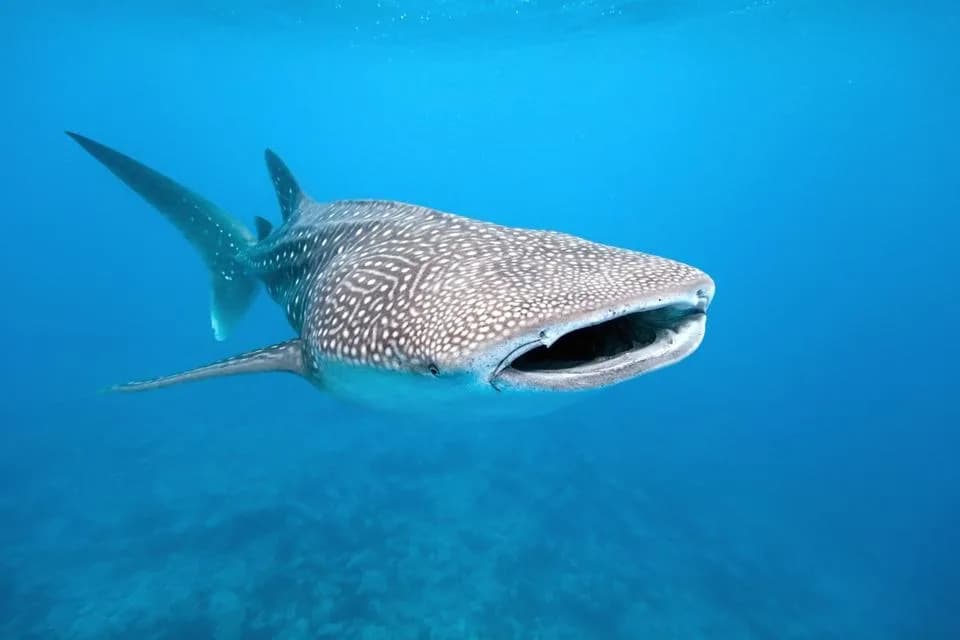
The blue whale is still the heaviest animal that has ever lived, consuming several tonnes of krill each day to fuel its metabolism. The lion's mane, by contrast, is cold, diffuse and metabolically economical. Both can claim to be "largest" by different measures: the whale by mass, the jellyfish by reach. As oceans warm and ecosystems change, the species shaped to survive on minimal energy may fare better in some altered habitats.
How connected do you feel to a world reshaped by animals like this? Consider how human activities influence ocean structure, and how those changes can favor different life strategies.
Help us improve.