The LHCb collaboration has confirmed the doubly charmed baryon Ξcc⁺ with a measured mass of 3619.97 MeV/c², based on roughly 915 reconstructed decays from the upgraded detector. Manchester teams provided key silicon pixel modules and engineering leadership that helped isolate the signal. The result resolves a long-standing conflicting measurement, strengthens tests of Quantum Chromodynamics, and highlights detector and computing innovations with wider applications.
LHCb Confirms Doubly Charmed Baryon Ξcc⁺ at 3619.97 MeV/c² — Manchester Hardware Helped Crack a Two-Decade Puzzle
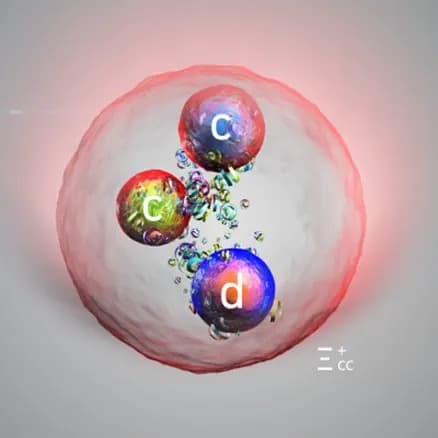
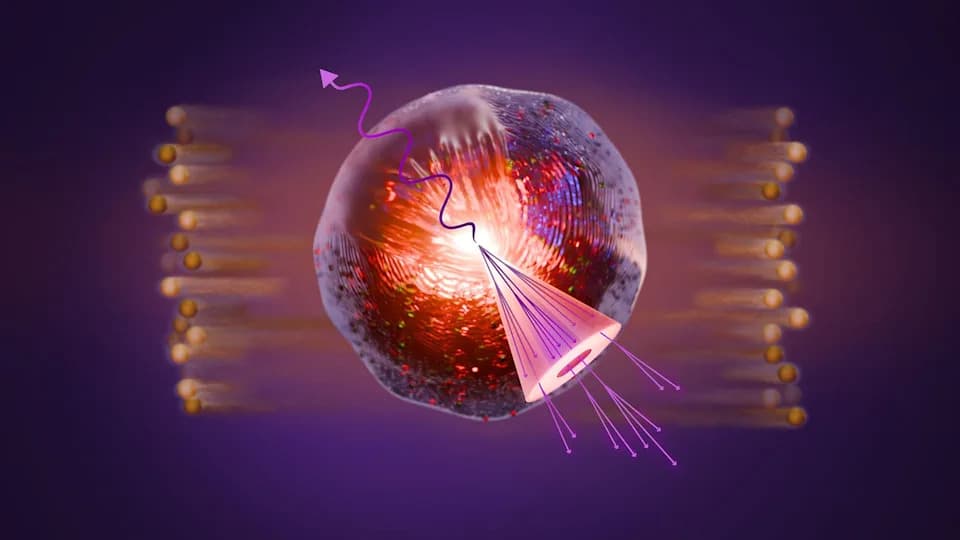
The particle, known as the Ξcc⁺ (Xi‑cc‑plus), is a new type of heavy proton-like particle containing two charm quarks and one down quark. (CREDIT: University of Manchester)
Researchers from the LHCb collaboration at CERN have confirmed the existence of a previously elusive, heavier cousin of the proton: the doubly charmed baryon Ξcc⁺. Announced at the Rencontres de Moriond Electroweak Conference, the result is based on fresh data from the upgraded LHCb detector and resolves a long-standing experimental disagreement about this particle’s mass.
The Ξcc⁺ is fundamentally different from a proton. While a proton is made of two up quarks and one down quark, the Ξcc⁺ contains two charm quarks and a single down quark. That composition makes it substantially heavier and extremely short-lived: it decays in only a fraction of a picosecond, so physicists reconstruct it from the tracks left by its decay products rather than observing it directly.
The LHCb analysis assigns a mass of 3619.97 MeV/c² to the Ξcc⁺ and identifies roughly 915 reconstructed decays into three lighter particles. That sample size and the upgraded detector performance give the collaboration confidence that the signal is genuine and not a statistical fluctuation. The new measurement disagrees with an early-2000s claim and instead aligns with theoretical expectations derived from the previously observed doubly charged partner, Ξcc⁺⁺, discovered by LHCb in 2017.
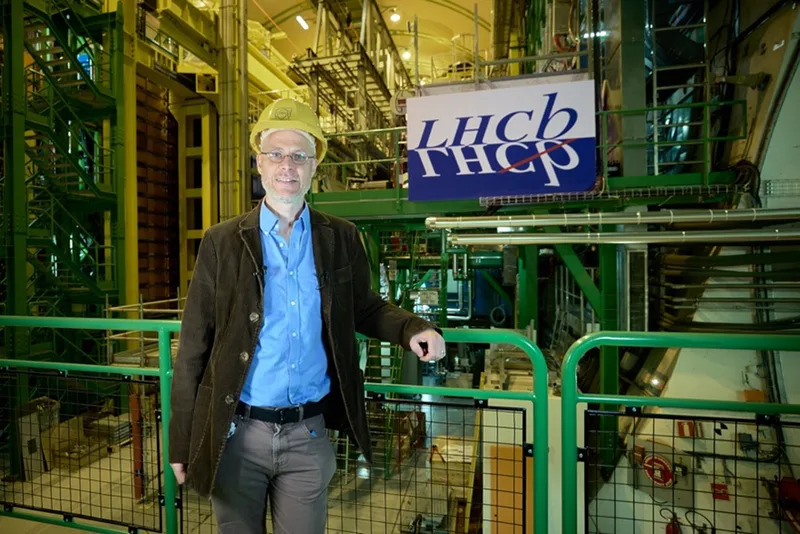
Prof Chris Parkes with the LHCb experiment. (CREDIT: Piotr Traczyk, CERN)
Manchester’s Role and Detector Upgrades
The University of Manchester played a leading part in the upgrade and in the hardware that made this observation possible. The Manchester group designed and built key elements of the new tracking system, notably silicon pixel detector modules assembled in the Schuster Building on campus. Those modules act like a high-speed camera, recording collision events about 40 million times per second, and provided the fine-grained tracking needed to separate the Ξcc⁺ signal from many overlapping decays.
“All of this represents the amazing capabilities of the upgraded LHCb detector and the outstanding UK and Manchester contributions to the project,” said Chris Parkes, Head of Physics and Astronomy at the University of Manchester, who coordinated the UK’s role through the upgrade program.
More than a thousand scientists from roughly twenty countries contributed to the upgrade. The UK made the largest national contribution, with Manchester providing both technical leadership and crucial hardware that extended beyond authorship on papers to direct engineering impact.
Why This Matters
Quarks come in six flavors, and Quantum Chromodynamics (QCD) describes how they combine to form composite particles. Ordinary matter is built from the two lightest flavors, up and down. The charm quark is much heavier, so systems containing two charm quarks are rare and offer a unique testing ground for QCD in a mixed heavy–light environment.
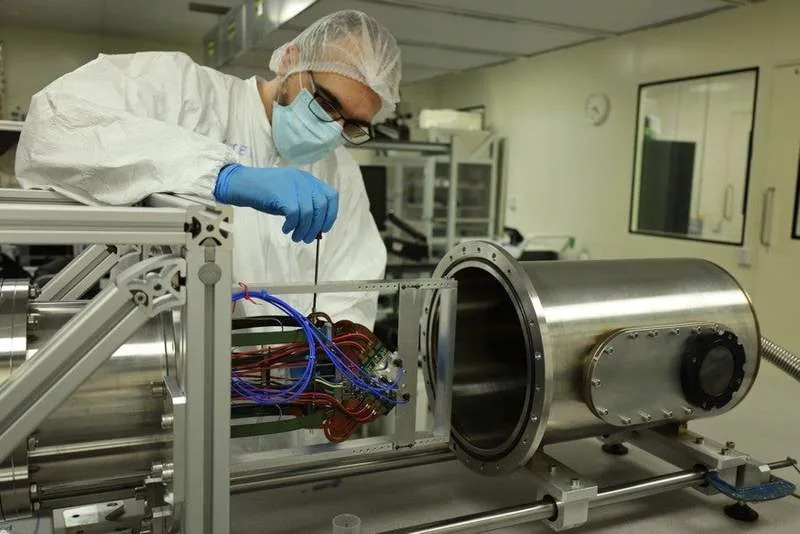
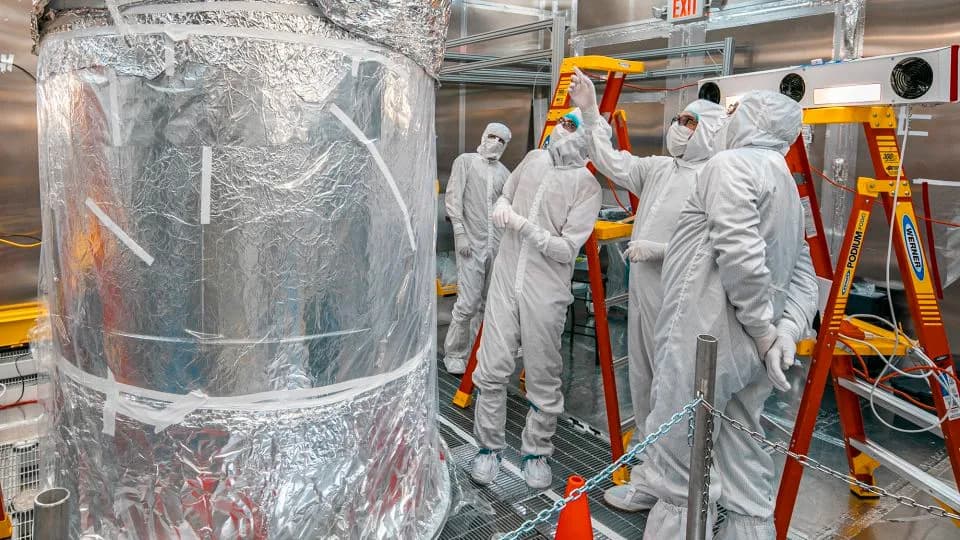
Dr Stefano de Capua testing the LHCb silicon detector modules in the Schuster Laboratory clean-rooms at the University of Manchester. (CREDIT: Amy O’Connor/STFC UKRI)
The Ξcc⁺ and its partner Ξcc⁺⁺ form the doubly charmed baryon pair. Observing both members gives theorists a firmer experimental basis to test calculations of how quarks bind under the strong interaction, improving confidence in QCD predictions and guiding searches for still more exotic states.
These short-lived baryons typically exist for only a few tenths of a picosecond before decaying via the weak interaction. Physicists infer their properties by reconstructing the decay products’ trajectories and energies inside detectors like LHCb.
Broader Impact and Future Prospects
Immediate practical applications of the Ξcc⁺ discovery are unlikely, but the technologies and computational methods developed for the measurement have broader benefits. The silicon detector technology is already finding medical imaging applications, and the high-throughput data processing and pattern-recognition techniques push the limits of computing and machine learning.
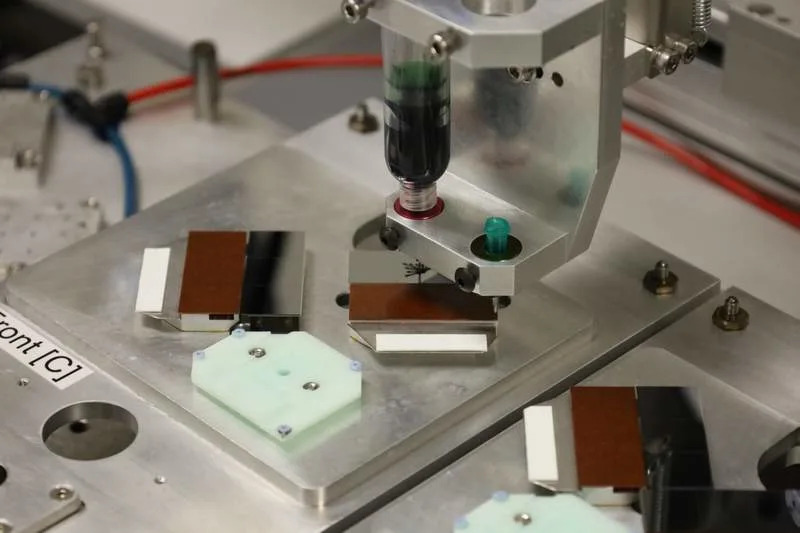
VELO detectors being made at University of Manchester. (CREDIT: Amy O’Connor/STFC UKRI))
LHCb is preparing for a further upgrade (Upgrade 2) to run with the High-Luminosity LHC. That next phase will dramatically increase collision rates and data volumes, improving the chances of discovering even rarer particles such as triply heavy baryons or novel multi-quark states.
Historically, the result also resonates with Manchester’s legacy in particle physics: Rutherford’s early-20th-century experiments there established the proton, and Manchester researchers in the 1950s first identified a member of the Xi family. The new Ξcc⁺ observation builds on that long tradition, now enabled by contemporary detector technology and international collaboration.
In short, the LHCb observation of the Ξcc⁺ at 3619.97 MeV/c², supported by about 915 reconstructed decays and enabled by Manchester-built silicon modules, settles a two-decade discrepancy and sharpens experimental tests of how quarks bind to form matter.
Help us improve.