Researchers sent bacteriophage T7 and its host E. coli to the International Space Station and compared them with Earth controls. Space-grown phages initially took longer to infect, but after adapting in microgravity they evolved surface mutations that improved attachment and increased bacterial killing. Returned phages were able to kill a phage-resistant E. coli strain linked to persistent urinary tract infections, suggesting a possible path to develop stronger therapeutic phages, though safety and specificity require further study.
Spaceflight Makes Bacteriophages More Potent — Potential Boost For Phage Therapy
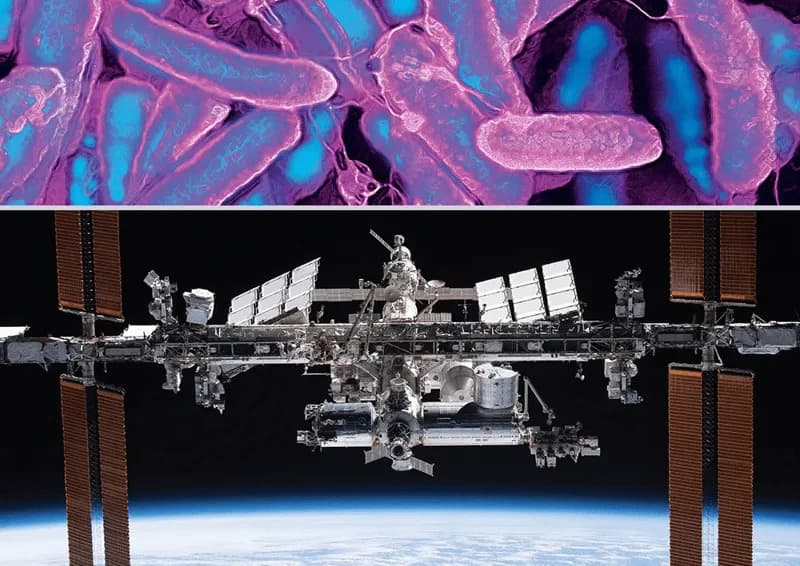
Escherichia coli bacteria went up against viruses on the International Space Station.(Cavallini James/BSIP/Universal Images Group/Getty Images (top); NASA (bottom))
Bacteria and the viruses that infect them are locked in constant evolutionary conflict. A recent experiment on the International Space Station shows that exposure to microgravity can drive bacteriophages (viruses that prey on bacteria) to evolve mutations that increase their ability to kill bacterial cells.
In a study published in PLOS Biology, researchers grew the well-characterized laboratory phage T7 alongside its host, Escherichia coli, in parallel incubations on Earth and in low Earth orbit. On the ground, phage infection typically established within two to four hours. In orbit, phages initially took longer than four hours to overcome bacterial defenses — a delay the authors attribute to the unfamiliar physical stresses of microgravity that both virus and host must adapt to.
After multiple generations in microgravity the space-evolved phages acquired genetic changes that altered surface structures involved in attachment. Once adapted, these phages became more effective at finding and binding to bacterial cells and were more lethal than their Earth-reared counterparts.
Why microgravity matters: The team and external experts point to changes in fluid dynamics as a likely driver. Under normal gravity, fluid motion helps mix microbes and increases encounter rates between phage and host. In microgravity, reduced mixing may select for phage variants with improved attachment or host-recognition features so they can infect successfully despite fewer random encounters.
Importantly, when returned to Earth the space-adapted phages were able to kill a different E. coli strain known to cause stubborn urinary tract infections and often resist phage attack. Senior author Srivatsan Raman described that outcome as "really quite promising," highlighting the possibility that environmental stressors could be used to select phages with enhanced therapeutic potential.
Context and caution: While the findings point to a novel way to evolve phages with increased potency, researchers emphasize the need for extensive follow-up work. Key next steps include testing the specificity and safety of evolved phages, assessing how broadly effective the mutations are across bacterial strains, and ensuring no unintended consequences arise from using environment-evolved viruses in medical settings.
Bottom line: Microgravity can change the course of viral evolution in measurable ways. That effect may be harnessed to develop stronger, more effective bacteriophages for research and potentially for treating antibiotic-resistant infections — but careful testing and biosafety assessment are essential before any clinical application.
Help us improve.