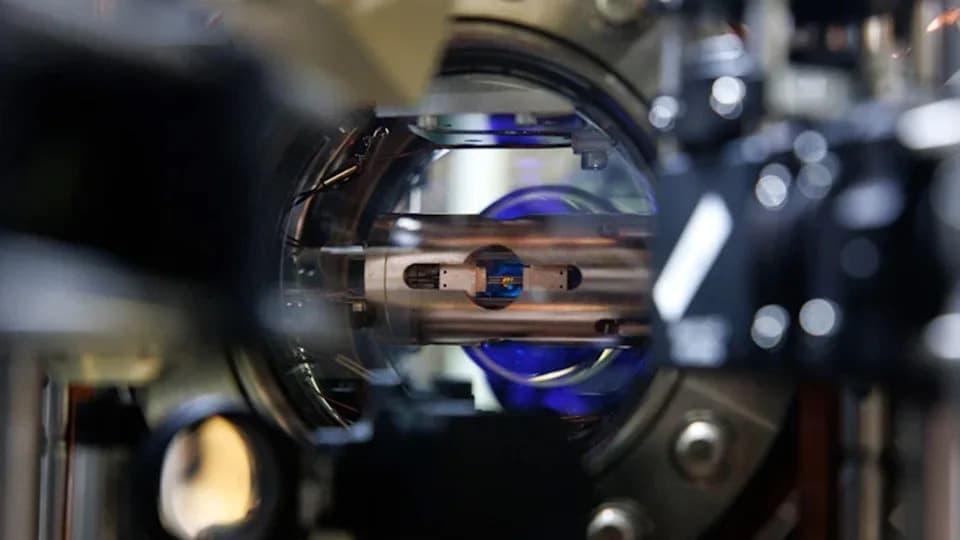
The University of Science and Technology of China upgraded a strontium optical lattice clock that measures time to 19 decimal places, with uncertainty 9.2 × 10⁻¹⁹ and stability 6.3 × 10⁻¹⁹. This meets proposed single-clock accuracy benchmarks for redefining the SI second. If at least three independent clocks using the same atomic transition reach similar performance, a redefinition could be proposed for the CGPM in 2030. Such clocks also enable relativistic geodesy and sensitive dark-matter searches.
USTC's Strontium Optical Clock Measures Time to 19 Decimal Places — Could Drive Redefinition of the SI Second
(Adam Gault/Photographer's Choice RF/Getty Images)
Researchers at the University of Science and Technology of China (USTC) have upgraded a strontium optical lattice clock that ranks among the most precise timekeepers ever built. The instrument can resolve time to 19 decimal places — meaning it would gain or lose only about one second over roughly 30 billion years.
Record Precision and Stability. The team reports an uncertainty of 9.2 × 10⁻¹⁹ and a stability of 6.3 × 10⁻¹⁹. This performance meets the widely cited 2 × 10⁻¹⁸ single-clock accuracy criterion that many metrologists consider necessary for proposing a redefinition of the SI second.
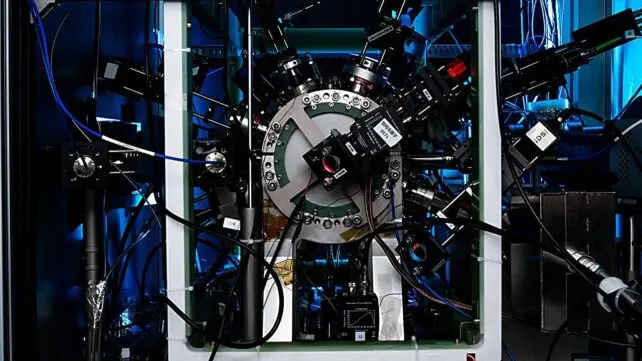
The USTC's strontium optical clock. (CMG)
Why Optical Clocks Are Better. Since 1967 the SI second has been defined by the cesium-133 atom as exactly 9,192,631,770 oscillations of its microwave transition. Optical clocks use much higher-frequency transitions in atoms like strontium — on the order of hundreds of terahertz (the strontium clock transition is around 429 THz) — which produces many more cycles per second and enables far greater precision (approaching 10−18 seconds).
Requirements for Redefinition. Before the international community adopts a new definition, at least three independent optical clocks that rely on the same atomic "tick" and demonstrate the required accuracy and stability must operate at separate institutions so they can be cross-compared. The USTC clock meets those benchmarks; two other strontium clocks and two aluminum-ion clocks have already surpassed similar thresholds.

Subscribe to ScienceAlert's free fact-checked newsletter
Scientific Applications. Beyond improving timekeeping, ultra-precise optical clocks enable practical and scientific advances: relativistic geodesy (measuring tiny differences in Earth's gravitational potential by comparing clock rates), sensitive searches for transient or persistent dark matter signatures, improved synchronization for navigation and communication systems, and tests of fundamental physics.
International Timeline. Decisions about SI base units are made by the General Conference on Weights and Measures (CGPM), which meets every four years. The committee asked experts to "work towards a proposal for the new definition of the second to be presented at the 29th meeting of the CGPM (2030)" and recommend an implementation date once the technical criteria are robustly met.
"This performance meets the 2 × 10⁻¹⁸ single-clock accuracy requirement for redefining the SI second, with potential applications in relativistic geodesy and high-resolution dark matter searches," the USTC team writes in their paper.
The USTC results have been published in the journal Metrologia. As more ultra-stable optical clocks are built and compared across laboratories worldwide, the case for an SI-second redefinition becomes increasingly compelling.
Help us improve.