The study from Queen Mary University of London and University College London demonstrates that human fingertips can detect objects buried in dry sand before contact by sensing pressure waves traveling through the grains. In tests with 12 volunteers (216 trials), participants produced 79 precontact detections and an average sensitivity of d' = 1.1973. A robotic fingertip equipped with force sensors and LSTM models replicated and extended the effect, achieving up to 91% precision at conservative thresholds while revealing a clear trade-off between detection range and reliability. Applications range from archaeology and search-and-rescue to planetary exploration.
Hidden 'Seventh Sense': Humans Can Detect Buried Objects Through Sand

A new study finds people can detect buried objects through dry sand before contact, revealing an overlooked extension of the human sense of touch. (CREDIT: Shutterstock)
New experiments from Queen Mary University of London and University College London show that human fingertips can sense pressure waves traveling through loose sand and detect objects before direct contact. Volunteers sliding a finger through dry grains often reported feeling a buried 5 cm cube several centimetres ahead of contact — a result confirmed and extended by a robotic fingertip equipped with force sensors and machine learning.
What the Study Did
Inspired by shorebirds that locate prey by probing sediment, the research team tested whether untrained humans retain a comparable ability. They recruited 12 volunteers (ages 18–26) and had each participant sweep a single index finger through dry sand inside a covered box at a steady pace of 2 cm/s, guided by a blinking LED strip. The track exceeded one metre and, on some trials, a 5 cm plastic cube was buried at an unknown location.
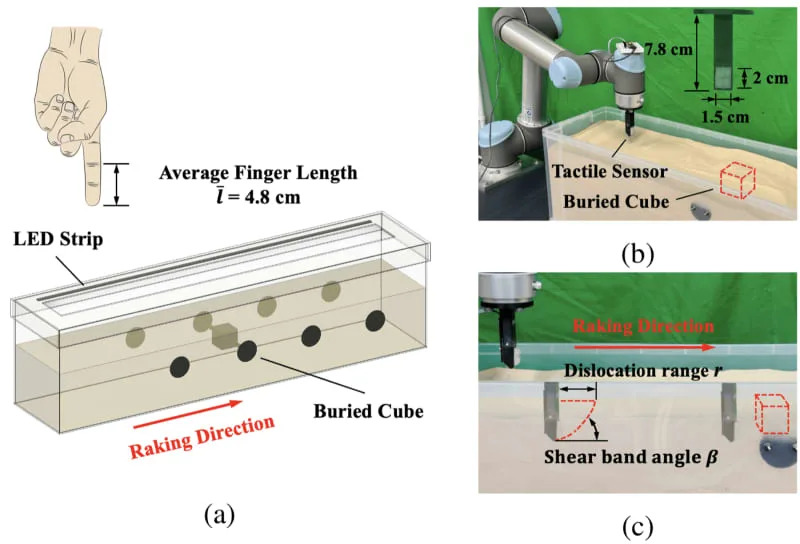
Experimental setup for detecting touch in granular materials. (CREDIT: IEEE Xplore)
Before each trial participants briefly touched the cube to standardize finger depth; average depth during trials was about 4.8 cm. Participants reported when they felt something unusual while moving their finger through the sand. The design deliberately removed visual and contextual cues so responses relied on tactile information alone.
Human Results
Across 216 human trials, volunteers detected buried objects without contact 79 times, found objects by touch 35 times, recorded 30 false positives, and correctly reported no object on 58 trials. Applying signal detection theory yielded an average sensitivity of d' = 1.1973 (well above chance) and a response-bias c = -0.112, indicating no strong tendency to say "yes" indiscriminately.

Shorebirds such as sandpipers, lesser yellowlegs and plovers hunt by pressing their bills into wet sand, detecting buried prey through tiny pressure shifts without ever seeing what they are after. (CREDIT: Russ / Wikimedia / CC BY-SA 4.0),
Most precontact detections occurred about 2.7 cm before fingertip contact with the cube. Granular-physics calculations place a theoretical detection ceiling at roughly 6.9 cm for these conditions; human performance fell short of that physical limit, likely because of natural finger wobble and the variability of shifting grains. Still, participant precision exceeded 70% overall.
"This changes our conception of the perceptual world," said Elisabetta Versace of Queen Mary University of London, describing touch as extending awareness beyond direct contact.
Robotic Follow-Up
To probe the physical signals driving the effect, the team built a robotic finger: a UR5 arm fitted with a human-sized tactile tip instrumented with four sensors measuring forces in three axes. The robot ran 120 trials (including 20 no-object trials) at the same 2 cm/s pace.
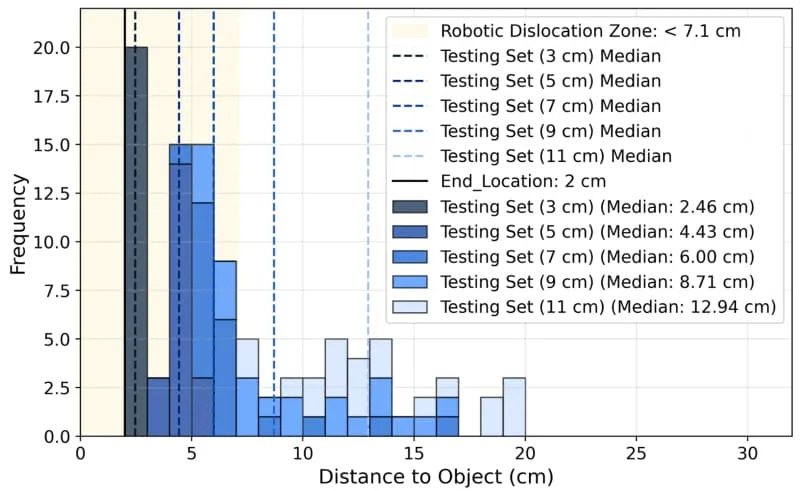
Histogram showing how far each of five LSTM models was from the object when it first detected it during the robotic experiment (20 trials with the object buried). (CREDIT: IEEE Xplore)
Five LSTM (Long Short-Term Memory) machine-learning models processed the sensor streams with different early-detection thresholds between 3 and 11 cm. With the lowest threshold the robot detected the buried cube in every trial and avoided false alarms 90% of the time; precision peaked at 91%, exceeding any individual human score. However, increasing the allowable detection range introduced false positives as ordinary sand motion began to trigger detections — at the broadest threshold, precision dropped toward zero.
Median detection distances illustrate the trade-off between reach and reliability: 2.46 cm for the most conservative threshold, 4.43 cm for a mid-range (5 cm) model, and up to 12.94 cm for the widest threshold. Matching human performance to a seven-centimetre robot model placed both near the predicted physical limit, although humans showed fewer false positives and tended to hesitate when cues were ambiguous.
Why It Matters
The findings suggest practical applications for tactile sensing in domains where vision fails or disturbance must be minimized. Potential uses include:
- Archaeology: locate fragile buried objects before excavation to reduce damage.
- Search and rescue: probe rubbled or buried spaces when cameras or sonar are ineffective.
- Planetary exploration: navigate and detect objects in dusty or low-visibility terrains such as Mars or icy moons.
- Assistive tools: provide humans with remote or mediated tactile feedback for tasks in granular materials.
PhD student Zhengqi Chen and collaborators emphasize that psychology, robotics, and machine learning combined to reveal both the behavioral capacity and the underlying physical signals. The research report is available via IEEE Xplore, and the original journalism summary appeared in The Brighter Side of News.
Help us improve.