This study presents the first experimental evidence that humans can detect a buried object in sand before direct contact — a form of "remote touch." In 216 trials with 12 volunteers, participants achieved 70.7% precision and sensitivity d' = 1.1973 (p = 0.0004); the modelled detection zone averaged ~6.9 cm and median pre-touch detections were ~2.7 cm. A UR5 robot with LSTM models often detected objects earlier but produced many more false positives (40% precision), highlighting differences between raw sensitivity and reliable perception. Findings may inform tactile robots for archaeology, search-and-rescue, marine work and planetary exploration.
Humans May Have a 'Seventh Sense' — They Can Detect Buried Objects Before Touching Them

People detected buried objects through sand before contact, revealing a previously undocumented form of remote touch in humans. (CREDIT: The Brighter Side of News)
Researchers report the first experimental evidence that people can detect objects hidden beneath sand before the fingertip makes direct contact — a form of "remote touch" previously documented in some probing shorebirds.
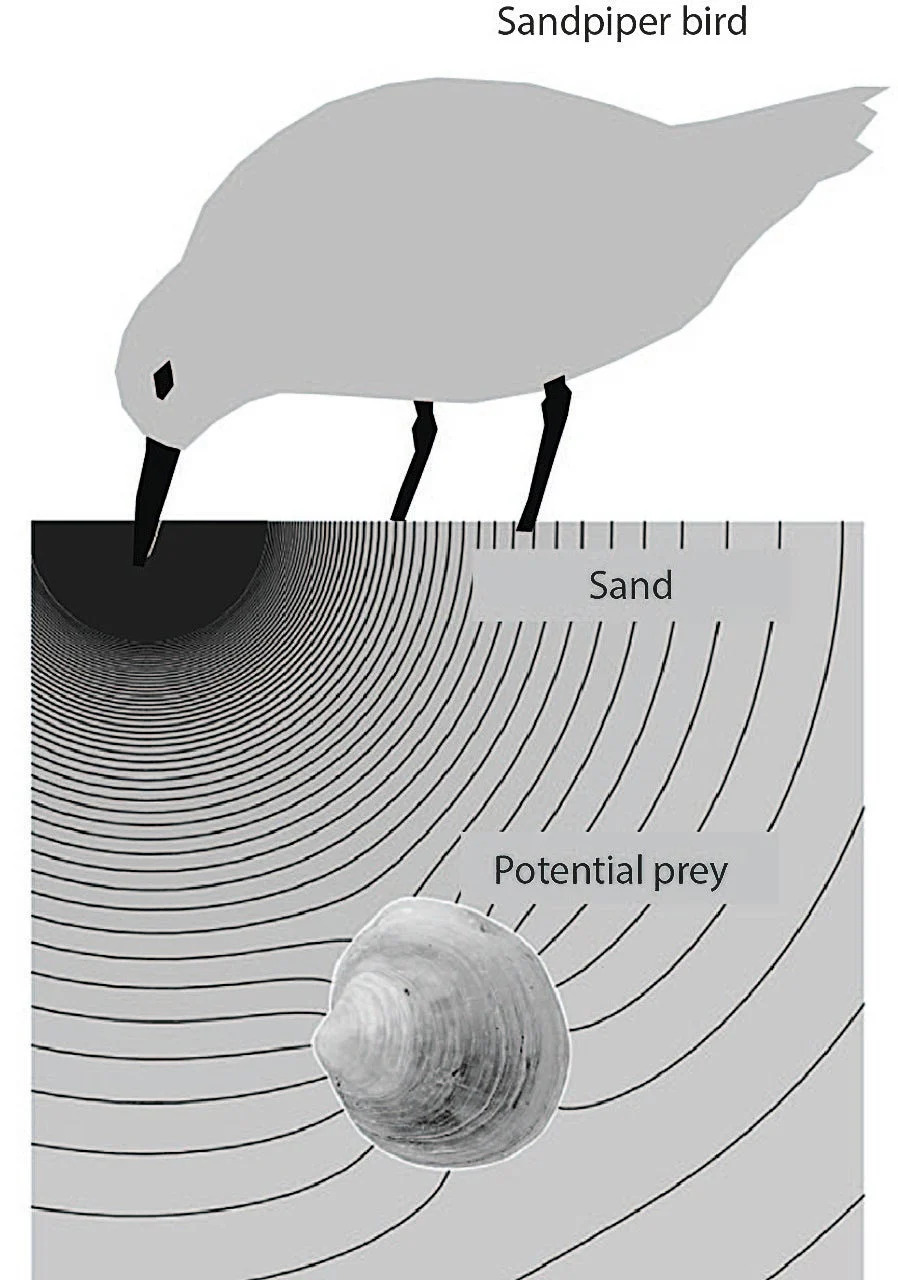
A sandpiper (red knot) produces a pressure field with the bill in a sand sediment of a hypothetical mudflat. Modified from de Fouw et al. (2016) Animal Behaviour. (CREDIT: de Fouw. Modified from de Fouw et al. (2016) Animal Behaviour)
How the experiment worked
Scientists from Queen Mary University of London and University College London recruited 12 volunteers (ages 18–26). Each participant slid an index finger through a 1+ meter box containing a 7 cm layer of fine, dry sand while blind to the contents. A blinking LED guided movement at ~2 cm/s so each trial had a consistent pace. A 5 cm cube was placed in 144 trials and absent in 72 trials; participants completed 18 testing trials after familiarization, yielding 216 test trials in total.
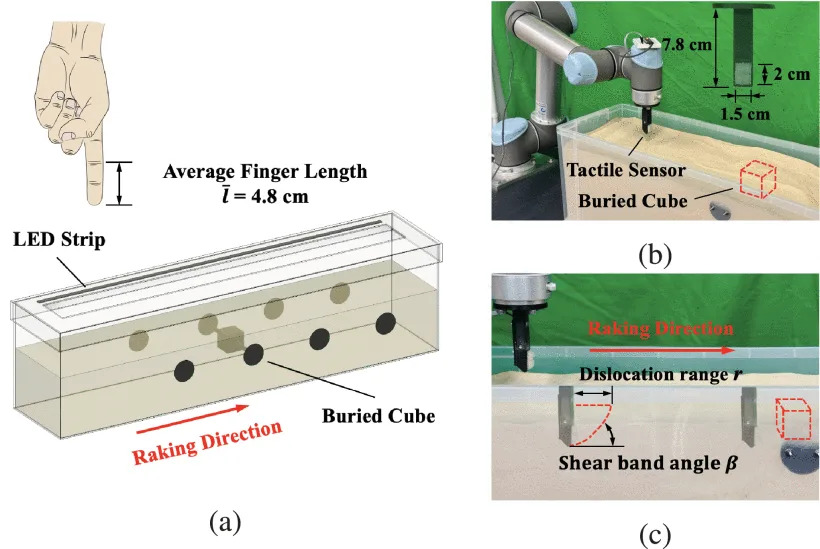
Overview of the experimental setup for tactile detection in granular media. (CREDIT: Elisabetta Versace et al, IEEE Xplore)
What the researchers measured
The team compared where participants stopped with predictions from a granular-physics model that estimates how disturbances travel through sand via networks of particle force chains. The model predicted a theoretical detection zone averaging about 6.9 cm in front of a buried object. Participants were instructed to stop as soon as they believed they sensed a cube.
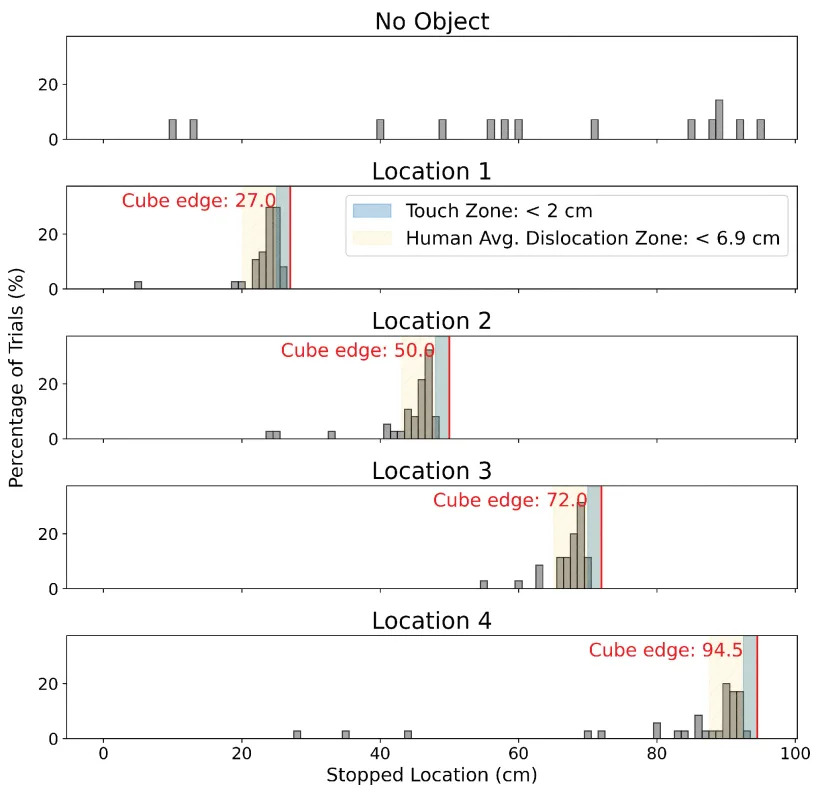
Histogram of stopped locations across raking conditions in the human experiment. (CREDIT: Elisabetta Versace et al, IEEE Xplore)
Key human results
- Across 144 object-present trials, 79 stops occurred before physical contact but within the model’s detection zone. Another 35 stops fell within 2 cm of the cube and were conservatively treated as contact rather than pre-touch detection.
- In 72 no-object trials participants continued correctly 58 times and registered 14 false alarms.
- Signal-detection analysis produced an average sensitivity (d') of 1.1973 (p = 0.0004), and overall precision of 70.7%.
- The median pre-touch detection distance was about 2.7 cm, though some detections occurred farther out, consistent with the modelled ~6.9 cm range.
Robotic comparison
To compare human performance with machines, the researchers used a UR5 robotic arm fitted with a custom tactile sensor (four elements measuring three-axis forces) that raked through the same sand and sampled at ~135 Hz. Long Short-Term Memory (LSTM) neural networks were trained to recognize force patterns indicating a buried cube. Models tested assumed detection thresholds from 3 to 11 cm; the 7 cm model best matched the theoretical human range.
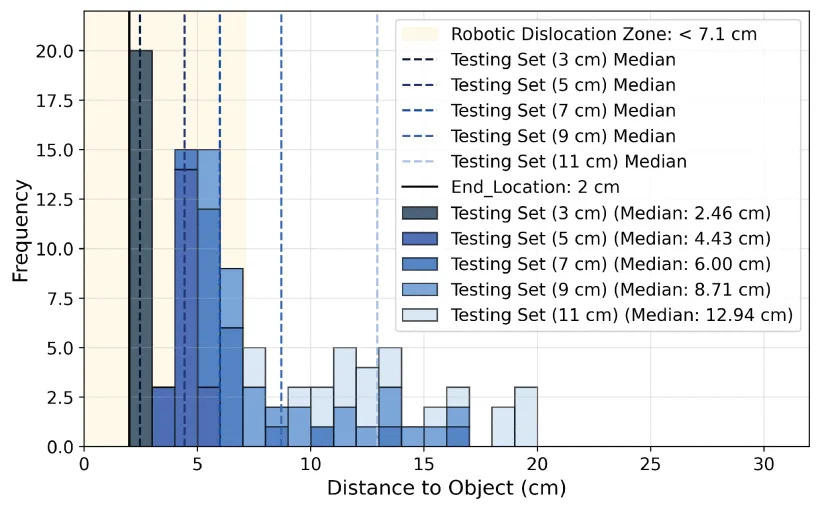
Histogram of first detection distances from the object for five LSTM models in the robotic experiment (20 testing trials with object buried). (CREDIT: Elisabetta Versace et al, IEEE Xplore)
The robot often signaled presence earlier than people (median detection ~6 cm; estimated physical range ~7.1 cm) but produced many more false positives, achieving only ~40% precision in the researchers’ comparison. In short, the robot was highly sensitive to small disturbances yet less calibrated than humans at deciding which disturbances indicated a real buried object.
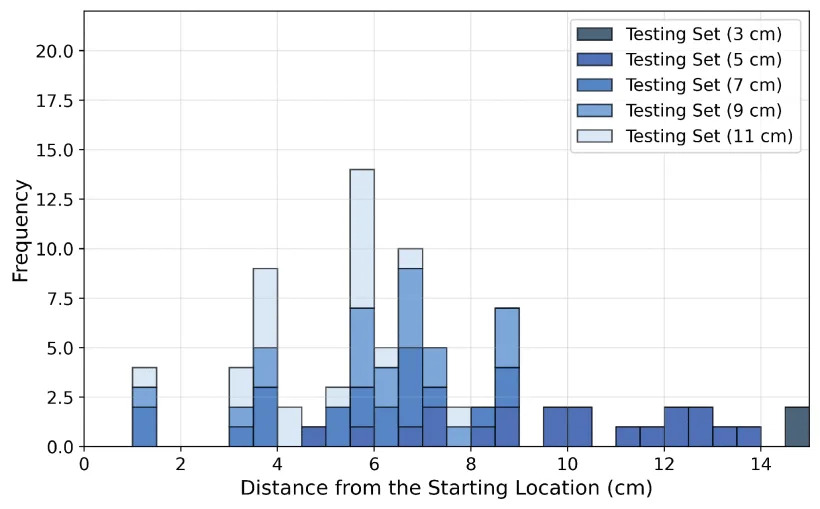
Histogram of first reported stops across five LSTM models in the robotic experiment (20 testing trials with no object buried). Each model uses a distinct threshold (3 cm, 5 cm, 7 cm, 9 cm, 11 cm), with distances from the starting location shown. (CREDIT: Elisabetta Versace et al, IEEE Xplore)
Interpretation and implications
Mechanically, the effect arises because a moving finger displaces and compresses grains ahead of it; those disturbances propagate through force chains and change resistance patterns when they encounter a buried solid. The human nervous system appears capable of detecting those subtle mechanical cues and integrating them to make reliable decisions. As the authors note, human perception balances sensitivity with noise filtering and uncertainty assessment, which likely explains higher precision versus the robot.
"What makes this research especially exciting is how the human and robotic studies informed each other," said Lorenzo Jamone (UCL). Lead researcher Elisabetta Versace (Queen Mary University of London) described the study as the first quantitative demonstration of remote tactile detection in people.
The study, published on IEEE Xplore, suggests practical applications: tactile robots inspired by these findings could probe soils in archaeology, search rubble during disaster response, explore marine sediments, or examine granular terrain on the Moon and Mars.
Further reading
The paper builds on literature about granular media (force chains, jamming) and tactile sensing (mechanoreceptors, modern tactile sensors). These concepts explain how mechanical signals travel through particulate materials and how both biological and artificial systems can exploit them.
Help us improve.