Xiphodracon, nicknamed the “Sword Dragon of Dorset,” is a nearly complete Early Jurassic ichthyosaur discovered near Golden Cap in 2001 and described in late 2025. The three‑dimensional fossil (about 9–10 ft long) preserves a sword‑like snout and possible stomach contents of fish and squid. Limb pathologies and bite marks on the skull reveal injury, illness and predation, while the specimen fills a major gap in knowledge of Pliensbachian ichthyosaur diversity and evolution.
190-Million-Year-Old 'Sword Dragon' of Dorset Rewrites Early Jurassic Ichthyosaur History
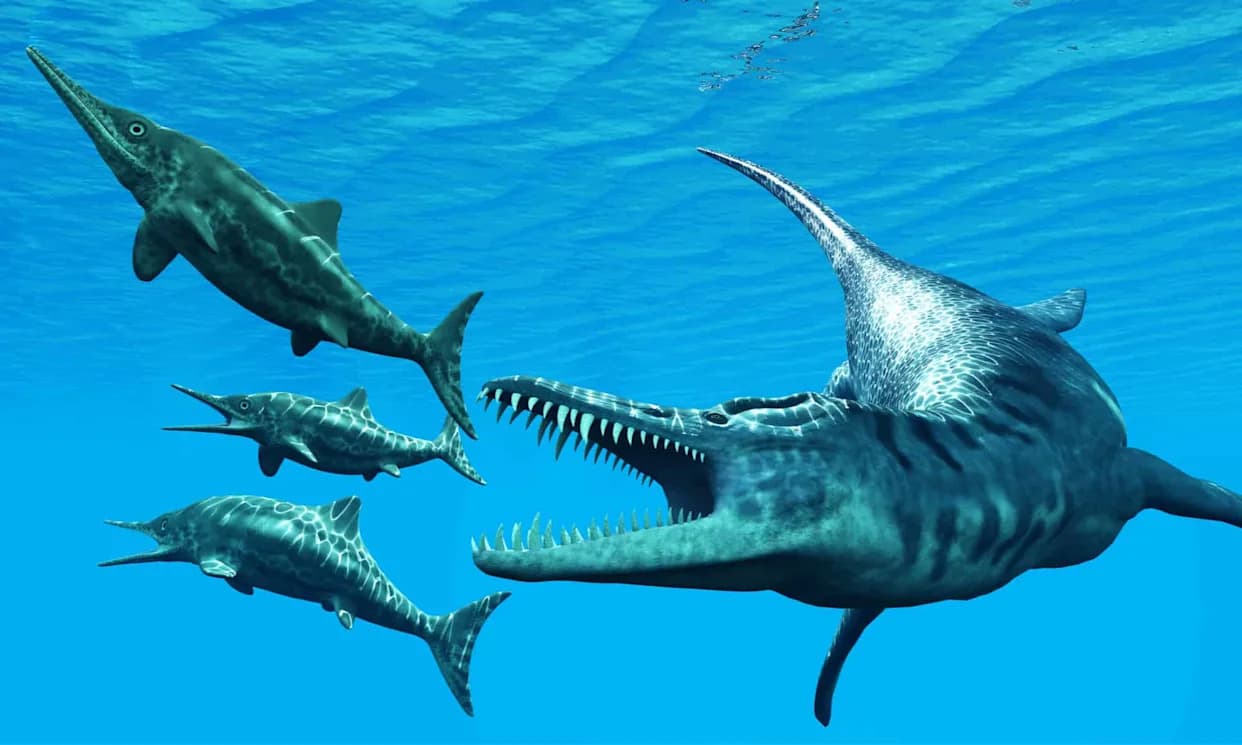
Liopleurodon attacks Ichthyosaurus - Liopleurodon was a giant marine reptile that hunted Ichthyosaurus dinosaurs in Jurassic Seas© Catmando/Shutterstock.com
A nearly complete ichthyosaur fossil nicknamed “Xiphodracon” — the “Sword Dragon of Dorset” has offered fresh, detailed evidence about marine reptile life during the Early Jurassic Pliensbachian Stage (about 192–184 million years ago).
Discovered near Golden Cap in Dorset by a local collector in 2001 and formally described in late 2025, Xiphodracon stands out because it is preserved in three dimensions rather than the usual flattened fragments typical of this interval. The specimen preserves an elongated, sword‑like snout, a largely intact skeleton and — unusually for Pliensbachian material — possible traces of the animal’s last meal.

Dorset’s Jurassic Coast in the UK is rich in fossils.©JeniFoto/Shutterstock.com(JeniFoto/Shutterstock.com)
What the Fossil Reveals
Researchers estimate Xiphodracon measured roughly 9–10 feet (≈2.7–3 m) long. The skull’s long, narrow snout and tooth shape suggest a diet of fish and squid; indeed, fossilized remains interpreted as stomach contents appear preserved inside the ribcage.
- Three-dimensional preservation: Provides anatomical detail rarely available for Pliensbachian ichthyosaurs.
- Dietary evidence: Tooth and snout shape plus possible gut contents point to fish and cephalopods.
- Pathologies and injuries: Limb bones and teeth show abnormalities consistent with severe injury or disease.
- Predation marks: Deep bite marks on the skull indicate an encounter with a larger predator.
Why Xiphodracon Matters
Because most Pliensbachian finds are fragmentary, Xiphodracon fills a critical gap in our understanding of ichthyosaur evolution and species diversity during a poorly known interval. Scientists had already noted that ichthyosaur faunas before and after the Pliensbachian were markedly different; this well‑preserved specimen helps narrow down when and how those major changes occurred.
Context: Dorset’s stretch of the UK Jurassic Coast — from Lyme Regis east to Charmouth and Seatown — has produced many important fossils, but Xiphodracon is exceptional for its preservation and the new evolutionary and ecological insights it provides into Early Jurassic marine ecosystems.
Help us improve.