
The House will vote Thursday on whether to override President Trump's vetoes of two bills: one funding a Colorado water pipeline and another adding land to the Miccosukee Reservation in the Everglades. Sponsors say the measures were noncontroversial and passed unanimously, and they were vetoed without prior warning. Some Republicans, including Rep. Don Bacon and Rep. Lauren Boebert, support an override, while Speaker Mike Johnson and others back the president. An override requires two-thirds support in both chambers and the Senate's position remains uncertain.
House Poised to Vote on Overriding Two Trump Vetoes as GOP Weighs Split With President

FILE - Airboats carry members of a task force that brings together federal, state, tribal and local agencies working to restore and protect the Florida Everglades, on a field visit to the Miccosukee Indian Reservation ahead of a task force meeting hosted by the Miccosukee Tribe, April 24, 2024. (AP Photo/Rebecca Blackwell, File)(ASSOCIATED PRESS)
House Republicans are preparing a rare public test of loyalty to President Donald Trump, with votes set for Thursday on whether to override his vetoes of two bills that had been treated as noncontroversial when they passed Congress.
One measure would help Colorado communities finance construction of a pipeline to deliver water to tens of thousands of residents. The other would formally designate a site inside Everglades National Park as part of the Miccosukee Indian Reservation, restoring local tribal authority over the land.
The White House issued no advance warning that it would veto the bills, and sponsors say the sharply worded veto messages came as a surprise. Supporters contend the vetoes amount to punishment for lawmakers who opposed the president on other matters.
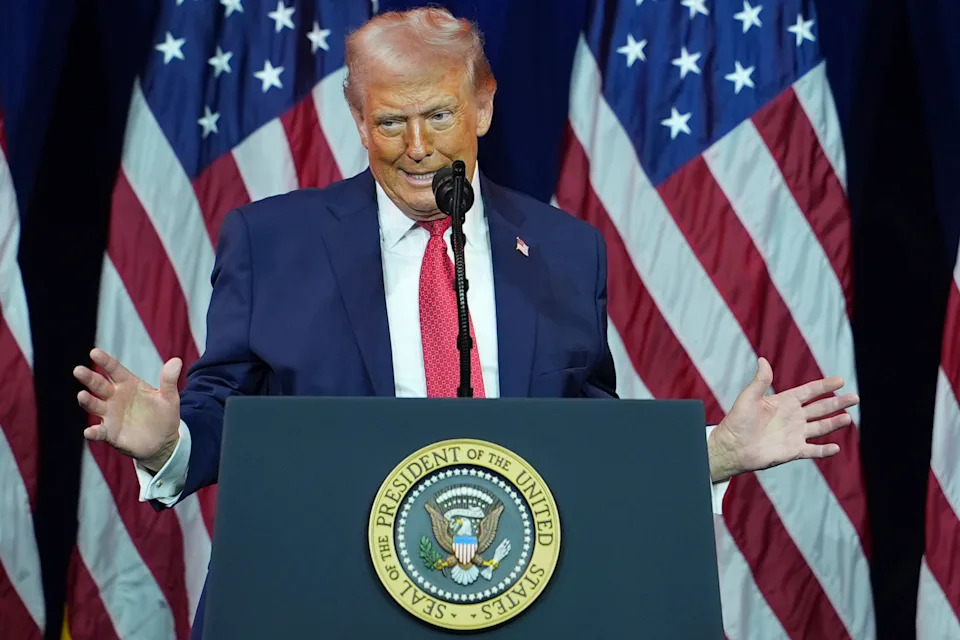
President Donald Trump speaks to House Republican lawmakers during their annual policy retreat, Tuesday, Jan. 6, 2026, in Washington. (AP Photo/Evan Vucci)(ASSOCIATED PRESS)
The Bills and Their Backers
The water pipeline measure was introduced by Rep. Lauren Boebert (R-Colo.), a longtime Trump ally who publicly clashed with him in November by pushing to release files related to convicted sex offender Jeffrey Epstein. Boebert said the bill merely gives local water users extra time to repay their share of the project and that it advanced through committee with bipartisan support and passed both chambers unanimously.
The Florida measure, sponsored by Rep. Carlos Gimenez (R-Fla.), would allow an inhabited Miccosukee village to be included within the tribe's reservation boundaries, giving the tribe authority to manage water flow into the Everglades and to raise structures to reduce flooding risk. Gimenez has the president's endorsement but his bill was nonetheless vetoed.
GOP Divisions
Speaker Mike Johnson (R-La.) said House leadership is not whipping members on the votes and that he plans to sustain the vetoes, describing the president's objections as "very reasonable." He added he understands Colorado members' concerns and will try to help on the pipeline issue going forward.

Rep. Tim Burchett, R-Tenn., left, speaks with Rep. Lauren Boebert, R-Colo., during a hearing of the House Committee on Oversight and Government Reform on Capitol Hill, Wednesday, Jan. 7, 2026, in Washington. (AP Photo/Mark Schiefelbein)(ASSOCIATED PRESS)
Boebert has been speaking privately with colleagues about pursuing an override but acknowledged doubt that the two-thirds margin can be reached: "Some colleagues don't want to go against the president," she said. Rep. Don Bacon (R-Neb.) said he will vote to override, noting the measures passed unanimously. By contrast, Rep. Nicole Malliotakis (R-N.Y.) said she will sustain the vetoes, saying her constituents want her to stand with Trump.
What Comes Next
If the House votes to override, the measures would move to the Senate, where GOP senators were noncommittal. "Let's see what the House does," said Sen. John Barrasso, the second-ranking Senate Republican.
To overturn a presidential veto, both chambers must approve the override by a two-thirds majority. It is unclear whether the Republican-controlled House and Senate can muster that support, especially with a midterm election cycle ahead and many members cautious about alienating the president.
Context
Trump issued 10 vetoes during his first term; Congress overrode only one of them — a defense policy bill late in his presidency. Lawmakers and political observers view these upcoming votes as an unusual intra-party test of independence versus party unity ahead of high-stakes elections.
Help us improve.


